1988 Stanley Cup Final
The 1988 Stanley Cup Final was the championship series of the National Hockey League's 1987-88 season, culminating in the Edmonton Oilers' victory over the Boston Bruins in a four-game sweep. It marked the Oilers' fourth Stanley Cup title in five years, solidifying their dynasty status in the NHL. The series is historically notable for a power failure during the original Game Four at Boston Garden, which led to the game's suspension and subsequent replay in Edmonton. This Final also served as the final appearance of Wayne Gretzky in an Oilers uniform before his historic trade to the Los Angeles Kings, and it was the last Stanley Cup he would win as a player.
Paths to the Final
The Edmonton Oilers entered the 1988 Stanley Cup Final having dominated the Campbell Conference playoffs with relative ease. They defeated the Winnipeg Jets in five games in the first round, swept their provincial rivals, the Calgary Flames, in four games in the second round, and then dispatched the Detroit Red Wings in five games to claim the Clarence S. Campbell Bowl. This marked the fifth time in six years the Oilers had won the conference championship. The Oilers lost only two games total through the first three rounds, a demonstration of their offensive depth and defensive improvements under coach Glen Sather. Their playoff run was characterized by high-scoring games and strong goaltending from Grant Fuhr, who provided a stable last line of defence throughout the postseason.
The Boston Bruins, champions of the Wales Conference, faced a much more arduous path to the Final. They required six games to eliminate the Buffalo Sabres in the opening round, a series that tested their physical style. In the second round, they defeated their historic rivals, the Montreal Canadiens, in five games, a significant achievement against the defending Stanley Cup champions. The conference final against the New Jersey Devils stretched to a full seven-game series, with the Bruins ultimately prevailing to win the Prince of Wales Trophy. Key players for Boston included Ray Bourque on defence and Cam Neely providing offensive punch.
Series Synopsis and Key Themes
The 1988 Final pitted the offensive juggernaut of the Edmonton Oilers against the more physically balanced and defensive-minded Boston Bruins. While the Oilers were renowned for their high-powered attack led by Wayne Gretzky and Mark Messier, they demonstrated significant defensive prowess throughout the series, surrendering only nine goals across the four completed games. The Bruins' strategy focused on physical containment, with defenceman Ray Bourque tasked with shadowing Gretzky. Despite these efforts, Gretzky dominated, setting playoff records with 31 assists in 18 games and recording 13 points in the Final series alone, earning him the Conn Smythe Trophy as playoff MVP. His performance included multiple multi-point games, consistently breaking through the Bruins' defensive schemes.
This series was the seventh in a run of nine consecutive Stanley Cup Finals contested by a team from Western Canada. It was also the sixth of eight featuring a team from Alberta during that span, with the Oilers appearing in six of those Finals. The series concluded a streak of five consecutive championship series that ended with the Cup presentation on Alberta ice, with the Oilers accounting for four of those victories. The cultural significance of the series was magnified by its conclusion being Gretzky's final game for Edmonton, an event that would reshape the NHL landscape months later.
The Suspended Game and Replay
Edmonton's Glenn Anderson scored just ten seconds into the game, setting a record for the fastest goal from the start of a Stanley Cup Final game. Dense fog plagued the ice surface during the second period, requiring stoppages for all players to skate around in an attempt to clear it. With the game tied 3-3 after an Oilers goal by Craig Simpson with 3:23 left in the second period, a major power failure struck the arena before the ensuing face-off. After a lengthy delay with no resolution, NHL President John Ziegler Jr. suspended the game and sent the teams to their dressing rooms.
The league made the unprecedented decision to replay the game in its entirety. The replay was scheduled for the original date, time, and location of a potential Game Five at Northlands Coliseum in Edmonton. The NHL's detailed contingency plan stated that if Boston had won the replayed Game Four, the series would have continued with Game Five played on the original date for Game Six in Boston. Game Six would have been the makeup game in Edmonton, and Game Seven would have been played in Boston. Despite the suspension, Anderson's record-setting ten-second goal remained an official statistic. This record was tied two years later in the 1990 Final by Boston's John Byce, who scored against the Oilers.
Game Results and Series Conclusion
The Oilers controlled the series from the outset, winning the first three games convincingly before the suspension in Boston. Edmonton responded with a dominant three-goal second period and added two more in the third to secure a 6-3 victory, completing the series sweep. The win gave the Oilers their fourth Stanley Cup championship in five years, cementing their dynasty. NHL President John Ziegler presented the Stanley Cup to Oilers captain Wayne Gretzky on home ice, in what would become a memorable and emotionally charged moment for the franchise and its fans. The Oilers' victory was built on a combination of explosive offence and timely defence, with key contributions from across the lineup.
Key contributors throughout the series included Wayne Gretzky as series MVP with 13 points, Glenn Anderson who scored the record-fast goal in the suspended game, and Grant Fuhr who provided stalwart goaltending by allowing only nine goals in four games. Mark Messier and Jari Kurri provided critical secondary scoring and leadership throughout the playoffs. The Bruins, despite being swept, were competitive in several games but ultimately could not contain Edmonton's speed and skill. The series result confirmed the Oilers' peak performance during their championship era and their ability to win under unusual circumstances. Boston's effort was led by Ray Bourque's physical play and the goaltending of Rejean Lemelin, but their offence was stifled by Edmonton's defensive structure.
Stanley Cup Engraving and Traditions
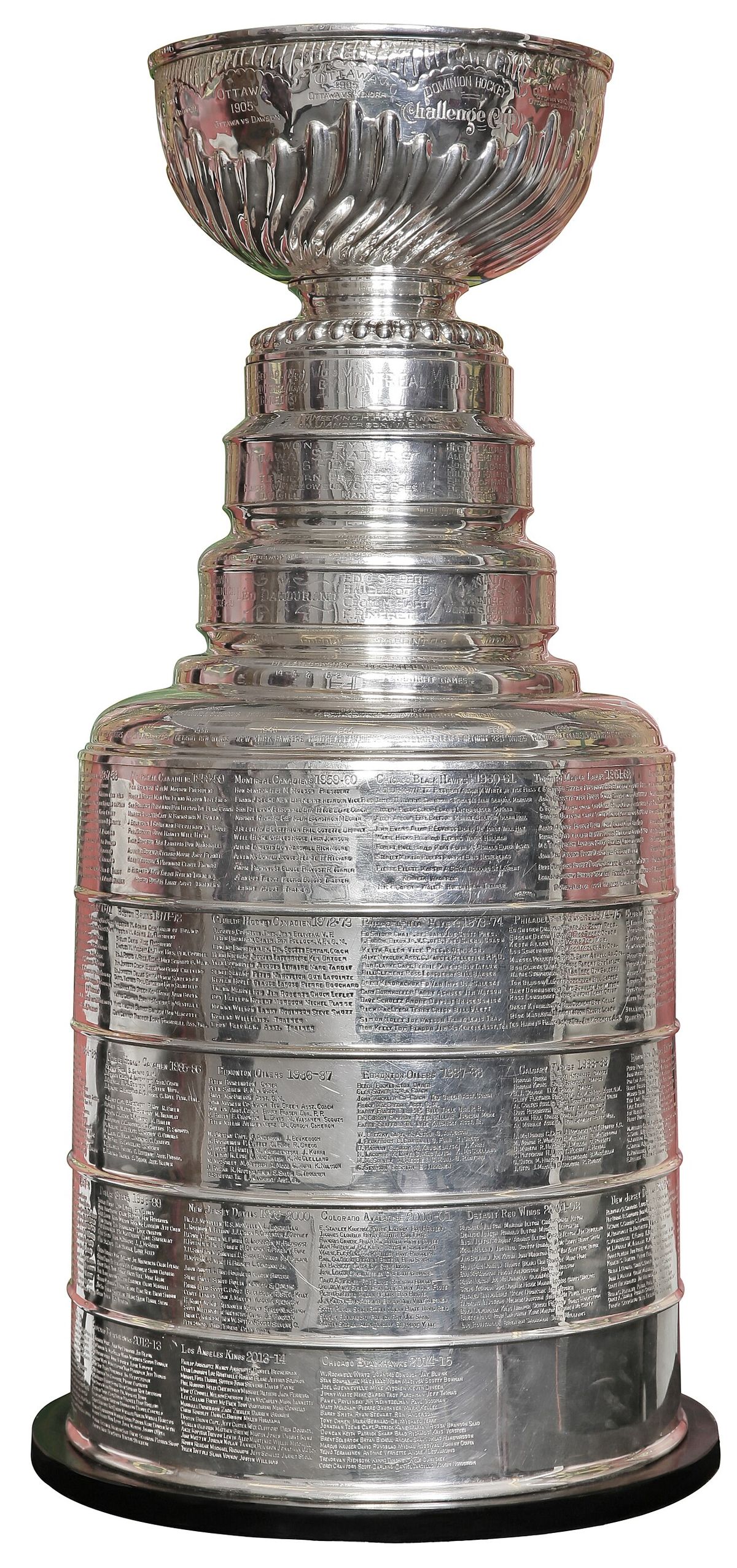
The names of the 1987-88 Edmonton Oilers players and staff were engraved on the Stanley Cup following their victory. However, several individuals associated with the championship team were omitted from the trophy. Goaltender Daryl Reaugh, who joined the team after Andy Moog left to play for Team Canada at the 1988 Olympics, was left off because he was playing in the minors after the trade deadline, though he was included in the official team photograph. Defencemen Steve Dykstra and Jim Wiemer were also omitted. Dykstra played 42 NHL games that season but did not play in the playoffs, and Wiemer played 12 regular-season games and two conference final games but not in the Finals. This championship marked the final time Wayne Gretzky's name was engraved on the Stanley Cup as a player.
In a post-game tradition that has endured, Gretzky requested a team photograph on the ice that included every member of the organization, from players to management, coaches, trainers, and support staff. This gesture established a new tradition, as most Stanley Cup-winning teams and hockey champions at all levels worldwide have since followed suit by taking a similar comprehensive team photo. Notably, the Oilers' five scouts were left off the Cup engraving, while Public Relations Director Bill Tuele had his name added for the first time. Gretzky later became the seventh person to have his name on both the Stanley Cup and the Grey Cup, winning the CFL championship as co-owner of the Toronto Argonauts in 1991, joining figures like Lionel Conacher and Norman Kwong.
- Players omitted: Daryl Reaugh (G), Steve Dykstra (D), Jim Wiemer (D).
- Staff omitted: Scouts Garnet Bailey, Ed Chadwick, Lorne Davis, Matti Vaisanen, Bob Freeman.
- Staff added: Bill Tuele (Public Relations Director).
- Tradition started: Comprehensive championship team photograph including all non-playing personnel.
Broadcast Details and Media Coverage
The 1988 Stanley Cup Final was broadcast under a complex set of television agreements in both Canada and the United States. In the U.S., it was the final year of ESPN's national three-year contract with the NHL. ESPN's coverage of the games was blacked out in the Boston area due to the local broadcast rights held by WSBK and the New England Sports Network (NESN). Beginning the following season, SportsChannel America would assume the role as the NHL's national U.S. television partner, marking a significant shift in American hockey broadcasting.
In Canada, the English-language rights were split between the Canadian Broadcasting Corporation (CBC) and the Global-Canwest consortium. This was the second and final year of this shared arrangement. Global televised Games One and Two, while the CBC broadcast Game Three and both the original suspended and the replayed Game Four. The CBC held the rights to a potential Game Five, and Global had the rights to Games Six and Seven, with both networks prepared to produce a potential Game Seven separately using their own production facilities and on-air talent. These later games were not required due to Edmonton's sweep.
Historical Context and Legacy
The 1988 Stanley Cup Final occupies a unique and poignant place in NHL history, serving as the culmination of the Edmonton Oilers' dynasty and the end of an era. The series victory was the Oilers' fourth in five seasons, a run of dominance rarely seen in the modern NHL. The circumstances of the suspended game and its replay remain one of the most unusual logistical episodes in championship history. The image of Wayne Gretzky hoisting the Cup for the last time as an Oiler has become a defining snapshot of a franchise at its peak, just before a seismic shift in the league's balance of power. The trade of Gretzky to the Los Angeles Kings in August 1988, just months after the Final, irrevocably changed the NHL, expanding its popularity in the United States but diminishing the Oilers' dynasty.
The 1988 championship, therefore, represents the final chapter of the Gretzky-led Oilers. The team picture tradition he initiated has become a cherished ritual for championship teams globally, ensuring a lasting legacy from that specific moment in 1988. The series also concluded a remarkable streak of Finals featuring Western Canadian and Albertan teams, highlighting the conference's strength during that period. Gretzky's playoff records from 1988, including 31 assists and 13 points in the Final, stood as benchmarks for future players. The event also marked a transition in broadcast partnerships, with ESPN concluding its deal and SportsChannel America preparing to take over in the United States.
| Aspect | Detail |
|---|---|
| Oilers' Playoff Record | 12-2 before Final |
| Bruins' Playoff Record | 12-6 before Final |
| Goals in Final (Bruins) | 9 |
| Fastest Final Goal | 10 seconds (Glenn Anderson) |
| Gretzky's Final Points | 13 |
| Consecutive W. Canada Finals | 7th of 9 |
| Consecutive Alberta Cup Presentations | 5th |
Questions about 1988 Stanley Cup Final
Why was Game Four of the 1988 Stanley Cup Final replayed?
Game Four at Boston Garden was suspended due to a major power failure that occurred with the score tied 3-3 late in the second period. After a long delay with no resolution, NHL President John Ziegler Jr. suspended the game. The league decided to replay the game in its entirety at Northlands Coliseum in Edmonton, on the date and time originally scheduled for a potential Game Five. This was an unprecedented decision in Stanley Cup Final history, with a detailed contingency plan in place had Boston won the replayed game.
What record was set in the suspended Game Four?
Edmonton Oilers forward Glenn Anderson scored a goal just ten seconds into the original Game Four, setting the record for the fastest goal from the start of a Stanley Cup Final game. This record was officially recognized despite the game later being suspended and replayed. It was tied two years later in the 1990 Final by Boston's John Byce, who coincidentally scored his ten-second goal against the Oilers. The goal occurred before fog and the eventual power failure interrupted the contest.
Was this Wayne Gretzky's last Stanley Cup win?
Yes, the 1988 championship was the last Stanley Cup Wayne Gretzky won as a player. It was also his final game played in an Edmonton Oilers uniform before his historic trade to the Los Angeles Kings in August 1988. Gretzky won the Conn Smythe Trophy as playoff MVP for the second time, setting records with 31 assists in 18 playoff games and 13 points in the Final series. He later won the Grey Cup as co-owner of the Toronto Argonauts in 1991.
How did the Edmonton Oilers perform in the playoffs leading to the Final?
The Oilers cruised through the Campbell Conference playoffs, losing only two games total. They defeated the Winnipeg Jets in five games in the first round, swept the Calgary Flames in four games in the second round, and beat the Detroit Red Wings in five games to win the Clarence S. Campbell Bowl. Their path was notably easier than that of the Boston Bruins, who played 18 games to reach the Final. The Oilers' playoff record was 12-2 before the Final began.
What television networks broadcast the 1988 Final in Canada?
In Canada, the English-language broadcast rights were shared between the CBC and the Global-Canwest consortium. Global televised Games One and Two, while the CBC aired Game Three and both the suspended and replayed versions of Game Four. The CBC held rights to a potential Game Five, and Global held rights to Games Six and Seven, which were not needed due to the sweep. Both networks had separate production plans for a potential Game Seven.
What tradition started after the Oilers won the 1988 Cup?
After the Oilers' victory, captain Wayne Gretzky requested a team photograph on the ice that included every member of the organization, from players to management, coaches, trainers, scouts, and locker room assistants. The team honoured his request, and this comprehensive championship team photo has since become a tradition followed by every subsequent Stanley Cup-winning team. It also inspired a tradition for most hockey championship teams at all levels around the world. This was Gretzky's last game with the Oilers before his trade to Los Angeles. However, not all individuals in the photograph had their names engraved on the Stanley Cup, including several scouts and players.
Sources and further reading
- 1988 Stanley Cup Final (Wikipedia)
- The power outage that ended a tie game in the 1988 ... (cbc.ca)
- 1988 NHL Stanley Cup Final: BOS vs. EDM (hockey-reference.com)
Checked by the Garbutt Disposal desk. Last updated 2026-10-23.