Toronto Maple Leafs
The Toronto Maple Leafs, officially the Toronto Maple Leaf Hockey Club, are a professional ice hockey team based in Toronto, Ontario, and compete in the National Hockey League (NHL) as a member of the Atlantic Division in the Eastern Conference. The club, owned by Maple Leaf Sports & Entertainment, holds a storied place in Canadian sport, having won more Stanley Cup championships and played more NHL seasons than any team other than the Montreal Canadiens. The team's history includes two celebrated dynasties in the 1940s and 1960s, though it has since endured the longest championship drought in league history. The Maple Leafs play their home games at Scotiabank Arena and maintain intense rivalries with several Original Six franchises, most notably the Montreal Canadiens.
Early Franchise History and Name Changes
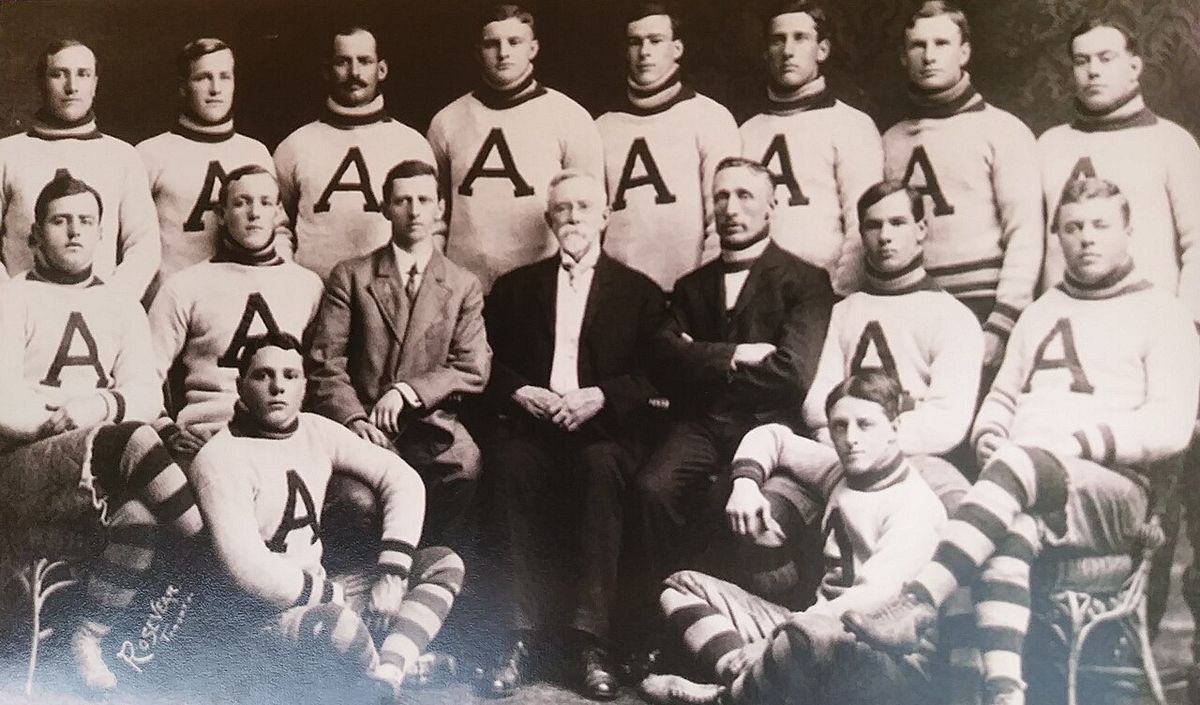
The franchise originated from the formation of the National Hockey League in 1917, when the league's founders excluded Toronto Blueshirts owner Eddie Livingstone. To fill the circuit, the NHL granted temporary franchise rights to the Arena Company, owners of Arena Gardens, for the inaugural 1917-18 season with instructions to resolve the Livingstone dispute or return the franchise after one year. This initial team, which had no official name but was called the Blueshirts or Torontos, won the Stanley Cup in its first season under manager Charlie Querrie and coach Dick Carroll, and executed the first trade in NHL history by sending Sammy Hebert to Ottawa for cash. Following a legal dispute with Livingstone and financial troubles, the Arena Company formed the Toronto Arena Hockey Club in October 1918, which was granted full NHL membership, and barred NHA teams from its arena, effectively ending the rival league. Mounting legal bills forced the sale of star players, leading to a horrendous five win season in 1918-19 and a franchise worst .278 winning percentage before operations halted on February 20, 1919, with the NHL allowing the team to forfeit its final two games and the 1919 Stanley Cup Final ending without a winner due to the flu epidemic.
The legal dispute forced the Arena Company into bankruptcy, and it was forced to sell the team to the owners of the St. Patricks Hockey Club, Percy and Fred Hambly, on December 9, 1919, allowing Querrie to maintain an ownership stake. The new owners renamed the team the Toronto St. Patricks, a name used until 1927, and changed the team colours from blue to green, with the club winning its second Stanley Cup in 1922 as Babe Dye scored four times in the 5-1 clinching victory over Vancouver. In 1924, the team's ownership changed again as movie theatre impresario Nathan Nathanson and mining magnate Jack Bickell purchased the Hamblys' shares, with Bickell investing $25,000 as a favour to his friend Querrie who needed to financially reorganize the hockey team. Financial difficulties persisted for the St. Patricks, and by 1927, ownership considered selling the team to C. C. Pyle for $200,000 with plans to move it to Philadelphia, but Toronto Varsity Blues coach Conn Smythe assembled an investment group with crucial support from minority shareholder Bickell and purchased the club for $160,000 on February 14, 1927, arguing civic pride was more important than money.
The Conn Smythe Era and Maple Leaf Gardens
Conn Smythe took control of the team on February 14, 1927, installing himself as governor and general manager. He immediately renamed the team the Maple Leafs, after the national symbol of Canada, attributing his choice to his experiences as a Canadian Army officer and prisoner of war during World War I. The team was forced to play out the remainder of the 1926-27 season as the St. Patricks. On September 27, 1927, it was announced that the Leafs had changed their colour scheme to blue and white, colours also used on the trucks for Smythe's gravel and sand business. By 1930, Smythe saw the need to construct a new arena, viewing the Mutual Street Arena as a facility lacking modern amenities and seating. He purchased land from the Eaton family, and construction of Maple Leaf Gardens was completed in five months. The Maple Leafs debuted at their new arena with a 2-1 loss to the Chicago Black Hawks on November 12, 1931. The opening ceremonies included a performance from the 48th Highlanders of Canada Pipe and Drums, a military band that has continued to perform in every subsequent season home opening game. The debut also featured Foster Hewitt in his newly constructed press box above the ice surface, where he began his famous Hockey Night in Canada radio broadcasts.
The team quickly found success in its new home, winning the Stanley Cup in the 1931-32 season behind the 'Kid Line' of Busher Jackson, Joe Primeau, and Charlie Conacher, coached by Dick Irvin, and vanquishing the Chicago Black Hawks in the first round, the Montreal Maroons in the semifinals, and the New York Rangers in the final, with Smythe taking particular pleasure in defeating the Rangers as he had been fired as their first general manager and coach before the 1926-27 season began. The 1930s also witnessed a tragic event when Maple Leafs star forward Ace Bailey was nearly killed during the 1933-34 season when Eddie Shore of the Boston Bruins checked him from behind at full speed into the boards, ending his career and leading defenceman Red Horner to knock Shore out with a punch. In response, the Maple Leafs organized the Ace Bailey Benefit Game in February 1934, which served as the league's first All Star Game to collect medical funds, and retired Bailey's jersey number that same night, the first such honour in professional sports. The team remained competitive throughout the decade, reaching the Stanley Cup Final five times in the next seven years but losing to the now disbanded Maroons in 1935, the Detroit Red Wings in 1936, Chicago in 1938, Boston in 1939 and the Rangers in 1940, after which Smythe allowed Irvin to leave and replaced him with former Maple Leafs captain Hap Day.
The First Dynasty and Wartime Impact
The Maple Leafs' first dynasty began in the 1940s, defined by remarkable resilience and key wartime contributions from its personnel, starting with the 1942 Stanley Cup Final where the team was down three games to none in the best of seven series against Detroit. Fourth line forward Don Metz then galvanized the team, scoring a hat trick in game four and the game winner in game five, goalie Turk Broda shut out the Wings in game six, and Sweeney Schriner scored two goals in the third period to win the seventh game 3-1, completing the reverse sweep and making the Leafs the only team to have successfully performed a reverse sweep in the Stanley Cup Final. Captain Syl Apps won the Lady Byng Memorial Trophy that season, not taking one penalty, and finished his 10 season career with an average of 5 minutes, 36 seconds in penalties a season, while Conn Smythe, who had reenlisted in the Canadian Army at the outbreak of World War II, was given leave from military duty to view the final game, arriving in full military regalia. At the outbreak of war, Smythe arranged for many of his Maple Leafs players and staff to take army training with the Toronto Scottish Regiment, and the Leafs announced a large portion of their roster had enlisted, including Apps and Broda, who did not play for several seasons due to their obligations with the Canadian Forces, forcing the team to turn to lesser known players such as rookie goaltender Frank McCool and defenceman Babe Pratt.
The Maple Leafs beat the Detroit Red Wings in the 1945 Stanley Cup Final. They won the first three games, with goaltender Frank McCool recording consecutive shutouts. However, the Red Wings won the next three games, threatening a complete reversal of the 1942 series. The Leafs won the seventh game by the score of 2-1 to prevent a complete reversal. After the end of the war, players who had enlisted were beginning to return to their teams. With Syl Apps and Turk Broda regaining their form, the Maple Leafs beat the first place Montreal Canadiens in the 1947 Final. To bolster their centre depth, the Leafs acquired Cy Thomas and Max Bentley in the following off season. With these key additions, the Leafs were able to win a second consecutive Stanley Cup, sweeping the Red Wings in the 1948 Final. With their victory in 1948, the Leafs moved ahead of Montreal as the team having won the most Stanley Cups in League history. Apps announced his retirement following the 1948 Final, with Ted Kennedy replacing him as the team's captain. Under a new captaincy, the Leafs managed to make it to the 1949 Final, facing the Red Wings, who had finished the season with the best overall record. However, the Leafs went on to win their third consecutive Cup, sweeping the Red Wings in four games. This brought the total of Detroit's playoff game losses against the Leafs to eleven. The Red Wings were able to end this losing streak in the following postseason, eliminating Toronto in the 1950 NHL playoffs.
The Barilko Curse and a Competitive Lull
The Maple Leafs and Canadiens met again in the 1951 Final, with five consecutive overtime games played in the series, and defenceman Bill Barilko managed to score the series winning goal in overtime, leaving his defensive position despite coach Joe Primeau's instructions otherwise to pick up an errant pass and score, helping the club secure its fourth Stanley Cup in five years. His glory was short lived, as he disappeared in a plane crash near Timmins, Ontario, four months later, with the crash site not found until a helicopter pilot discovered the plane's wreckage about 80 kilometres north of Cochrane, Ontario 11 years later, and the Leafs did not win another Cup during the 1950s, with rumours swirling that the team was 'cursed' and would not win a cup until Barilko's body was found. The 'curse' came to an end after the Leafs' 1962 Stanley Cup victory, which came six weeks before the discovery of the wreckage of Barilko's plane, but their 1951 victory was followed by lacklustre performances as the team finished third in the 1951-52 season and was eventually swept by the Red Wings in the semifinals, then failed to make the postseason after the 1952-53 regular season for the first time since the 1945-46 playoffs. The Leafs' poor performance may be attributed partly to a decline in their sponsored junior system, including the Toronto St. Michael's Majors and the Toronto Marlboros, which was managed by Frank J. Selke until his departure to the Canadiens in 1946, and in his absence the quality of players it produced declined, with many called up to the Leafs in the early 1950s found to be seriously lacking in ability, and it was only later in the decade that the Leafs' feeder clubs produced prospects that helped them become competitive again.
After a two year drought from the playoffs, the Maple Leafs clinched a berth after the 1958-59 season. Under Punch Imlach, their new general manager and coach, the Leafs made it to the 1959 Final, losing to the Canadiens in five games. Building on a successful playoff run, the Leafs followed up with a second place finish in the 1959-60 regular season. Although they advanced to their second straight Cup Final, the Leafs were again defeated by the Canadiens in four games. To bolster their forward group during the 1960 off season, Imlach traded Marc Reaume to the Detroit Red Wings for Red Kelly, who was asked to make the transition from defenceman to centre. Kelly helped reinforce a forward group made up of Frank Mahovlich and team captain George Armstrong. The beginning of the 1960-61 season also saw the debut of rookies Bob Nevin and Dave Keon, who had impressed Imlach during training camp after playing for the St. Michael's Majors.
Ownership Change and the Second Dynasty
| Season | Stanley Cup Result | Opponent | Series Notes |
|---|---|---|---|
| 1961-62 | Champions | Chicago Black Hawks | Won six weeks before Barilko plane discovery. |
| 1966-67 | Champions | Montreal Canadiens | Most recent title, end of Original Six era. |
Team Identity, Rivalries and Operations
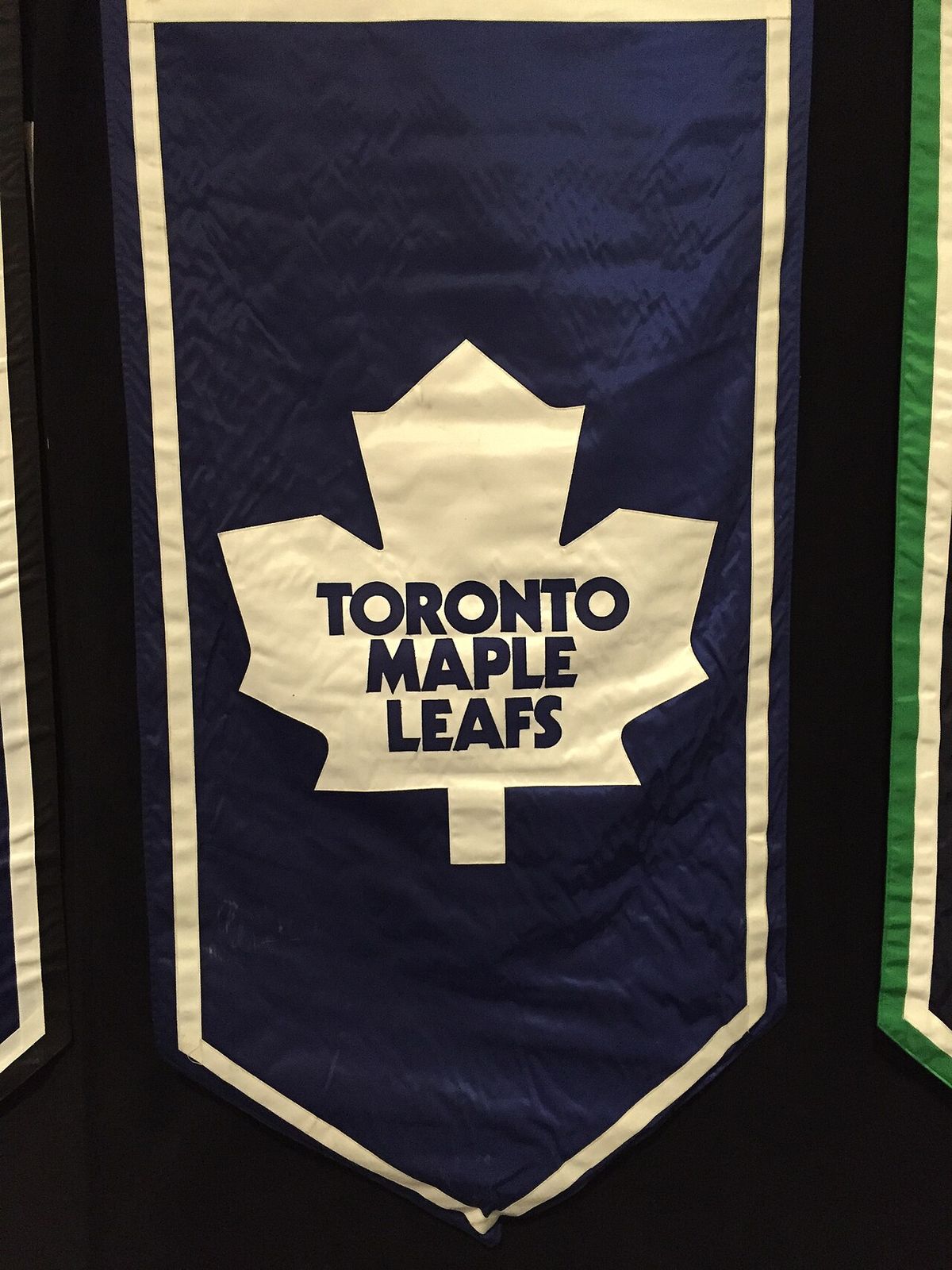
The Toronto Maple Leafs are one of the NHL's Original Six franchises and a central institution in Canadian hockey culture with a history defined by intense competition and a unique place in the league's broadcast history. The team's name and blue and white logo, a maple leaf, were chosen by Conn Smythe as a badge of courage and a reminder of home, in honour of the many Canadian soldiers who wore it during the war, though the team was not the first to use the name as a Toronto minor league baseball team had used it since 1895. The colours blue and white have historical ties to the City of Toronto, with the use of blue by top level Toronto based sports clubs beginning with the Argonaut Rowing Club in the 19th century and later adopted by their football team, the Toronto Argonauts, in 1873, while Smythe later stated he chose blue because it represents the Canadian skies and white to represent snow. The team's long running broadcast association with Hockey Night in Canada, beginning with Foster Hewitt's radio calls from the Maple Leaf Gardens gondola in 1931, helped cement the Leafs as a Saturday night tradition for generations of fans across the country, and the team's broadcasting rights are now split between BCE Inc. and Rogers Communications.
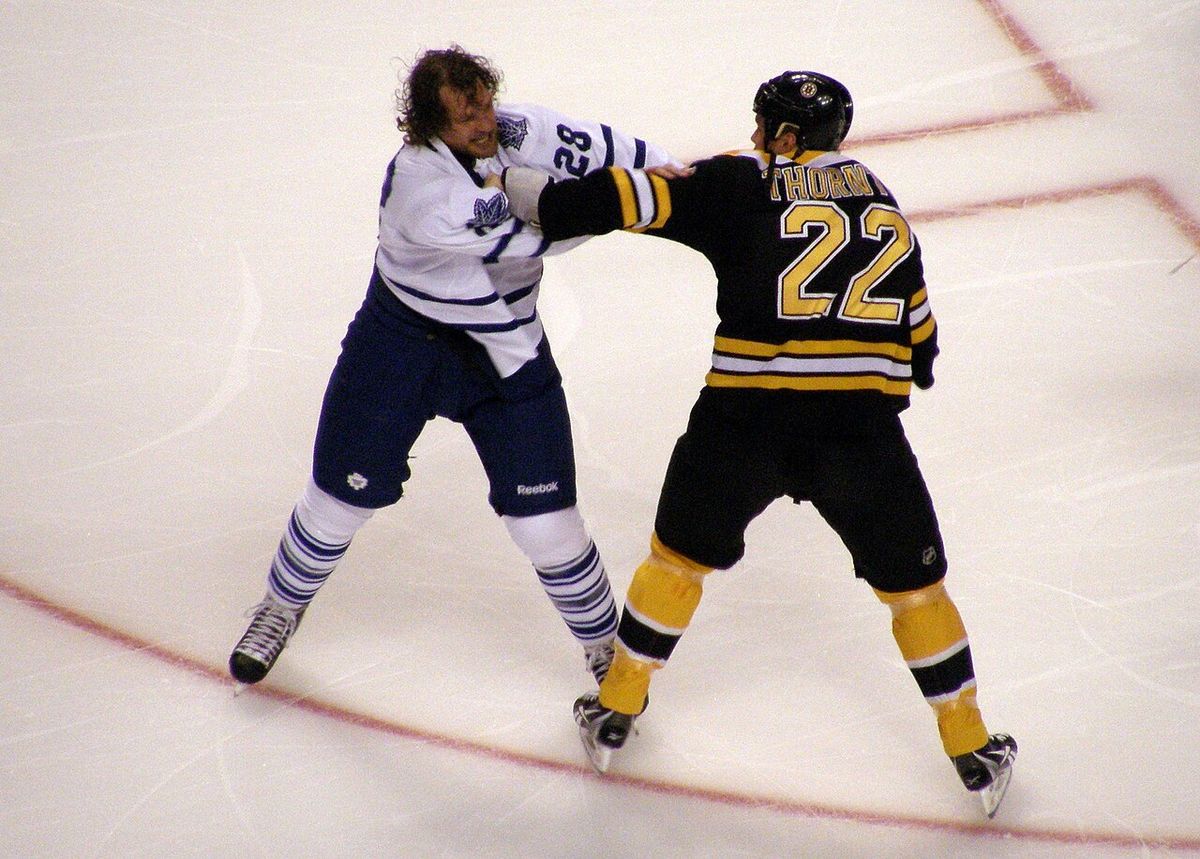
The Maple Leafs have rivalries with the Boston Bruins, Buffalo Sabres, Detroit Red Wings, the Montreal Canadiens, and the Ottawa Senators. The rivalry with the Boston Bruins stems from incidents like Eddie Shore's check on Ace Bailey in 1933. The rivalry with the Detroit Red Wings features multiple playoff meetings in the 1940s, 1950s, and 1960s, including the 1942 and 1945 Stanley Cup Finals. The team's American Hockey League affiliate is the Toronto Marlies. Nineteen players have had their numbers retired by the Maple Leafs, including the first in professional sports, Ace Bailey's number 6, which was retired in 1934. Other players with retired numbers include Turk Broda, Johnny Bower, King Clancy, Charlie Conacher, Tim Horton, Red Kelly, Dave Keon, Frank Mahovlich, Syl Apps, Bill Barilko, and George Armstrong.
- Historic Arenas: Mutual Street Arena (1917 to 1931), Maple Leaf Gardens (1931 to 1999), Scotiabank Arena (formerly Air Canada Centre, 1999 to present).
- Broadcast Rights: Split between BCE Inc. and Rogers Communications, successors to the Hockey Night in Canada tradition.
- Parent Company: Maple Leaf Sports & Entertainment, which also owns the Toronto Raptors, Toronto FC, and Toronto Argonauts.
- Notable Retired Numbers: Ace Bailey (6), Turk Broda (1), Johnny Bower (1), King Clancy (7), Charlie Conacher (9), Tim Horton (7), Red Kelly (4), Dave Keon (14), Frank Mahovlich (27), Syl Apps (10), Bill Barilko (5), and George Armstrong (10).
Records, Feats and Statistical History
The Toronto Maple Leafs franchise holds several notable records and has been the scene of unique events in NHL history, beginning with its inaugural 1917-18 season where it performed the first trade in NHL history by sending Sammy Hebert to the Senators for cash. The team's 1918-19 season, with a .278 winning percentage, remains the worst in franchise history, a season that ended with the NHL agreeing to let the team forfeit their last two games and the 1919 Stanley Cup Final ending without a winner due to the worldwide flu epidemic. In 1942, the Maple Leafs became the first and only team to complete a reverse sweep in the Stanley Cup Final, overcoming a 3-0 series deficit against the Detroit Red Wings, a feat that has not been replicated in the final round since, and the 1951 Stanley Cup Final against Montreal featured five consecutive overtime games, culminating in Bill Barilko's famous overtime winner. The team's 1967 championship marked the end of the Original Six era and the start of a drought that now represents the longest in league history at 57 seasons, while the franchise's two dynasties spanned the 1946-47 to 1950-51 seasons and the 1961-62 to 1966-67 seasons, during which the Leafs won a combined eight of eleven possible Stanley Cup championships.
Captain Syl Apps won the Lady Byng Memorial Trophy in the 1942 season, not taking one penalty. He finished his 10 season career with an average of 5 minutes, 36 seconds in penalties a season. Toronto has won more Stanley Cup championships and played more NHL seasons than any team other than the Montreal Canadiens. The club had two recognized dynasties which spanned the 1946-47 to 1950-51 seasons and the 1961-62 to 1966-67 seasons. During these dynasties, the Leafs won a combined eight of eleven Stanley Cup championships. These successes were followed by an extended championship drought, which at 57 seasons is the longest in league history.
Questions about Toronto Maple Leafs
Why are they called the Maple Leafs?
The team was renamed the Maple Leafs by new owner Conn Smythe after he purchased the franchise in 1927. Smythe chose the name after the maple leaf, a national symbol of Canada, which he viewed as a badge of courage from his experiences as a Canadian Army officer and prisoner of war in the First World War. He stated he wanted the name to honour the many Canadian soldiers who wore the symbol. The name was not entirely new, as a Toronto minor league baseball team had used it since 1895.
Where do the Toronto Maple Leafs play their home games?
The Toronto Maple Leafs play their home games at Scotiabank Arena in downtown Toronto. The arena, originally named the Air Canada Centre, opened in February 1999. Prior to that, the team played at the historic Maple Leaf Gardens from 1931 to 1999, and before that at the Mutual Street Arena from the franchise's inception in 1917 until 1931. Scotiabank Arena is also home to the Toronto Raptors of the NBA and is owned by Maple Leaf Sports & Entertainment.
Who owns the Toronto Maple Leafs?
The Toronto Maple Leafs are owned by Maple Leaf Sports & Entertainment (MLSE), a large sports and entertainment company. MLSE owns several other Toronto professional teams, including the Toronto Raptors (NBA), Toronto FC (MLS), and the Toronto Argonauts (CFL). The company itself is owned by a consortium of major Canadian corporations, including Rogers Communications and BCE Inc., which also hold the team's broadcasting rights. The team was previously owned by Maple Leaf Gardens Limited, controlled by Conn Smythe and later the partnership of Stafford Smythe, John Bassett, and Harold Ballard.
What are the Maple Leafs' team colours and why?
The Toronto Maple Leafs' colours are blue and white. When Conn Smythe renamed the team in 1927, he initially considered red and white and the team wore a green maple leaf for its first game, but settled on blue and white by September 1927. He later stated blue represented the Canadian skies and white represented snow, though the colours were also used for his sand and gravel business trucks. Historically, blue has been associated with top level Toronto sports clubs since the 19th century, notably with the Toronto Argonauts football and rowing clubs.
What is the 'Barilko Curse'?
The 'Barilko Curse' was a superstition that the Toronto Maple Leafs were cursed after defenceman Bill Barilko's disappearance. Barilko scored the Stanley Cup winning goal in overtime against the Montreal Canadiens in the 1951 Final. Four months later, he disappeared in a plane crash near Timmins, Ontario. The crash site was not found for 11 years. During that period, the Leafs did not win another Stanley Cup, with rumours swirling that the team was cursed and would not win until Barilko's body was found. The so called curse ended after the Leafs' 1962 Stanley Cup victory, which came six weeks before the discovery of the wreckage of Barilko's plane about 80 kilometres north of Cochrane, Ontario.
Sources and further reading
- Toronto Maple Leafs (Wikipedia)
- Official Toronto Maple Leafs Website (nhl.com)
- Teams (mlse.com)
Checked by the Garbutt Disposal desk. Last updated 2026-10-18.