Commonwealth Stadium
Commonwealth Stadium is a major open-air, multi-purpose stadium located in the McCauley neighbourhood of Edmonton, Alberta. As the largest stadium in Canada by seating capacity, it has served as the primary home field for the Edmonton Elks of the Canadian Football League since 1978. Constructed for the 1978 Commonwealth Games, the venue has hosted a wide array of international sporting events, including FIFA World Cups, World Athletics Championships, and multiple Grey Cup championships. Its role as a premier venue for Canadian national soccer team matches and major concerts solidifies its status as a central hub for sport and entertainment in Western Canada.
Construction and Development
Planning for a new stadium in Edmonton began in the early 1970s as part of the city's successful bid to host the 1978 Commonwealth Games. Initial proposals focused on renovating the existing Clarke Stadium, but by 1974, consensus shifted towards constructing an entirely new facility. In January 1975, Edmonton City Council approved the construction of a 40,000-seat stadium adjacent to Clarke Stadium, designed by Ragan, Bell, McManus Consultants and inspired by Jack Trice Stadium in Ames, Iowa. The project faced public debate, particularly over a proposed roof, which was ultimately rejected due to its $18.2 million cost and the Commonwealth Games' requirement for an open-air venue. Excavation on the former site of the Rat Creek Dump and Williamson Slaughter House commenced in December 1974, moving 380,000 cubic metres of earth. The stadium was completed on time and within budget, opening officially on July 15, 1978, with a capacity of 42,500 on natural grass turf.
In preparation for the 1983 Summer Universiade, the stadium underwent an $11 million expansion in 1981, adding 18,000 seats to the upper tiers and north end zone. This increased the capacity to 60,081 by 1983, making it the second-largest stadium in Canada at the time. A major $24 million renovation occurred ahead of the 2001 World Championships in Athletics, featuring a new façade, enlarged concourse, improved lighting, a new scoreboard, and an all-weather running track. The most significant change to the playing surface came in May 2010, when the natural grass was replaced with FieldTurf Duraspine Pro artificial turf at a cost of $2.6 million, split between the city and the Edmonton Eskimos. This ended the stadium's 21-year distinction as the last CFL venue with a natural grass field.
A comprehensive $112 million redevelopment began in 2009, culminating in the February 2012 opening of the Commonwealth Community Recreation Centre. This complex, designed by MacLennan Jaunkalns Miller Architects and HIP Architects, includes a field house, new locker rooms, an aquatic centre, a fitness centre, and administrative offices. Between 2011 and 2012, all stadium seating was replaced with wider, coloured seats in the Elks' green and yellow, reducing capacity to 56,302 and creating an all-seater configuration. In 2016, the field was renamed The Brick Field at Commonwealth Stadium under a five-year partnership, which was succeeded in 2025 by a new naming rights deal with Play Alberta, renaming it Play Alberta Field at Commonwealth Stadium.
Stadium Facilities and Features
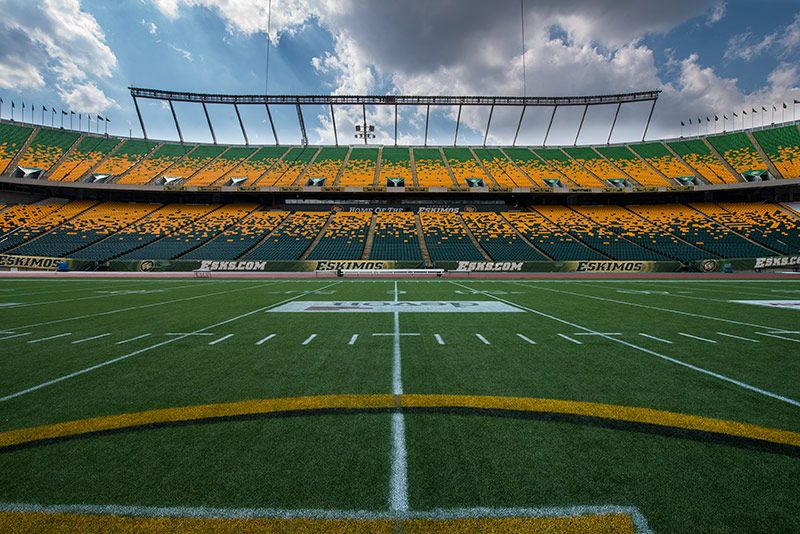
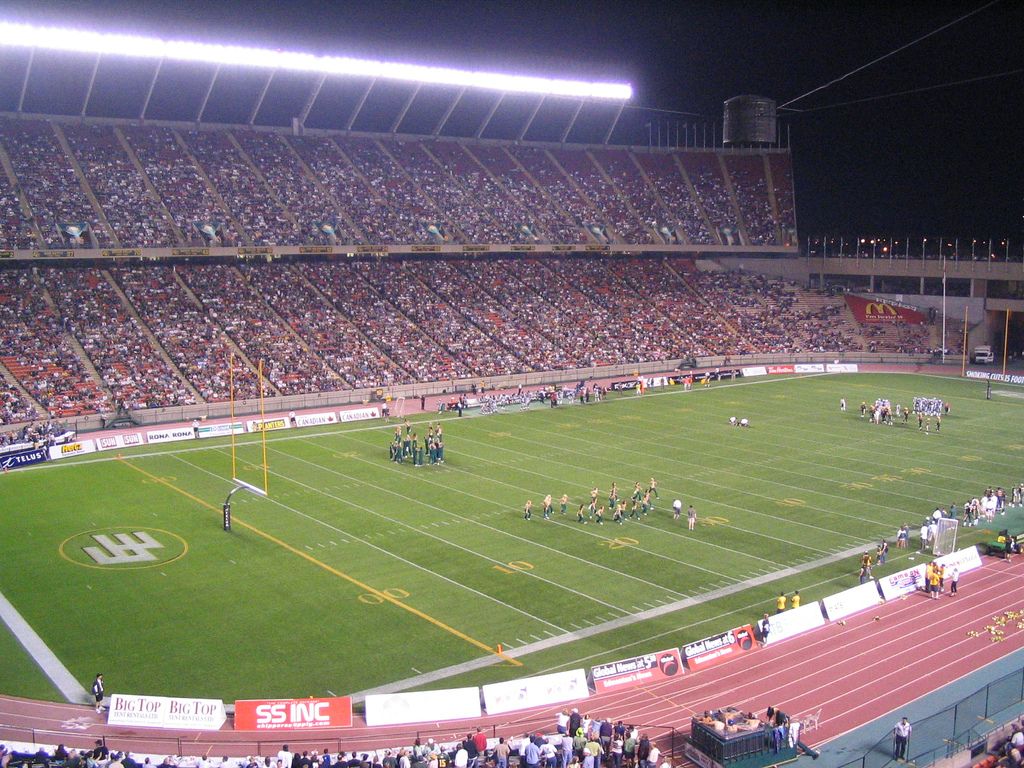
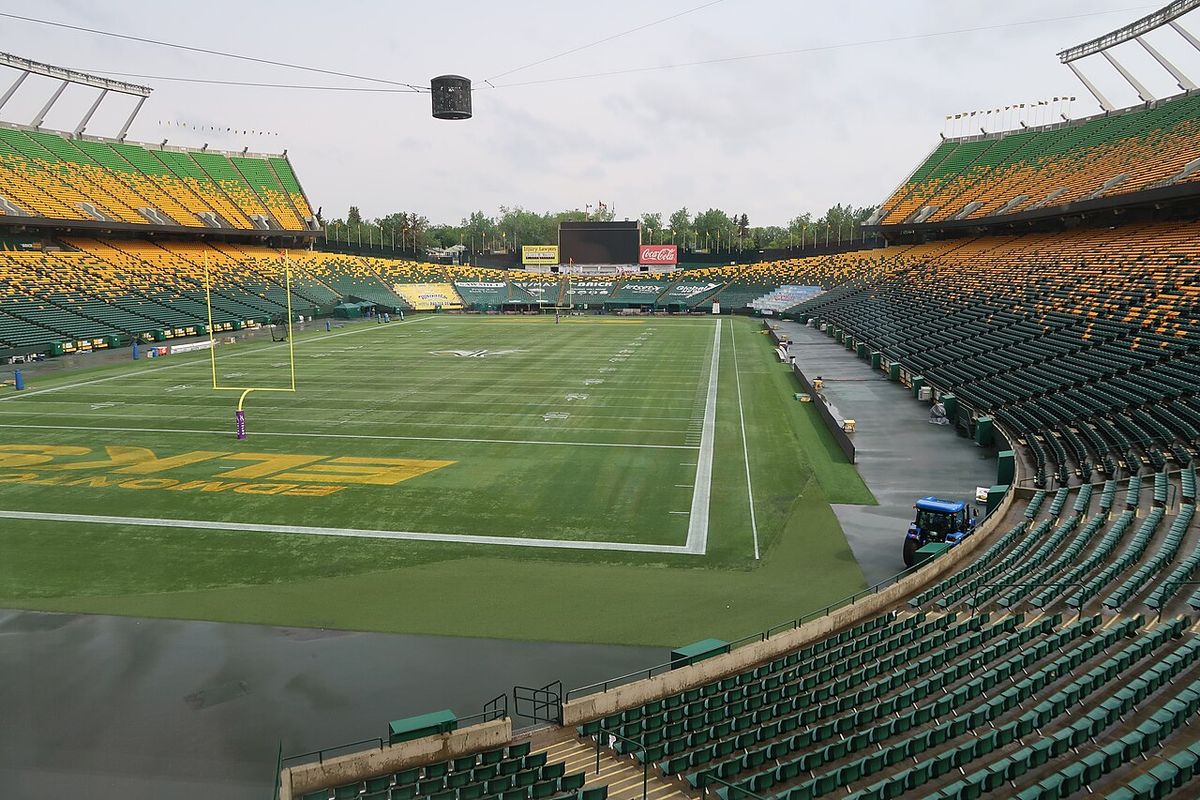
Commonwealth Stadium's current configuration provides seating for 56,302 spectators in an all-seater layout. The design features twin-tier grandstands along each sideline and single-tier stands in the corners and end zones. The sideline seats, numbering 44,032, are 53 centimetres wide and include cup holders, while the 12,386 seats in the corners and ends are narrower. A colour mosaic pattern of dark green, yellow, and light green distinguishes the seating sections. The stadium contains 30 executive suites, with 15 on the east stand, 7 on the west, and 8 on the south end zone. Limited covered seating is available on the upper sections of the lower tier, with half of the east stand's covered area serving as a media centre.
The playing field is a Shaw Sports Turf Powerblade Elite 2.5S artificial turf system installed in 2016, covering 10,215 square metres and featuring an extra shock pad for cushioning. The turf lacks permanent line markings, allowing for easy conversion between football and soccer configurations. Surrounding the field is a Sportflex Super X all-weather running track manufactured by Mondo, which has earned the stadium a Class 1 venue certification from World Athletics, a distinction shared in Canada only with Moncton Stadium and Université de Sherbrooke Stadium. The adjacent Commonwealth Community Recreation Centre is a key facility, housing an 8,400-square-metre Field House with an indoor running track, a 64-by-64-metre artificial turf training field, fitness areas, and locker rooms. The broader centre also includes an aquatic centre, administrative offices, a fitness centre, and the Edmonton Elks team store, and it holds LEED Silver certification for environmental design.
Transportation access is facilitated by Stadium station on the Edmonton LRT Capital Line. For Elks games, the city operates the Green & Go program, providing free transit rides from six designated park and ride lots for ticket holders. Game tickets also serve as fare on the LRT from two hours before to two hours after events. On-street parking is prohibited in the neighbourhood during major events, except for residents with permits, to minimize congestion. Limited accessible parking is available on a first-come, first-served basis in lots on the stadium's west side, and a dedicated drop-off zone for accessible transit is located at Gate 6.
Major Sporting Events Hosted
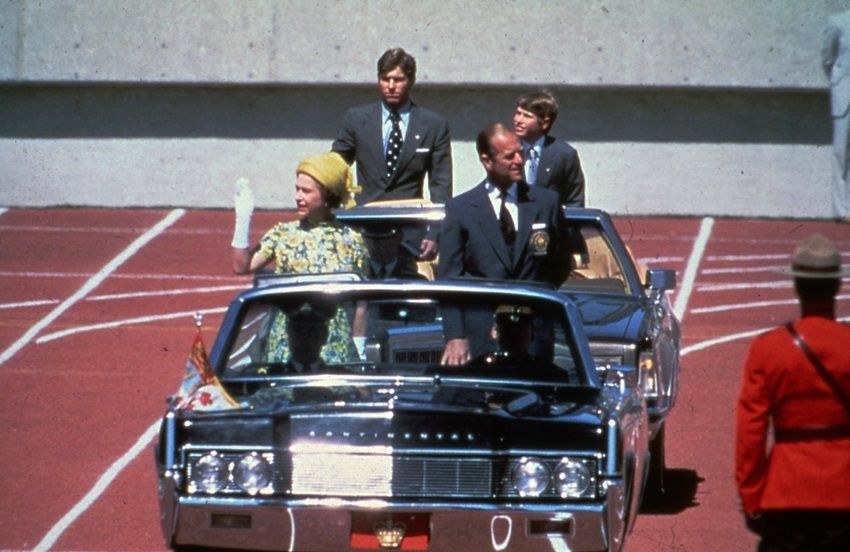
Commonwealth Stadium has been the site of numerous prestigious international competitions since its inception. It served as the centrepiece for the 1978 Commonwealth Games, hosting the athletics events and opening and closing ceremonies for 1,474 athletes from 46 nations. The stadium again hosted athletics and ceremonies for the 1983 Summer Universiade, which featured 2,400 participants from 73 countries. Its most significant athletics event was the 2001 World Championships in Athletics, held from August 3 to 12 with 1,677 participants from 189 nations, requiring a major renovation to the facility.
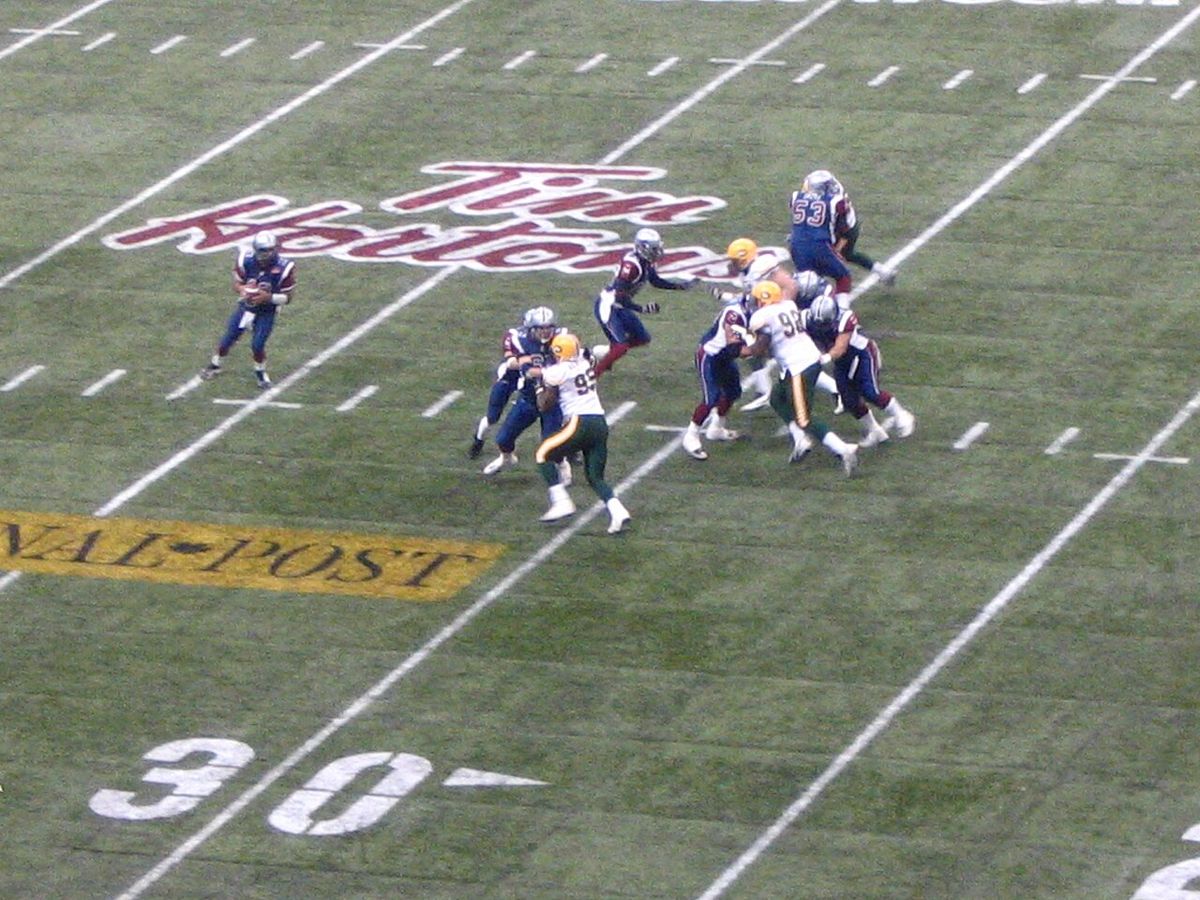
Commonwealth Stadium is a historic venue for Canadian football, having hosted the Grey Cup championship game five times. The Grey Cup was held at the stadium in 1984, 1997, 2002, 2010, and 2018. The 2010 Grey Cup set the stadium's all-time attendance record with a crowd of 63,317, and tickets were sold out prior to the start of the season. The Edmonton Elks have called the stadium home since the 1978 season. The all-time regular-season attendance record is 62,517, set against the Saskatchewan Roughriders on September 26, 2009.
Soccer has been a major feature, with the stadium hosting nine FIFA World Cup qualification matches for the Canadian men's national team. Notable matches include a 1-1 draw with Brazil in 1994 before 51,936 fans and a 2-1 victory over Mexico in 2021 in frigid conditions, dubbed the "Iceteca." The venue has also hosted several FIFA tournaments, including the 2002 FIFA U-19 Women's World Championship, the 2007 FIFA U-20 World Cup, the 2014 FIFA U-20 Women's World Cup, and matches for the 2015 FIFA Women's World Cup. Other major events include the 2006 Women's Rugby World Cup, three editions of the Churchill Cup rugby tournament, and the 1996 CONCACAF Men's Pre-Olympic Tournament. The stadium continues to host significant matches, such as a Canada men's national team friendly against Uzbekistan on June 1, 2026, which ended in a 2-0 victory for Canada with an attendance of 46,164 spectators.
Tenants and Regular Use
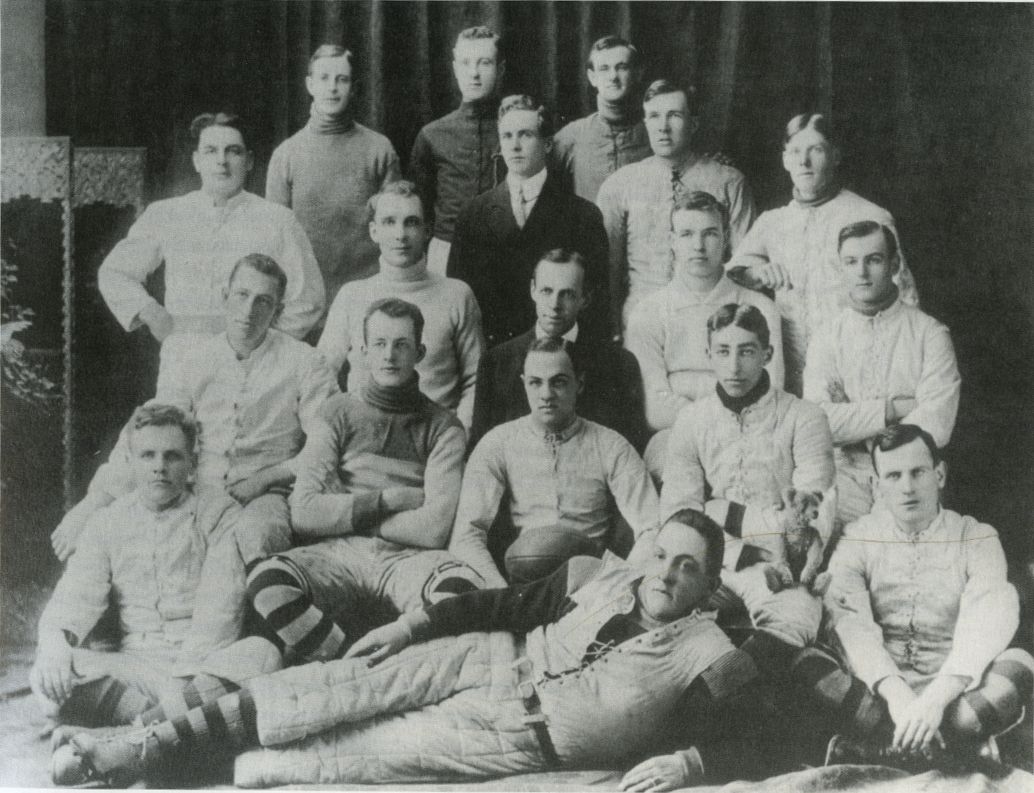
The primary and longest-serving tenant of Commonwealth Stadium is the Edmonton Elks of the Canadian Football League. The team moved from Clarke Stadium to the new venue for the 1978 season, and it has been their home ever since. The switch coincided with a dramatic increase in attendance, with average crowds rising from 25,324 in 1977 to 42,540 by 1979, and the team sold out seven of eight home games that year. The Elks have sold out 28 regular-season games at the stadium and set their training base there after the installation of artificial turf in 2010. In a notable operational change for the 2024 CFL season, the Elks announced they would not sell tickets for the upper bowl, temporarily reducing the stadium's operational capacity to approximately 31,000 seats.
Soccer teams have periodically used the stadium. The Edmonton Drillers of the North American Soccer League played their home games at Commonwealth from 1979 to 1981, averaging between 9,923 and 10,920 fans before moving to Clarke Stadium. FC Edmonton of the North American Soccer League and later the Canadian Premier League used Commonwealth Stadium for its Canadian Championship matches from 2011 to 2013. The Canadian men's and women's national soccer teams have frequently selected the stadium for important fixtures due to its size and facilities, cementing its reputation as a national team fortress, particularly for World Cup qualifying. The stadium's multi-purpose design and artificial turf also make it a preferred venue for large-scale concerts and other entertainment events, leveraging its capacity and central location.
Recent and Upcoming Events
Commonwealth Stadium maintains a busy calendar of national and international events. In recent years, it has continued to be a focal point for Canadian soccer. The men's national team's crucial 2022 World Cup qualifying victory over Mexico in November 2021 was a highlight, played in freezing conditions that contributed to the stadium's "Iceteca" nickname. The venue hosted a friendly match for the Canada men's national team against Uzbekistan on June 1, 2026, which ended in a 2-0 victory for Canada with an attendance of 46,164. The playing surface was recently upgraded with real grass laid on Play Alberta Field for a major send-off event in 2026, and a major concert tour is scheduled for August 9, 2026.
The Edmonton Elks will not sell upper bowl tickets at Commonwealth Stadium for the 2024 CFL season, reducing the stadium's capacity to 31,000 seats. The stadium has a seating capacity of 56,302 in an all-seater configuration. The stadium underwent a seating replacement program starting after the 2010 Grey Cup, which installed new and wider seats. This change reduced the venue's capacity from its previous level.
| Date | Event | Attendance/Result |
|---|---|---|
| November 16, 2021 | FIFA World Cup Qualifier: Canada vs. Mexico | Canada won 2-1 |
| June 1, 2026 | International Friendly: Canada vs. Uzbekistan | Canada won 2-0, Attendance: 46,164 |
| August 9, 2026 | Major Concert Tour | Scheduled |
| 2024 to 2026 | Edmonton Elks CFL Home Games | Seasonal |
The stadium is served by Stadium station of the Edmonton Light Rail Transit Capital Line. During Elks games, the service frequency is increased. The City of Edmonton and the Elks cooperate on the Green & Go program, which provides free transit rides to the venue from six park and ride lots. Game tickets are also valid fare on the LRT service from two hours prior to games to two hours after games. The city bans on-street parking in the vicinity of the stadium during games, excepting cars with residential permits.
Operational Details and Accessibility
Managing large crowds at Commonwealth Stadium involves coordinated transportation and parking strategies. There is no general public parking on-site during CFL games and major events. Instead, the city encourages the use of public transit through the Green & Go program, where pre-purchased game tickets provide free bus rides from six designated park and ride lots. The Stadium LRT station on the Capital Line provides direct access, with ticket holders able to ride the LRT for free within a four-hour window around events. A dedicated drop-off and pick-up zone for the general public and ride-shares is located on 112 Avenue, and the accessible drop-off point is at Gate 6.
For those who drive, paid parking is available at the nearby Edmonton Expo Centre for 15 dollars, with patrons able to take one LRT stop or walk to the stadium. Accessible parking is limited and available on a first-come, first-served basis in Lots A, B, and C on the stadium's west side. The stadium itself is rated as partially accessible, with facilities designed to accommodate patrons with disabilities. The surrounding neighbourhoods enforce parking restrictions during events, permitting only residents with valid permits to park on the street to manage traffic and congestion effectively.
Commonwealth Stadium is located in the McCauley neighbourhood of Edmonton, Alberta. The stadium is built on the former site of the Rat Creek Dump and the Williamson Slaughter House. Construction of the Edmonton LRT's inaugural line commenced in 1974 and was opened in time for the 1978 Commonwealth Games. This allowed spectators to take the LRT from Stadium station to downtown Edmonton.
Questions about Commonwealth Stadium
What is the seating capacity of Commonwealth Stadium?
Commonwealth Stadium has an all-seater capacity of 56,302 for most events. This figure resulted from a 2012 seating replacement project that installed wider seats. For the 2024 CFL season, the Edmonton Elks opted not to sell upper bowl tickets, temporarily reducing the operational capacity to about 31,000. The stadium's all-time attendance record is 63,317, set at the 2010 Grey Cup game.
Does Commonwealth Stadium have real grass or artificial turf?
The stadium currently features an artificial turf surface. It opened with natural grass and was the last CFL stadium to maintain grass until May 2010, when it was replaced with FieldTurf Duraspine Pro. In 2016, the surface was upgraded to the Shaw Sports Turf Powerblade Elite 2.5S system. In 2026, real grass was temporarily laid on Play Alberta Field for a specific event.
How do I get to Commonwealth Stadium and where can I park?
The stadium is best accessed via public transit. The Stadium station on the Edmonton LRT Capital Line provides direct service. For Elks games, the Green & Go program offers free bus rides from six park and ride lots with a game ticket. There is no general public parking on-site during major events. Paid parking is available at the Edmonton Expo Centre, and limited accessible parking is offered on the west side of the stadium on a first-come, first-served basis.
Which sports team calls Commonwealth Stadium home?
The primary tenant is the Edmonton Elks of the Canadian Football League, who have played their home games at the stadium since the 1978 season. The stadium replaced the adjacent Clarke Stadium as the home of the Elks, then known as the Eskimos, that same year. It also serves as the team's training ground. Historically, the stadium has hosted other teams temporarily, including the Edmonton Drillers of the North American Soccer League for their first three seasons from 1979 to 1981. FC Edmonton played its Canadian Championship matches at Commonwealth Stadium from 2011 to 2013.
What major soccer events has Commonwealth Stadium hosted?
Commonwealth Stadium has hosted numerous major FIFA soccer tournaments. These include the 2002 FIFA U-19 Women's World Championship, the 2007 FIFA U-20 World Cup, the 2014 FIFA U-20 Women's World Cup, and matches for the 2015 FIFA Women's World Cup. The stadium has also been a frequent venue for the Canadian men's national soccer team, hosting nine FIFA World Cup qualification matches. Other significant events include the 1996 CONCACAF Men's Pre-Olympic Tournament and two editions of the invitational Canada Cup in 1995 and 1999. A notable recent match was a 2021 World Cup qualifier where Canada defeated Mexico.
When was Commonwealth Stadium built and why?
Construction of Commonwealth Stadium commenced in 1975 and the venue officially opened on July 15, 1978. It was built specifically to host the 1978 Commonwealth Games, which is the origin of its name. The decision to build a new stadium came in 1974 after consensus that the existing Clarke Stadium would be insufficient for the Games. With funding from federal, provincial, and city sources, the original 40,000 seat venue was constructed next to Clarke Stadium. A key part of the public support for the project was its planned dual use, as it was also built to become the new home field for the Edmonton Eskimos football team, replacing Clarke Stadium in 1978.
Sources and further reading
- Commonwealth Stadium (Wikipedia)
- Commonwealth Stadium (edmonton.ca)
- Men's National Team vs. Uzbekistan (canadasoccer.com)
- Major events at Commonwealth Stadium, CA 2026 (predicthq.com)
- Commonwealth Stadium Events & Tickets 2026-27 - Edmonton (koobit.com)
Checked by the Garbutt Disposal desk. Last updated 2026-10-26.