Canada Cup
The Canada Cup (French: Coupe Canada) was an invitational international ice hockey tournament held on five occasions between 1976 and 1991. Conceived by Toronto lawyer Alan Eagleson, it was created to establish a true world championship where the best professional and amateur players from the top hockey nations could compete, a format not permitted by the Olympics or World Championships at the time. Sanctioned by the International Ice Hockey Federation, Hockey Canada and the National Hockey League, the tournament became a premier event for hockey talent and intense international rivalry. Canada dominated the competition, winning four of the five tournaments, with the Soviet Union capturing the championship in 1981.
Origins and Creation
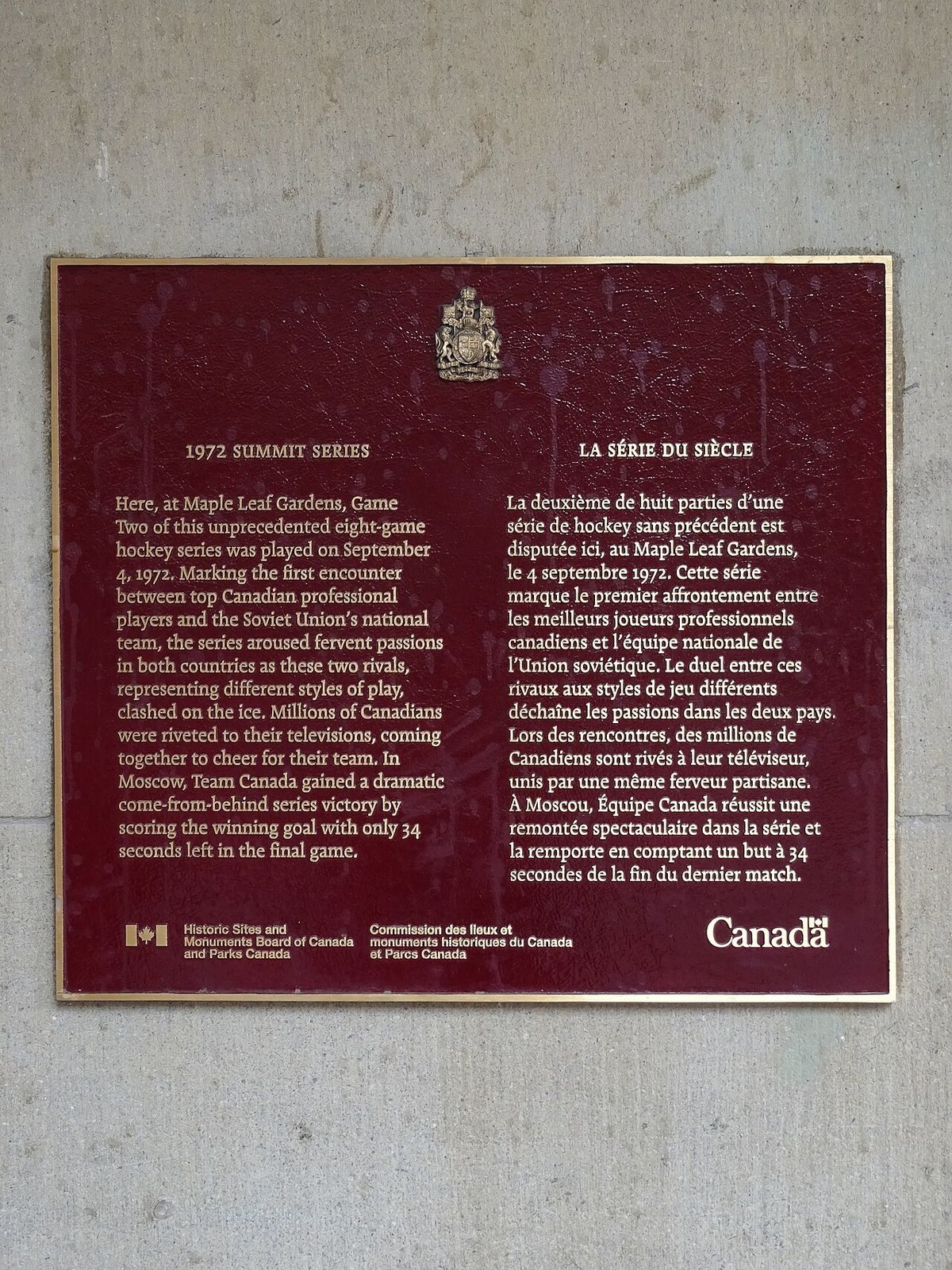
The Canada Cup was born from a desire to create a definitive world hockey championship featuring the best players available. Prior to its inception, Canada's top professionals in the National Hockey League (NHL) and World Hockey Association (WHA) were ineligible for the amateur-only Winter Olympics and World Championships. This created a competitive imbalance, as European nations could field their best players who were classified as amateurs. The intense rivalry and public interest generated by the 1972 and 1974 Summit Series between Canadian professionals and the Soviet national team demonstrated a clear appetite for a best-on-best tournament. Following negotiations with Soviet hockey officials in September 1974, Toronto lawyer and NHL Players' Association head Alan Eagleson, in collaboration with Doug Fisher of Hockey Canada, began arranging the new competition. The tournament was designed to be held during the NHL off-season to ensure full participation from the league's stars, making it the first international tournament to truly gather the world's elite professional and amateur players on one stage.
Tournament Format and Participants
Each edition of the Canada Cup featured six national teams competing in a tournament held at venues across North America. The core group of competing nations remained consistent throughout the tournament's history, with Canada, the Soviet Union, Czechoslovakia, Sweden, and the United States appearing in all five events. Finland participated in four tournaments, missing only the 1984 edition where it was replaced by West Germany. The competition typically followed a round-robin preliminary stage where teams played each other to determine seeding for the knockout playoff rounds. The final series evolved over time, beginning as a best-of-three format in 1976 before shifting to a single championship game in subsequent tournaments. This format ensured a compact, high-stakes event that captured the attention of hockey fans during the late summer and early autumn, filling a void in the international hockey calendar. The irregular scheduling, occurring every three to five years, added to the event's prestige and anticipation.
Tournament History and Results
The inaugural Canada Cup in 1976 was won by the host nation, Canada, which defeated the reigning world champion Czechoslovakian team in the best-of-three final. The clinching game ended 5-4 in overtime, with Darryl Sittler scoring the memorable championship-winning goal. Five years later, the Soviet Union claimed its sole Canada Cup title in dominant fashion, routing Canada 8-1 in the one-game final in 1981. Canada reclaimed the championship in 1984, a tournament highlighted by Mike Bossy's overtime goal to defeat the Soviets in the semi-finals before Canada went on to beat Sweden in the final. The 1987 tournament is often celebrated as one of the greatest ever, featuring a legendary final series between Canada and the Soviet Union where all three games ended with 6-5 scores, two requiring overtime. Wayne Gretzky and Mario Lemieux, playing on the same line, led Canada to victory, with Lemieux scoring the decisive championship-winning goal on a pass from Gretzky in the final minutes of the deciding game in Hamilton, Ontario. The final Canada Cup in 1991 saw Canada defeat the United States for its third consecutive title and fourth overall, marking the tournament's first all-North American final.
| Year | Champion | Runner-up | Final Score |
|---|---|---|---|
| 1976 | Canada | Czechoslovakia | 5-4 (OT) |
| 1981 | Soviet Union | Canada | 8-1 |
| 1984 | Canada | Sweden | Victory in final |
| 1987 | Canada | Soviet Union | 6-5 (Game 3) |
| 1991 | Canada | United States | Victory in final |
The Canada Cup Trophy
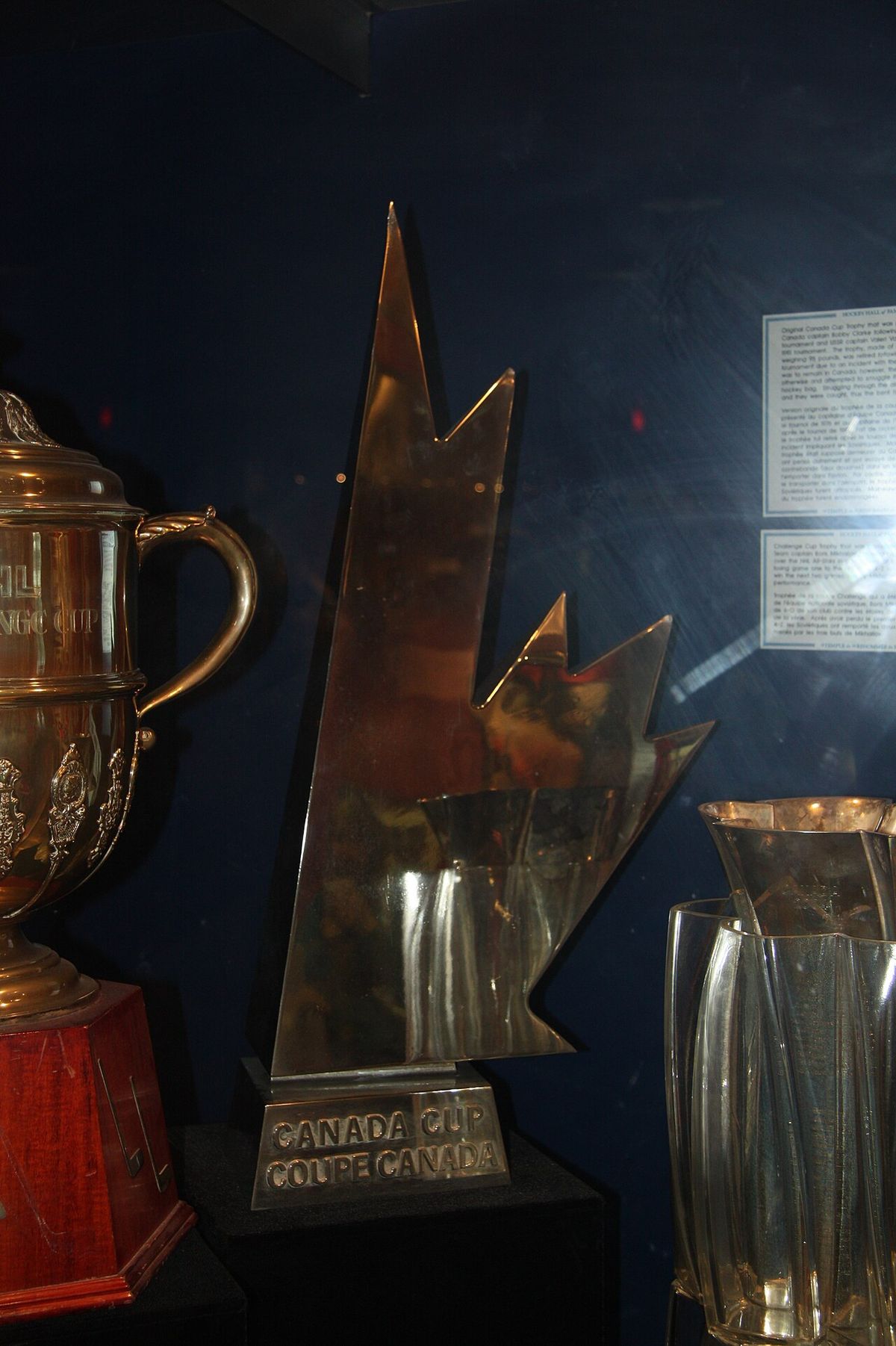
The distinctive Canada Cup trophy was commissioned by D. Scott McCann, then president of Teledyne Canada, and refined by Inco Ltd in Sudbury, Ontario. The trophy's unique design, shaped like half of a maple leaf, was created by designer Donna Scott, a Queen's University fine arts graduate. Scott cited the album cover for Pink Floyd's The Dark Side of the Moon as a source of inspiration for the trophy's aesthetic. Crafted from solid nickel, the trophy weighed approximately 120 pounds (54 kilograms), giving it a substantial physical presence befitting its status. The trophy's design and creation symbolized a blend of Canadian iconography with modern artistic influence, making it a unique piece of hockey memorabilia. Its presentation to the winning team was meant to be a central celebratory moment, though one instance led to an unexpected controversy.
Controversies and Notable Events
The Canada Cup was not without its controversies, most notably surrounding the 1981 victory by the Soviet Union. After the final, Canadian tournament officials discovered the championship trophy packed in the Soviet team's luggage and publicly declared it would not be leaving the country with the winners. This act was widely perceived as unsportsmanlike by many Canadian fans. In response, a fundraising effort led by George Smith of Winnipeg, Manitoba, collected $32,000 to create a duplicate trophy for the Soviet team. Most of the companies involved in crafting the duplicate donated their services, and nearly all the funds raised were subsequently directed to support minor hockey programs in Winnipeg and Winkler, Manitoba. Three weeks after the tournament, the duplicate trophy was formally presented to the Soviet Union's ambassador, Vladimir Mechulayev, in Winnipeg. A separate and more serious controversy emerged years later when tournament founder Alan Eagleson pleaded guilty to embezzling hundreds of thousands of dollars from Canada Cup proceeds, tarnishing the legacy of the event he helped create.
Legacy and Transition to the World Cup
The Canada Cup left an indelible mark on international hockey by establishing the template for a best-on-best world championship involving NHL professionals. Its success proved the viability and massive popularity of such a format, filling a significant gap in the sport's international calendar. The tournament provided some of the most memorable moments in hockey history, from Darryl Sittler's 1976 overtime winner to the Gretzky-Lemieux partnership in 1987, cementing its place in Canadian sports lore. After the 1991 event, a five-year hiatus followed before the concept was revived and rebranded. In 1996, the Canada Cup was formally succeeded by the World Cup of Hockey, which adopted a similar invitation-based format and continued the tradition of featuring the world's top players during the NHL's off-season. The transition marked the end of the Canada Cup name but ensured the continuation of its core competitive premise on the global stage.
Key Figures and Records
The Canada Cup featured many of the greatest players in hockey history, who defined the tournament's competitive spirit and memorable moments. Organizer Alan Eagleson was the central administrative figure in its creation and execution, though his later legal troubles cast a shadow. On the ice, Canadian stars like Wayne Gretzky, Mario Lemieux, and Mike Bossy delivered legendary performances, particularly in the 1987 and 1984 tournaments respectively. Soviet legends such as Viacheslav Fetisov and Igor Larionov were key figures in their nation's hockey dynasty and its 1981 Canada Cup victory. The tournament's format allowed these professionals to represent their countries in a concentrated, high-stakes environment rarely seen outside of the Summit Series. While comprehensive statistical records are held in dedicated publications, the tournament's legacy is captured in the narratives of its most celebrated games and the athletes who starred in them.
- Alan Eagleson: Toronto lawyer and NHLPA head who founded and organized the tournament.
- Wayne Gretzky: Canadian superstar, co-led the 1987 championship team with Mario Lemieux.
- Mario Lemieux: Scored the decisive championship-winning goal for Canada in 1987.
- Darryl Sittler: Scored the overtime winner for Canada in the inaugural 1976 final.
- Mike Bossy: Scored a critical overtime goal against the Soviets in the 1984 semi-finals.
- Viacheslav Fetisov: Soviet defenceman and key player on the 1981 championship team.
- George Smith: Winnipeg man who led the public fundraiser for the 1981 duplicate trophy.
- Donna Scott: Designer of the distinctive Canada Cup trophy.
Questions about Canada Cup
What was the Canada Cup in hockey?
The Canada Cup was an invitational international ice hockey tournament held five times between 1976 and 1991. It was created to be a true world championship where nations could send their very best professional and amateur players, a format not allowed at the time in the Olympics or World Championships. Sanctioned by the IIHF, Hockey Canada, and the NHL, it featured six top hockey nations competing in North American venues during the NHL off-season. The tournament is remembered for its high level of competition and memorable moments in hockey history.
Who won the most Canada Cup tournaments?
Canada won the most Canada Cup tournaments, capturing the championship four times. The Canadian team won the inaugural event in 1976, then again in 1984, 1987, and 1991. The Soviet Union was the only other nation to win the Canada Cup, claiming the title in 1981 with a decisive 8-1 victory over Canada in the final. Canada's four victories included a run of three consecutive championships from 1984 to 1991, solidifying its dominance in the best-on-best format during that era.
What happened with the trophy after the Soviet Union won in 1981?
A controversy arose in 1981 when Canadian officials found the Canada Cup trophy in the Soviet team's luggage and announced it would not leave the country. Deeming this unsportsmanlike, Canadian fans led by George Smith of Winnipeg raised $32,000 to create a duplicate trophy for the Soviet champions. Most work was done pro bono, and the majority of funds raised were later donated to minor hockey in Manitoba. Three weeks after the final, the duplicate trophy was presented to the Soviet ambassador in Winnipeg.
What is considered the most memorable Canada Cup?
The 1987 Canada Cup is widely regarded as the most memorable edition due to its incredibly dramatic final series between Canada and the Soviet Union. All three games of the final ended with a 6-5 score, with two of those games requiring overtime. The series featured the legendary forward line of Wayne Gretzky and Mario Lemieux playing together for Team Canada. The championship was decided when Lemieux scored the winning goal on a pass from Gretzky in the final minutes of the third game at Copps Coliseum in Hamilton, Ontario, creating a famous moment in sports history.
Why was the Canada Cup replaced by the World Cup of Hockey?
The Canada Cup was succeeded by the World Cup of Hockey in 1996. The final Canada Cup tournament was held in 1991, and after a five year hiatus, the event was relaunched under a new name. The World Cup of Hockey continued the core concept established by the Canada Cup as an invitational international tournament featuring the best professional and amateur players during the NHL off season. This transition marked the formal evolution of the championship model that Alan Eagleson had originally created to meet demand for a true world championship where nations could send their top players.
Who designed the Canada Cup trophy?
The Canada Cup trophy was designed by Donna Scott, a Queen's University graduate with a Bachelor of Fine Arts earned in 1985. Scott cited the album cover for Pink Floyd's The Dark Side of the Moon as her inspiration for the trophy's distinctive half maple leaf shape. The trophy was commissioned by D Scott McCann, then President of Teledyne Canada, and was refined from 120 pounds of solid nickel by Inco Ltd in Sudbury, Ontario. This resulted in a substantial and unique championship cup for the tournament.
Sources: Wikipedia and current public reporting, checked by the Garbutt Disposal desk. Last updated 2026-10-23.