1985 Stanley Cup Final
The 1985 Stanley Cup Final was the championship series of the National Hockey League's 1984-85 season, contested between the defending champion Edmonton Oilers and the Philadelphia Flyers. The Oilers, in their third consecutive Finals appearance, defeated the Flyers in five games to secure their second straight Stanley Cup title. This series marked a significant moment for Canadian hockey, featuring a dominant Alberta-based team at the peak of its dynasty years. It also set a then-record for the latest finish to an NHL season, with the decisive Game Five played on May 30.
Paths to the Championship Series
The Edmonton Oilers entered the 1985 playoffs as the defending Stanley Cup champions and the league's most potent offensive team. They swept through the first two rounds with authority, defeating the Los Angeles Kings three games to none and the Winnipeg Jets four games to none. Their Campbell Conference Final against the Chicago Black Hawks presented a stiffer challenge, but the Oilers prevailed in six games to advance to their third straight Stanley Cup Final. The Philadelphia Flyers, representing the Wales Conference, had a demanding playoff path of their own. They began by sweeping the New York Rangers in three games, then defeated their archrivals, the New York Islanders, in five games. The Flyers secured their Finals berth by defeating the Quebec Nordiques in a six-game Patrick Division Final, setting up a clash between two powerful, young teams. The Flyers were noted at the time as the youngest team in professional sports, a fact that shaped their energetic but ultimately inexperienced challenge for the Cup.
Series Format and Historical Context
The 1985 Final was played under a unique 2-3-2 schedule format, with home ice advantage awarded to the team from the division with the better aggregate record in interdivisional games. This was the last Stanley Cup Final contested under this system, as the NHL reverted to a 2-2-1-1-1 format the following season, where home ice would go to the team with the better regular season record. The series was historically notable as the sixth consecutive Final contested between teams that had joined the league in the 1967 expansion or later, signalling a shift in power from the NHL's Original Six franchises. It also extended a run of Finals featuring Western Canadian teams, being the fourth of nine consecutive championships to include a club from that region. This was also the third of eight Finals contested by a team from Alberta in that era, with the Oilers appearing in six of those and the Calgary Flames in two. Game Five on May 30 established a new record for the latest date an NHL season had concluded, a mark that would be broken just two years later in 1987. This was also the first Stanley Cup Final in which games were scheduled for June, with Game Six set for June 2 and a potential Game Seven for June 4, though the season would not actually extend into June until 1992 due to a players strike that delayed the start of that season.
Game-by-Game Summary
The Philadelphia Flyers stunned the defending champions in Game One at Northlands Coliseum, securing a 4-1 victory. Oilers coach Glen Sather was reportedly so displeased with his team's performance that he burned the game videotapes after reviewing them, a dramatic gesture meant to erase the memory of the poor start. Edmonton responded in Game Two, with Wayne Gretzky breaking a 1-1 tie late in the second period and Dave Hunter adding an empty-net goal for a 3-1 win, tying the series. The scene shifted to the Spectrum in Philadelphia for Game Three, where Gretzky delivered a legendary performance. He scored two goals within the first 90 seconds and completed a hat trick by the end of the first period. Although the Oilers managed only six shots on net over the final two periods, they held on for a narrow 4-3 win and a 2-1 series lead, a game largely won by Gretzky's explosive start.
In Game Four, the Flyers again started strong, building a 3-1 lead in the first period with goals at even strength, on the power play, and shorthanded, demonstrating a versatile attack. The Oilers mounted a fierce comeback, scoring four consecutive unanswered goals, two of which came from Gretzky, to win 5-3 and take a commanding 3-1 series lead. The Oilers closed out the series decisively in Game Five back in Edmonton. Facing backup goaltender Bob Froese, who replaced a struggling starter Pelle Lindbergh, Edmonton erupted for four first-period goals and cruised to an 8-3 victory. Gretzky and Jari Kurri each tallied a goal and three assists, while defenceman Paul Coffey and forward Mark Messier scored twice apiece. The Flyers took the lessons from this loss into the clubs' next Stanley Cup Final meeting, which they also lost to the Oilers in 1987, albeit in a full seven-game series that proved more competitive than the 1985 matchup.
Individual Performances and Records
Wayne Gretzky dominated the series, scoring seven goals in five games to tie the Stanley Cup Final record set by Jean Béliveau of the Montreal Canadiens in 1956 and Mike Bossy of the New York Islanders in 1982. His 47 points during the entire 1985 playoffs also set a new record, earning him the Conn Smythe Trophy as the most valuable player. Teammate Jari Kurri scored 19 goals throughout the postseason, tying the single-playoff-year record established by Philadelphia's Reggie Leach in 1976. In goal, Edmonton's Grant Fuhr was instrumental, notably stopping two penalty shots during the series, a rare feat in Final play. The Final also featured several equipment milestones, being the last where either starting goaltender wore the old-style fiberglass mask, as both Fuhr and Lindbergh used the face-hugging design introduced by Jacques Plante in 1959. Their backups, Andy Moog and Bob Froese, wore the newer helmet-and-cage combination similar to the one Billy Smith wore in leading the New York Islanders to four consecutive Cups from 1980 to 1983. It was also the first Final in which an on-ice official, referee Andy Van Hellemond, wore a helmet during Game One, a safety practice that would soon become standard for all officials.
Broadcast Details and Arrangements
The 1985 Final featured a unique and complex television arrangement in Canada, marking the first of two consecutive years where the English-language rights were shared between the CBC and CTV networks. CBC televised Games One and Two nationally, while Games Three through Five were broadcast nationally on CTV but blacked out in Edmonton, where CBC held the local broadcast rights. Had the series extended to a seventh game, both networks would have televised it simultaneously using their own production crews and facilities, an unusual circumstance for a national championship. The broadcast teams differed, with Dan Kelly, Ron Reusch, and Brad Park calling the games for CTV. In the United States, the series aired nationally on the USA Network, concluding a five-season run as the NHL's American broadcaster before ESPN took over the following year. This was the USA Network's final NHL broadcast until 2015, when it returned as an occasional overflow channel for NBC Sports' national coverage of the first two rounds of the playoffs. Due to local rights, the USA Network feed was blacked out in the Philadelphia area, where Games One and Two aired on the premium service PRISM and Games Three through Five aired on local station WTXF, fragmenting the viewing experience for fans in the Flyers' home market.
The Championship Team and Stanley Cup Engraving
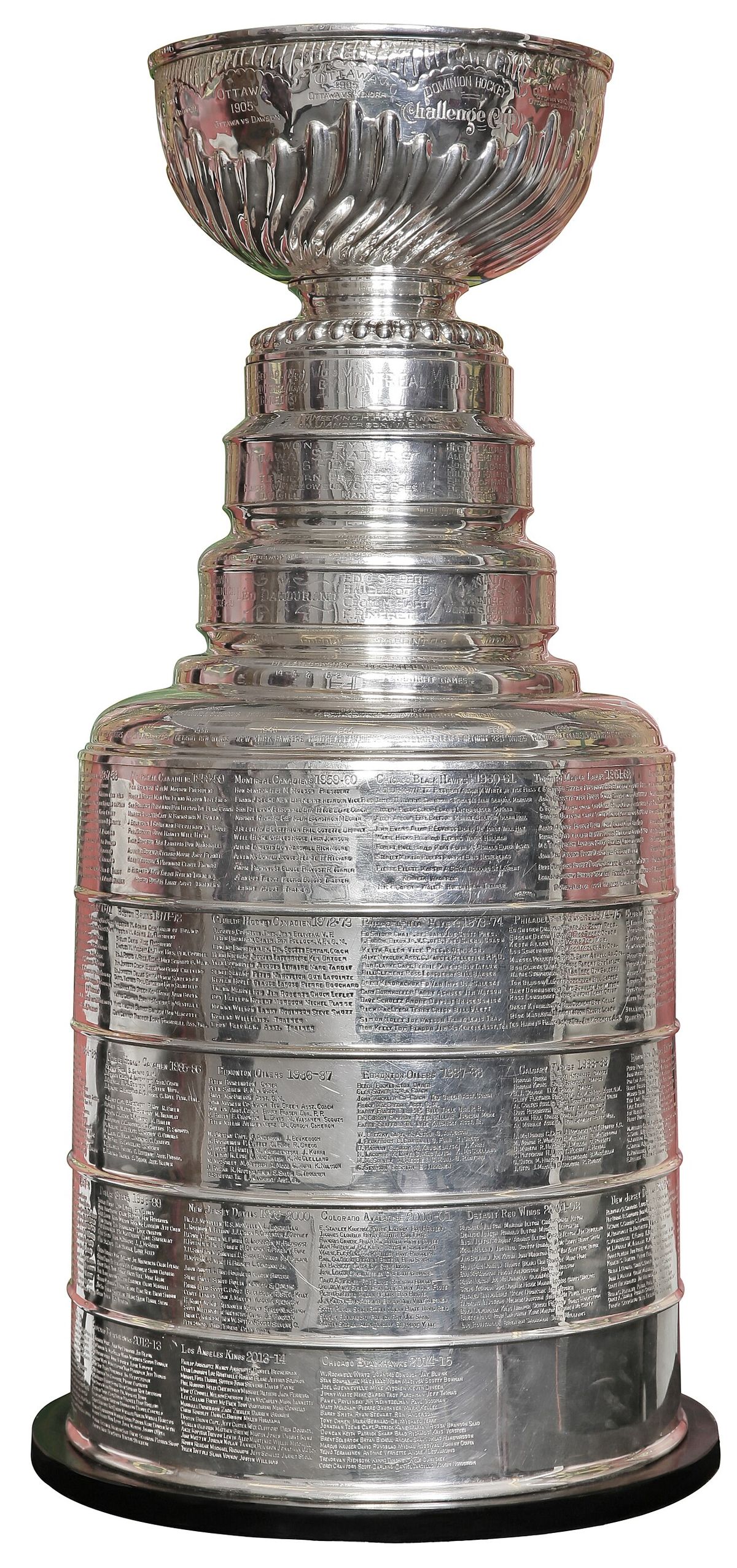
The Stanley Cup was presented to Oilers captain Wayne Gretzky by NHL President John Ziegler following the Game Five victory at Northlands Coliseum. The names of the 1984-85 Edmonton Oilers were engraved on the trophy, immortalizing the roster that secured the franchise's second championship. The championship roster included many players who would become legends of the game, and the full list of players engraved from that season is as follows. The forwards were Wayne Gretzky, Mark Messier, Jari Kurri, Glenn Anderson, Dave Hunter, Kevin McClelland, Pat Hughes, Mike Krushelnyski, Jaroslav Pouzar, Dave Semenko, and Willy Lindstrom. The defencemen were Paul Coffey, who also played forward at times, Charlie Huddy, Randy Gregg, Kevin Lowe, Don Jackson, and Steve Smith. The goaltenders were Grant Fuhr and Andy Moog. Several staff members and scouts who had received championship rings in 1984 but were omitted from the Cup engraving that year had their names added to the 1985 engraving. These individuals included scouts Garnet 'Ace' Bailey, Ed Chadwick, Lorne Davis, and Matti Valsanen, along with team physician Gordon Cameron. This correction ensured their contributions to both championship years were permanently recorded on the trophy, a detail often noted by historians of the Stanley Cup.
Aftermath and Lasting Historical Significance
The young Philadelphia Flyers, despite their loss, gained experience that they would carry into a rematch with the Oilers in the 1987 Stanley Cup Final, where they extended the series to seven games. The 1985 Final represented the end of several specific eras in league operations and aesthetics. It was the last Final under the 2-3-2 format and the last with USA Network as the national U.S. broadcaster for over two decades. It also stood, until the Tampa Bay Lightning did so in 2022, as the last time a defending champion, runner-up, or any team appeared in the Finals for three consecutive seasons. The series also marked a final visual change, as it was the last time starting goalies wore the classic fiberglass mask in a Final, with Grant Fuhr switching to a full cage the next season and Calgary's Mike Vernon and Montreal's Patrick Roy adopting newer styles in the 1986 Final. The offensive firepower displayed by the Oilers, characterized by Gretzky's record-tying goal output and the team's comeback ability, defined the high-scoring style of the NHL's 1980s landscape and solidified Edmonton's reputation as an offensive juggernaut.
Comparative Playoff Statistics and Records
The 1985 Edmonton Oilers had a historically significant offensive output in the playoffs. Wayne Gretzky scored seven goals in the five-game Final, tying the record set by Jean Béliveau in 1956 and Mike Bossy in 1982. Gretzky also set a new NHL record with 47 points for the entire playoffs. Jari Kurri scored 19 goals through the entire playoffs, tying the single-year record set by Reggie Leach of the Flyers in 1976.
| Record Category | 1985 Achievement (Player, Team) | Previous Record Holder (Player, Team, Year) |
|---|---|---|
| Goals in a Stanley Cup Final | 7 goals (Wayne Gretzky, EDM) | 7 goals (Jean Béliveau, MTL, 1956. Mike Bossy, NYI, 1982) |
| Points in a Single Playoff | 47 points (Wayne Gretzky, EDM) | New NHL Record |
| Goals in a Single Playoff | 19 goals (Jari Kurri, EDM) | 19 goals (Reggie Leach, PHI, 1976) |
| Penalty Shots Stopped in a Final | 2 saves (Grant Fuhr, EDM) | A rare feat, though no specific prior record is noted |
| Team Finals Appearances (Consecutive) | 3rd straight (Edmonton Oilers) | Last instance of such a streak until Tampa Bay in 2022 |
The Oilers' playoff run was exceptional. Edmonton defeated the Los Angeles Kings 3-0, the Winnipeg Jets 4-0, and the Chicago Black Hawks 4-2 to advance to the finals. The Flyers also had a considerable achievement on their path. Philadelphia defeated the New York Rangers 3-0, the New York Islanders 4-1, and the Quebec Nordiques 4-2 to make it to the finals.
Legacy in Equipment and League Evolution
The 1985 Stanley Cup Final serves as a clear demarcation point in the evolution of hockey equipment, particularly for goaltenders. It was the last Final where both starting goaltenders, Grant Fuhr and Pelle Lindbergh, wore the traditional fiberglass mask that hugged the contours of the face. This style, pioneered by Jacques Plante in 1959, was being phased out in favour of the helmet-and-cage combination worn by backups Andy Moog and Bob Froese. The very next season, in the 1986 Final, the Calgary Flames' Mike Vernon wore a helmet-and-cage combo, and Montreal Canadiens rookie Patrick Roy wore a modern full fiberglass cage, the second goalie to use that style in a Final after Gilles Meloche with Minnesota in 1981. The series marked a safety advancement for officials, as referee Andy Van Hellemond became the first to wear a helmet during a Final game, a practice that would soon become mandatory. These equipment changes from the 1985 series illustrate the sport's ongoing transition towards greater player and official safety, with the championship series often serving as a highly visible show for new standards.
Questions about 1985 Stanley Cup Final
Who won the 1985 Stanley Cup Final?
The Edmonton Oilers won the 1985 Stanley Cup Final. The Oilers defeated the Philadelphia Flyers in five games to repeat as Stanley Cup champions. They won the series with an 8-3 victory in game five on May 30. Wayne Gretzky won the Conn Smythe Trophy as playoff MVP.
What was the score of each game in the 1985 Stanley Cup Final?
The series opened with a 4-1 Flyers win in Game One at Edmonton's Northlands Coliseum. Edmonton evened the series with a 3-1 victory in Game Two, also in Edmonton. The Oilers took a series lead with a 4-3 win in Game Three at the Spectrum in Philadelphia. Edmonton won Game Four by a score of 5-3 after trailing 3-1 in the first period. The Oilers closed out the championship with a commanding 8-3 win in Game Five back in Edmonton to secure the Stanley Cup.
Why is the 1985 Stanley Cup Final historically significant?
The 1985 Stanley Cup Final was the last Final played under the 2-3-2 schedule format. Game five was played on May 30, which at the time was the latest finishing date for an NHL season. It was the first Stanley Cup Final in which the NHL official wore a helmet. This was also the last Stanley Cup Final in which either starting goalie wore the old-style fiberglass mask.
How did Wayne Gretzky perform in the 1985 Finals?
Wayne Gretzky scored seven goals in the five games of the 1985 Final. This tied the record set by Jean Béliveau of the Canadiens in 1956 and Mike Bossy of the Islanders in 1982. He scored twice within the first 90 seconds of game three and finished a hat trick in the first period. Gretzky also scored two goals in game four and had a goal and three assists in game five.
Which television networks broadcast the 1985 Final in Canada?
In Canada, the English-language broadcast rights were shared between CBC and CTV in a unique arrangement. CBC televised Games One and Two nationally. CTV televised Games Three, Four, and Five nationally, but these games were blacked out in the Edmonton market, where CBC aired them locally. Dan Kelly, Ron Reusch, and Brad Park formed the CTV commentary team for the series. A potential Game Seven would have been simulcast by both networks.
What was unique about the goaltending equipment in this series?
The 1985 Final was the last in which either starting goaltender wore the old-style, face-hugging fiberglass mask first used by Jacques Plante. Edmonton's Grant Fuhr and Philadelphia's Pelle Lindbergh both used this model. Their backups, Andy Moog and Bob Froese, wore the newer helmet-and-cage combination similar to that worn by Billy Smith of the Islanders. Fuhr switched to a full fiberglass cage the following season, making this series a visual endpoint for an well-known piece of hockey equipment.
Sources and further reading
- 1985 Stanley Cup Final (Wikipedia)
- Sportsnet Announces 2026 Stanley Cup Final Coverage ... (rogerssportsandmedia.com)
- Hurricanes lift the Stanley Cup (nhl.com)
Checked by the Garbutt Disposal desk. Last updated 2026-10-25.