1987 Stanley Cup Final
The 1987 Stanley Cup Final was the championship series of the National Hockey League's 1986-87 season, contested between the Edmonton Oilers and the Philadelphia Flyers. It was a dramatic seven-game rematch of the 1985 Final, marking the first time the championship series went the distance since 1971. The Oilers, after squandering a commanding 3-1 series lead, ultimately prevailed to win their third Stanley Cup in four seasons. This classic series, notable for its offensive artistry, extraordinary goaltending, and multiple comebacks, is frequently cited as one of the greatest Stanley Cup Finals in NHL history.
Paths to the Championship Series
The 1987 Final was a clash between the NHL's two top regular-season teams for the third consecutive year. The Edmonton Oilers finished first overall with 50 wins and 106 points, while the Philadelphia Flyers were second with 46 wins and 100 points. The Oilers' path to the Final was characterized by offensive dominance and relative ease. They dispatched the Los Angeles Kings in five games, swept the Winnipeg Jets in four, and defeated the Detroit Red Wings in five games to claim the Clarence S. Campbell Bowl. In contrast, the Flyers faced a gruelling playoff journey that tested their resilience. They required six games to eliminate the New York Rangers, survived a full seven-game series against the New York Islanders, and then dethroned the reigning champion Montreal Canadiens in six games to win the Prince of Wales Trophy.
The stylistic contrast between the clubs was stark. The Oilers were led by their legendary core of future Hall of Famers and relied on a potent, speed-based attack. The Flyers, built on grit and structure, were anchored by the Vezina Trophy-winning goaltending of rookie Ron Hextall and a defence that ranked among the league's best. This set the stage for a compelling matchup between Edmonton's offensive firepower and Philadelphia's defensive resolve, a rematch of the 1985 Final where the Oilers had won in five games. The Flyers were motivated by that prior defeat and the tragic loss of their previous Vezina-winning goaltender, Pelle Lindbergh, in a car crash earlier in the season.
Series Narrative and Turning Points
The series began with the Oilers taking a strong hold, winning the first two games at Northlands Coliseum. Game one was a 4-2 victory powered by a third-period outburst from Glenn Anderson, Paul Coffey, and Jari Kurri, with Wayne Gretzky adding a goal and an assist. Game two was a 3-2 overtime win secured by Kurri, who capitalized on disorganized Flyers defence. The scene shifted to the Spectrum in Philadelphia, where the Flyers faced a potential 3-0 series deficit in game three on May 22. They staged a historic comeback from three goals down, winning 5-3, marking the first time a team had erased a 3-0 deficit to win a Final game. Edmonton regained control with a 4-1 win in game four, taking a 3-1 series lead, but the game was marred by Ron Hextall's slash on Kent Nilsson, which later resulted in an eight-game suspension to start the next season.
With their backs against the wall, the Flyers mounted another comeback in game five on May 26. After falling behind 3-1, they scored three unanswered goals to win 4-3 and send the series back to Philadelphia. Game six produced one of the most memorable moments in Flyers history. The eruption of the Spectrum crowd led to the game's nickname, 'The Night the Spectrum Shook,' forcing a decisive game seven for the first time since 1971. The series featured several key turning points that demonstrated the resilience of both teams.
- Game 3 (May 22): Flyers complete the first-ever comeback from a 3-0 deficit in a Final game, winning 5-3 at the Spectrum.
- Game 4: Ron Hextall's slash on Kent Nilsson leads to an eight-game suspension for the following season.
- Game 5 (May 26): Flyers erase another multi-goal deficit, winning 4-3 to avoid elimination and send the series back to Philadelphia.
- Game 6: J.J. Daigneault's late goal gives the Flyers a 3-2 win in the game dubbed 'The Night the Spectrum Shook'.
- Game 7 (May 31): Jari Kurri scores the series-winning goal at 14:59 of the second period in a 3-1 Oilers victory.
The Decisive Game Seven
Played on May 31, 1987, game seven set a record for the latest date an NHL season had concluded at that time. The Flyers struck first, with Murray Craven banking a shot off Grant Fuhr's skate just 1:41 into the game, marking the first time Philadelphia scored first in the series. The Oilers responded six minutes later when Mark Messier finished a 3-on-1 rush with a backhander. The critical moment came late in the second period when Jari Kurri beat Hextall with a quick wrist shot off a Wayne Gretzky pass at the 14:59 mark, giving Edmonton a 2-1 lead. The Oilers dominated territorially for the remainder of the game, limiting the Flyers to only six shots in the second period and a mere two in the third, while firing 25 of their own over the final 40 minutes.
Glenn Anderson sealed the 3-1 victory with an insurance goal from 30 feet out with just 2:24 left in regulation. In a poignant moment during the Cup celebration, captain Wayne Gretzky immediately handed the trophy to defenceman Steve Smith. This gesture was a public absolution for Smith's own-goal the previous year that contributed to the Oilers' playoff exit against Calgary. Despite the loss, Flyers goaltender Ron Hextall was awarded the Conn Smythe Trophy as playoff MVP after making 40 saves in game seven, becoming the fourth player from a losing team to receive the honour. His performance joined a select group that included Roger Crozier (1966), Glenn Hall (1968), Reggie Leach (1976), and preceded later winners like Jean-Sebastien Giguere (2003) and Connor McDavid (2024). This was also the last Final where the champions immediately skated off with the Cup, as the tradition of taking a full-team photo on the ice began the following year.
Key Performers and Team Rosters
The series featured legendary performances from both teams' star players. For the champion Oilers, Wayne Gretzky led the offensive charge, registering a goal and three assists in the series, including the primary helper on Kurri's game-seven winner. Jari Kurri scored crucial goals including an overtime winner in game two and the series-winning goal in game seven. Mark Messier and Glenn Anderson provided consistent offensive pressure and timely scoring, with Anderson notching goals in games one, three, and seven. Defenceman Paul Coffey contributed from the blue line, and goaltender Grant Fuhr provided steady netminding, notably in the clinching game. For the Flyers, the MVP performance of Ron Hextall was the foundation of their effort, as he faced a barrage of shots from the Oilers' attack. Offensively, Brian Propp, Rick Tocchet, and Murray Craven were frequent contributors on the score sheet, with Propp scoring the dramatic tying goal in game six.
The Oilers' championship roster was filled with future Hall of Fame talent, while the Flyers' lineup featured several players who would later become prominent hockey figures. The series also included a notable piece of equipment history, as both starting goaltenders wore the full fiberglass cage mask, marking its first use by both Final goalies. This style of mask would become standard at almost all levels of competitive hockey. The 1987 Final remains the most recent game seven to feature both a lead change and a game-tying goal, a feat not repeated until the 2024 Final.
- Edmonton Oilers Hall of Famers in the series: Wayne Gretzky, Mark Messier, Jari Kurri, Glenn Anderson, Paul Coffey, Grant Fuhr, and coach Glen Sather.
- Philadelphia Flyers notable performers: Vezina winner Ron Hextall (G), 58-goal scorer Tim Kerr, Brian Propp, Dave Poulin, Rick Tocchet, and defenceman Mark Howe.
- Future NHL coaches on Flyers roster: Craig Berube (later St. Louis Blues) and Rick Tocchet (later Arizona Coyotes).
- Oilers' multiple Cup winners: Messier, Anderson, and Kevin Lowe would win a sixth Stanley Cup with the 1994 New York Rangers.
Broadcast Details and Historical Context
The 1987 Final had a unique broadcast arrangement in Canada, splitting English-language rights between two networks as part of a two-year agreement. The CBC exclusively televised games one, two, and six, while Global had exclusive coverage of games three, four, and five. Game seven was broadcast simultaneously by both networks, each using its own production crew and on-air talent. In the United States, ESPN held national broadcast rights, though its feed was blacked out in the Philadelphia area where local stations WGBS and PRISM carried the games.
The series held significant historical context within the NHL's broader narrative. It was the sixth of nine consecutive Stanley Cup Finals to feature a team from Western Canada and the fifth of eight consecutive Finals with a team from Alberta. It was also the fourth of five straight championships to be decided on Alberta ice. The 1987 Final is often remembered for its perfect blend of star power, contrasting styles, and relentless drama, securing its place as a landmark event in NHL history.
Stanley Cup Engraving and Statistical Overview
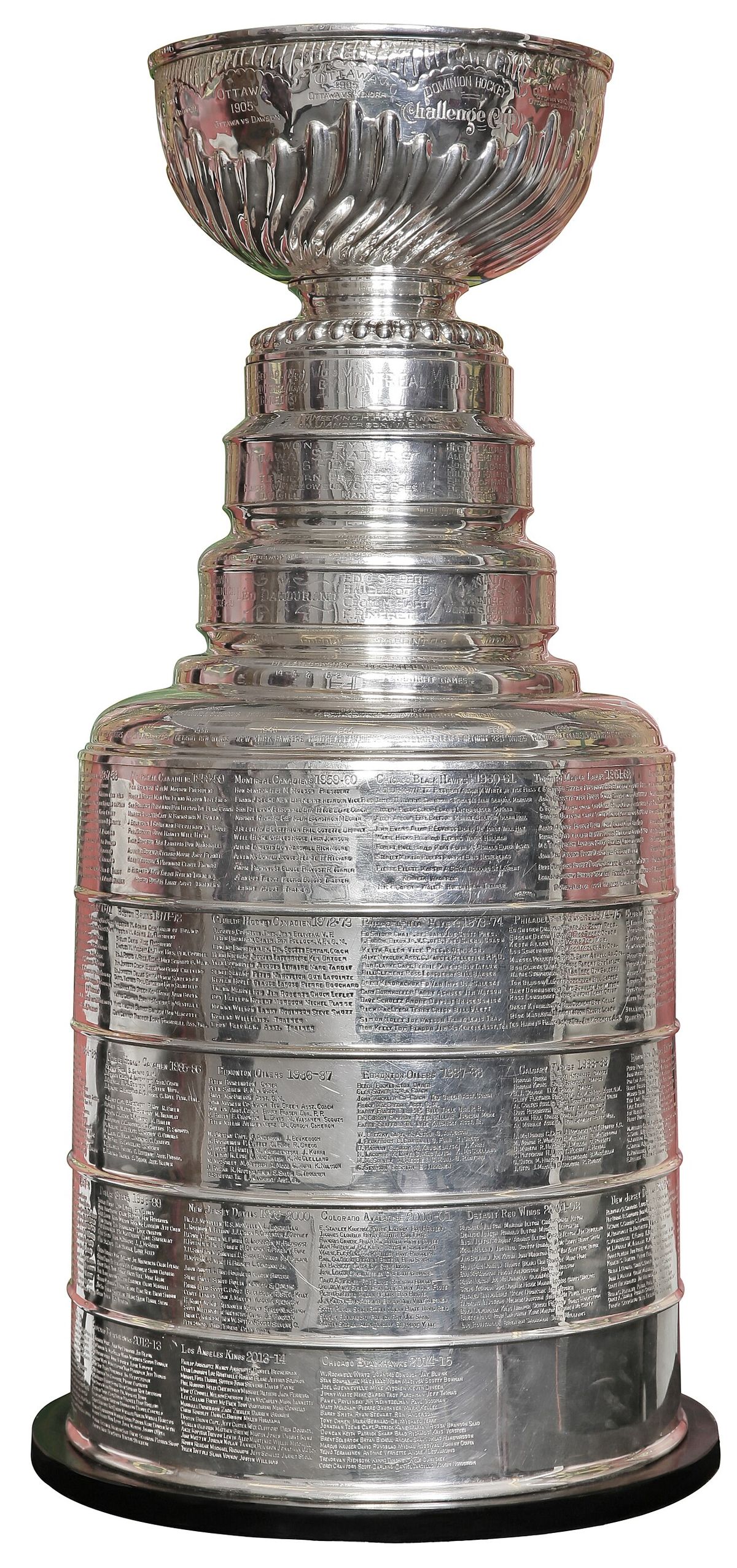
The Stanley Cup was presented to Oilers captain Wayne Gretzky by NHL President John Ziegler following the game seven victory. The names of the players and staff from the 1986-87 Edmonton Oilers were engraved on the trophy. The championship roster included the core of Hall of Famers who defined the era, along with key role players like Kevin Lowe, Marty McSorley, and Esa Tikkanen. Notably, winger Wayne Van Dorp, who played three regular-season games and three games in the Conference Finals, did not meet the minimum games requirement to have his name engraved on the Cup. The victory marked the Oilers' third title in four years, a run that would expand to five championships in seven years by 1990.
The statistical story of the series reveals the tight nature of the competition despite the Oilers' territorial dominance in the final game. The Flyers were outshot in several games, including a 15-5 deficit in the first period of game six, but were repeatedly bailed out by Ron Hextall. The series highlighted the evolution of the Oilers from a purely offensive juggernaut to a more balanced team capable of strong defensive play, a maturity that was evident in their ability to lock down the Flyers in the third period of game seven. The table below summarizes the results and locations for each game of the series.
| Game | Date | Location | Result | Series |
|---|---|---|---|---|
| 1 | May 17 | Northlands Coliseum | Oilers 4, Flyers 2 | EDM 1-0 |
| 2 | May 20 | Northlands Coliseum | Oilers 3, Flyers 2 (OT) | EDM 2-0 |
| 3 | May 22 | Spectrum | Flyers 5, Oilers 3 | EDM 2-1 |
| 4 | May 24 | Spectrum | Oilers 4, Flyers 1 | EDM 3-1 |
| 5 | May 26 | Northlands Coliseum | Flyers 4, Oilers 3 | EDM 3-2 |
| 7 | May 31 | Northlands Coliseum | Oilers 3, Flyers 1 | EDM 4-3 |
Questions about 1987 Stanley Cup Final
Who won the 1987 Stanley Cup Final?
The Edmonton Oilers won the 1987 Stanley Cup Final. They defeated the Philadelphia Flyers in seven games, securing their third championship in four seasons. The Oilers had built a 3-1 series lead but lost the next two games, forcing a decisive game seven which they won 3-1 on May 31, 1987. This was the first seven game Final since 1971. The victory was presented on Alberta ice, continuing a trend of the Cup being awarded there.
What happened in Game 3 of the 1987 Stanley Cup Final?
In Game 3, the Philadelphia Flyers staged a historic comeback to win 5-3 after trailing 3-0. The Edmonton Oilers built a 3-0 lead on goals from Mark Messier, Paul Coffey, and Glenn Anderson. The Flyers then rallied with second-period goals from Murray Craven and Peter Zezel, followed by two quick third-period goals from Scott Mellanby and Brad McCrimmon 17 seconds apart to take the lead. Brian Propp added an empty-net goal to seal the victory. This was the first time a team had rebounded from a 3-0 deficit to win a game in the Final.
What was significant about the goaltenders' equipment in the 1987 Final?
The 1987 Final was the first where both starting goalies wore the full fiberglass cage mask, now standard in hockey. Edmonton's Grant Fuhr had worn a face-hugging mask in his three previous Finals but switched to the full cage in the 1985-86 season. Philadelphia's Ron Hextall also wore the full cage. Patrick Roy was the second goalie to wear it in a Final the previous year, while Gilles Meloche of the Minnesota North Stars was the first in 1981.
How was the 1987 Stanley Cup Final broadcast in Canada?
In Canada, the English-language broadcast rights for the 1987 Final were split between two networks. The CBC exclusively aired games one, two, and six, while Global exclusively televised games three, four, and five. The decisive Game Seven was broadcast simultaneously by both the CBC and Global networks, with each using its own separate production facilities and on-air talent. This was the first of two consecutive years the Final was split between the Global-Canwest consortium and the CBC.
Why was the 1987 Stanley Cup Final considered a significant rematch?
The 1987 Stanley Cup Final was a rematch of the 1985 Final between the Edmonton Oilers and Philadelphia Flyers. This was the second time these two teams met for the championship in three years. Unlike the 1985 series which the Oilers won in five games, the 1987 series extended to a full seven games, making it the first seven game Final since 1971. The Oilers ultimately prevailed again, winning their third Stanley Cup in four seasons. This rematch highlighted the ongoing rivalry between the league's top offensive team and a gritty defensive squad.
How did the Edmonton Oilers and Philadelphia Flyers reach the 1987 Final?
The Oilers and Flyers finished the regular season with the two best records in the NHL for the third straight year. The Oilers cruised into the Final, losing only two playoff games total by beating the Los Angeles Kings in five, sweeping the Winnipeg Jets, and defeating the Detroit Red Wings in five. The Flyers had a much harder path, requiring six games to beat the New York Rangers, a full seven games to defeat the New York Islanders, and six games to overcome the reigning champion Montreal Canadiens. This set up a final between the league's top offensive team and a resilient defensive club.
Sources and further reading
- 1987 Stanley Cup Final (Wikipedia)
- 1987 Stanley Cup Finals: Was It the Best Playoff Series In ... (bleacherreport.com)
- 1987 NHL Stanley Cup Final: EDM vs. PHI (hockey-reference.com)
- BLOG: Oilers-Flyers 1987 Stanley Cup Final to be played ... (nhl.com)
Checked by the Garbutt Disposal desk. Last updated 2026-10-24.