Battle of Alberta
The Battle of Alberta is the intense rivalry between the Canadian cities of Calgary and Edmonton, the two largest metropolitan centres in the province of Alberta. While most prominently expressed through sporting competitions between professional and amateur teams, the rivalry has deep historical roots in the differing patterns of settlement, economic development, and political culture of northern and southern Alberta. It is a defining feature of provincial identity, generating passionate fan engagement and a friendly but persistent civic competition. The rivalry manifests across multiple sports leagues, including the National Hockey League and Canadian Football League, and extends to competition for hosting major cultural and sporting events.
Historical and Cultural Origins
The rivalry between Calgary and Edmonton is grounded in a longstanding cultural and geographical divide within Alberta that predates the cities themselves. Historian Harvey Locke identifies distinct pre-contact lifestyles between the boreal forest and parkland peoples of the north, who engaged in trapping and the fur trade, and the plains cultures of the south, who relied on the buffalo. This division was reinforced during the fur trade era, as the Hudson's Bay Company established Edmonton House in 1795 but was largely excluded from Blackfoot territory to the south, with the Battle River serving as a disputed frontier between the Iron Confederacy and Blackfoot Confederacy by the 1810s. The critical turning point in modern settlement patterns came in the 1880s with the Canadian Pacific Railway's decision to route its transcontinental line through Calgary instead of a more northerly path via Edmonton. This decision made Calgary a major railway hub and accelerated the settlement of its agricultural hinterland, primarily by immigrants of British and American origin, fostering a ranching culture. In contrast, Edmonton and northern Alberta, served later by other railways under a federal Liberal government, saw greater settlement by French Canadians, Métis, and immigrants from non-British European regions, particularly Ukraine in the Kalyna Country area, creating a more ethnically diverse population base.
These foundational differences were cemented by political contests following Alberta's creation in 1905. The federal Liberal government, which had encouraged broader European immigration, selected Edmonton as the provincial capital, a decision that infuriated Calgary's elite. The rivalry was further stoked when Edmonton's neighbour, the then-separate city of Strathcona, was chosen as the site for the University of Alberta. Economically, Calgary gained an early advantage with the 1914 discovery of the Turner Valley oil field, decades before the 1947 Leduc strike near Edmonton. This led to Calgary becoming the headquarters centre for large corporations, while Edmonton developed as the research, manufacturing, and refining hub, processing roughly 80 percent of Canada's oil through Refinery Row in Strathcona County. These historical currents established the enduring political character of the two cities, with Calgary tending toward conservatism and Edmonton toward more progressive politics, a dynamic that continues to inform the subtle, underlying civic rivalry that persists today outside of sporting events.
Football Rivalry
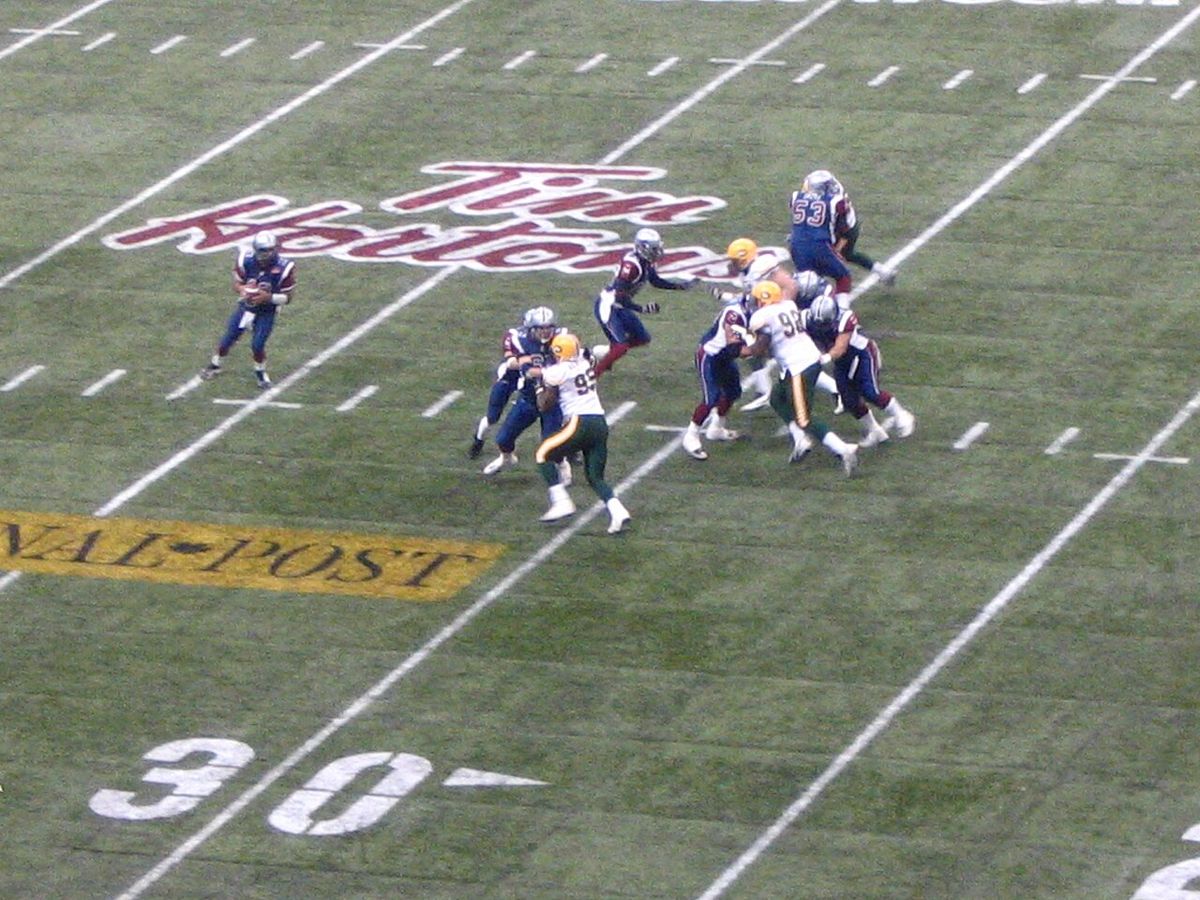
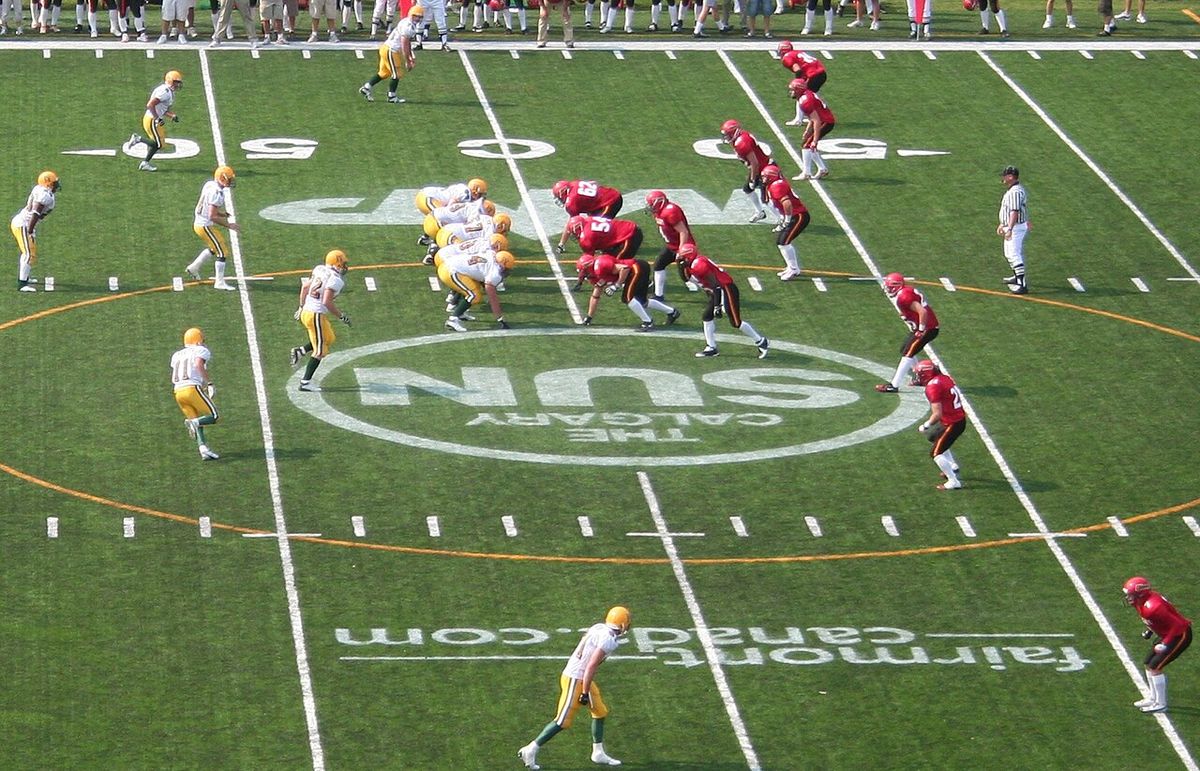
The football rivalry between Calgary and Edmonton is one of the oldest and most sustained expressions of the Battle of Alberta, with recorded games dating to 1891 when Edmonton beat Calgary 6-5 in a total point challenge series. The first organized teams emerged in the early 20th century within the Alberta Rugby Football Union, with clubs like the Calgary Tigers and Edmonton Esquimaux forming after the Calgary City Rugby Football Club and Edmonton Rugby Football Club were established. The nickname 'Eskimos' originated from Calgary media in the 1890s referencing Edmonton's northern latitude, and a team using that name won the ARFU title in 1921. The rivalry found a permanent footing with the formation of the Western Interprovincial Football Union, a precursor to the Canadian Football League. The modern incarnation began in 1948 when the Calgary Stampeders, formed from the earlier Calgary Bronks, joined the WIFU and immediately won the Grey Cup that same year, becoming the first Calgary team to compete for and win the championship.
The following season, in 1949, the current Edmonton Elks franchise (originally the Eskimos) was founded, and the two teams have been fierce rivals ever since. A central feature of the CFL calendar is the annual Labour Day Classic, where the Stampeders host the Elks on the Monday holiday, followed by a rematch in Edmonton a few days later, a tradition unbroken since 1982 and held every year since 1949 with only eleven exceptions prior to 1982. As of the 2026 CFL season, the Elks hold the all-time advantage in the series with a record of 134 wins, 109 losses, and 3 ties. In playoff meetings, the two teams have faced each other 27 times, with Edmonton holding a slight edge of 14 victories. The period from 1990 to 2003 was particularly dominant for Alberta football, as the West Final was contested between Calgary and Edmonton nine times, guaranteeing an Alberta team in the Grey Cup each of those years. While the Stampeders won the most recent championship in 2018, the Elks have won more Grey Cups overall, with 14 titles to Calgary's eight as of 2021.
- First intercity game: 1891 (Edmonton defeated Calgary 6-5).
- First Grey Cup appearance by an Alberta team: 1921 (Edmonton Eskimos, lost 9th Grey Cup).
- First Grey Cup win by an Alberta team: 1948 (Calgary Stampeders, 36th Grey Cup).
- Labour Day Classic tradition began: 1949 (Stampeders won 20-6).
- Elks' playoff streak: 34 consecutive seasons (1972 to 2005).
- Stampeders' recent playoff streak: Qualified every season from 2005 to 2023.
- Most recent playoff meeting: 2017 West Final (Calgary won).
- Most recent Grey Cup win by either team: 2018 (Calgary Stampeders, 106th Grey Cup).
Hockey Rivalry
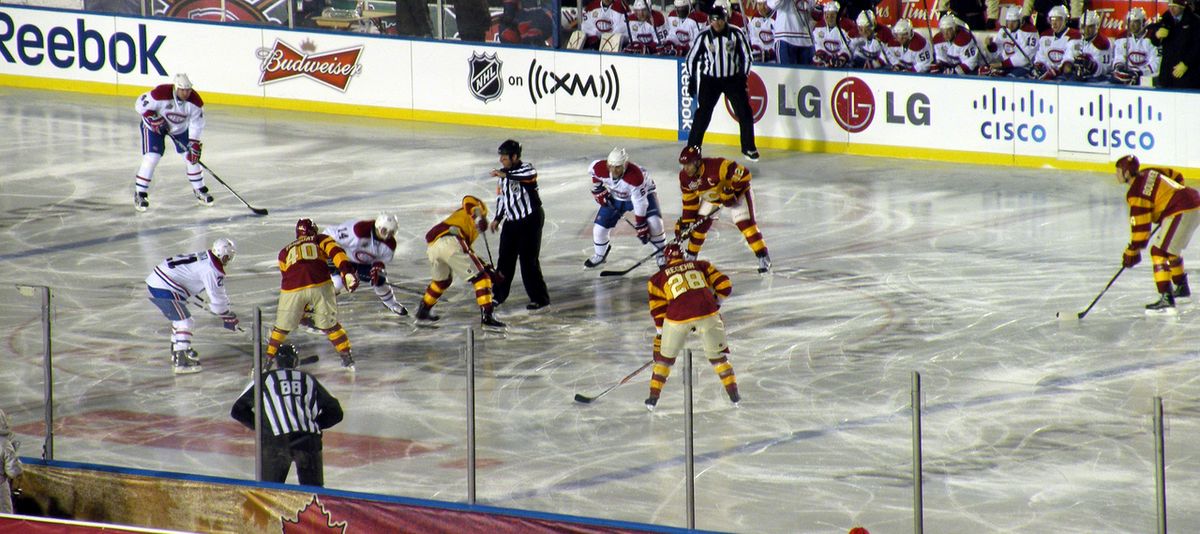
The hockey rivalry, known specifically as the Battle of Alberta, is the most famous sporting conflict between the two cities, primarily between the National Hockey League's Calgary Flames and Edmonton Oilers. The first recorded hockey game between teams from the cities occurred in the first week of March 1895 when a team of Calgarians, mostly from the Calgary Fire Brigade, travelled to Edmonton and shut out both a Mounted Police team from Fort Saskatchewan and the Edmonton Thistles. The Eskimos lost in 1923 and the Tigers in 1924. The modern NHL rivalry ignited after the 1979 WHA-NHL merger, which brought the Oilers into the league, followed by the Flames' relocation from Atlanta to Calgary in 1980, though earlier WHA attempts with the Calgary Cowboys from 1975 to 1977 were short-lived and the original Calgary Broncos folded in 1972 before playing a game.
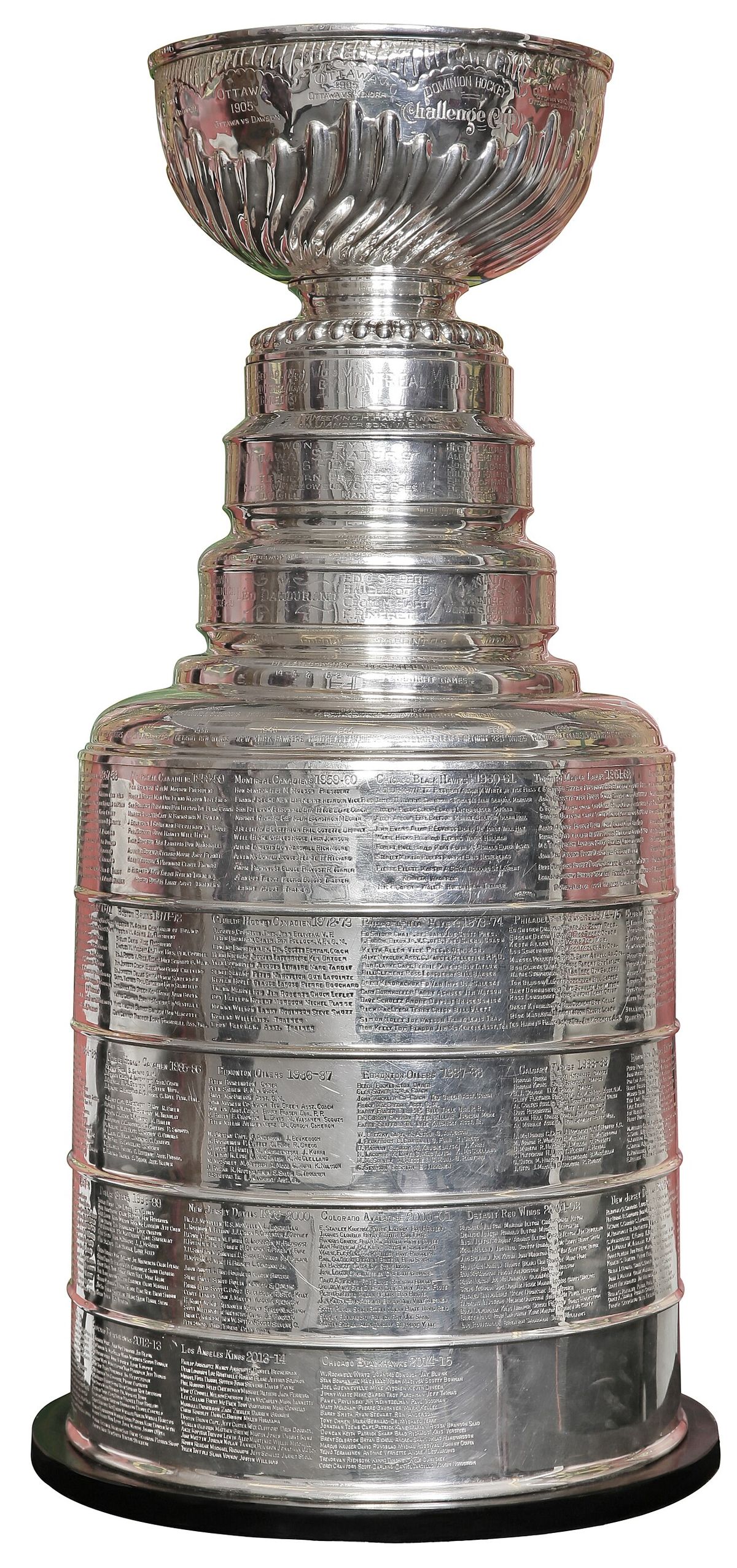
The rivalry reached its zenith in the 1980s, a period of unprecedented dominance for Alberta hockey where from 1983 to 1990 the Western Conference champion was either Calgary or Edmonton every single year. The two teams met in the playoffs five times during that era, with three of those series requiring the full seven games to decide. The on-ice battles were fierce and often violent, featuring legendary players like Wayne Gretzky, Mark Messier, and Jari Kurri for Edmonton, and Lanny McDonald, Joe Nieuwendyk, and Al MacInnis for Calgary. Edmonton captured the Stanley Cup in 1984, 1985, 1987, 1988, and 1990, while Calgary won its lone championship of the era in 1989, breaking the Oilers' potential five-in-a-row streak. In the regular season, the Flames lead the all-time series with a 141 to 129-18-6 record, but the Oilers hold a decisive 23-12 advantage in playoff victories, which reflects their playoff success during the dynasty years.
| Team | Stanley Cup Wins (1980s Era) | Playoff Series Wins (vs. rival, 1980s) | Notable WCHL Precedent |
|---|---|---|---|
| Edmonton Oilers | 5 (1984, 1985, 1987, 1988, 1990) | 4 | Edmonton Eskimos (WCHL title 1923) |
| Calgary Flames | 1 (1989) | 1 | Calgary Tigers (Stanley Cup finalist 1924) |
Other Sports Rivalries and the Alberta Games
Beyond football and hockey, the Battle of Alberta has manifested in other professional and amateur sports, though often with less longevity. In baseball, the most prominent rivalry existed between the Triple-A Pacific Coast League's Calgary Cannons (1985 to 2002) and Edmonton Trappers (1980 to 2004). The Trappers won four PCL championships during their tenure, while the Cannons won none, and both franchises eventually relocated to the United States, the Trappers to Round Rock, Texas and the Cannons to Albuquerque, New Mexico. A brief revival occurred in 2011 in the independent North American League, pitting the Calgary Vipers against the Edmonton Capitals. The Capitals won a playoff series in six games that year before both teams folded or suspended operations by 2012. In junior hockey, the Western Hockey League features five Alberta-based teams in one division, ensuring frequent intra-provincial competition among the Calgary Hitmen, Edmonton Oil Kings, Medicine Hat Tigers, Lethbridge Hurricanes, and Red Deer Rebels, with the original Oil Kings facing the Calgary Centennials from 1966 to 1976.
The rivalry also plays out at the amateur level through the Alberta Games, a major provincial multi-sport program for youth. The 2026 Alberta Winter Games were held in the Lakeland Region from February 13 to 16, while the 2026 Alberta Summer Games are scheduled for Strathcona County from July 16 to 19. These events foster competition among the province's eight geographic zones, with Zone 3 (Calgary) and Zone 6 (Edmonton) often among the top performers. At the 2026 Winter Games, Zone 6 won the Alberta Cup for overall performance, Zone 4 won the Minister's Cup for most improved from the 2024 Games, and Zone 2 won the Spirit of Sport Award. In contrast, at the 2024 Winter Games, Zone 3 (Calgary) had won the Alberta Cup and Zone 8 (Peace Country) won the Minister's Cup and Spirit of Sport Award. The games serve as a developmental pipeline, with 50 alumni from the Winter Games program having gone on to represent Canada at the Olympic and Paralympic Games, and 14 sports were represented at the 2023 Alberta Summer Games.
- Baseball (PCL): Edmonton Trappers (4 championships), Calgary Cannons (0 championships).
- Baseball (NAL): 2011 playoff series won by Edmonton Capitals over Calgary Vipers.
- WHL Alberta Teams: Calgary Hitmen, Edmonton Oil Kings, Medicine Hat Tigers, Lethbridge Hurricanes, Red Deer Rebels.
- 2026 Alberta Winter Games Host: Lakeland Region (February 13-16, 2026).
- 2026 Alberta Summer Games Host: Strathcona County (July 16-19, 2026).
- 2026 Winter Games Alberta Cup Winner: Zone 6 (Edmonton area).
- 2024 Winter Games Alberta Cup Winner: Zone 3 (Calgary area).
Competition for Events and Cultural Distinction
The civic rivalry extends beyond team sports to a continuous competition to host major national and international events, each city striving to prove its status and attract tourism and investment. Calgary's most significant coup was hosting the 1988 Winter Olympics, cementing its reputation as a winter sports hub and leading to it becoming an annual stop for bodies like the International Skating Union and International Bobsleigh and Skeleton Federation. The city also hosted the 1996 International Rotarian Convention, the 1997 World Police and Fire Games, the 2009 World Skills competition, and the 2015 World Handball Championships. It was designated Canada's Cultural Capital in 2012, receiving $1.6 million in federal funding, and is home to the globally recognised Calgary Stampede. Edmonton, known as Canada's Festival City due to its large number of annual events, counters with a vast array of cultural festivals, including the Edmonton International Fringe Festival and Folk Music Festival in August and K-Days in July, and it also hosted the Canadian Finals Rodeo from 1974 to 2017.
Edmonton's major event portfolio includes the 1978 Commonwealth Games, the 1983 World University Games, the 2001 World Championships in Athletics, the 2005 World Masters Games, and it was a host city for the 2015 FIFA Women's World Cup. The city also had the Edmonton Indy race from 2005 to 2012 and the Archdiocese of Edmonton hosted papal visits from John Paul II in 1984 and Pope Francis in 2022. This one-upmanship occasionally led to direct clashes, most notably in 2009 when both cities launched competing bids for Expo 2017. Edmonton's city council approved its bid first on April 15, 2009, but Calgary announced its own bid shortly after. The rivalry intensified when the provincial government provided funding for Edmonton's bid but not Calgary's, leading Calgary to withdraw. Ultimately, the federal government withdrew funding entirely, and the exposition was awarded to Astana, Kazakhstan. In recent years, the cities have shown more cooperation, as demonstrated by their successful joint bid to host the 2012 World Junior Ice Hockey Championships, though the underlying drive for civic prestige remains.
The Rivalry in the Modern Era and Its Enduring Nature
While the historical animosities have mellowed into a generally friendly and often humorous civic competition, the Battle of Alberta remains a potent force in Canadian sports culture. The professional rivalries in the CFL and NHL continue to drive media attention and fan engagement across the province and the country. The CFL's Labour Day home-and-home series remains a marquee event on the national sports calendar, with the short turnaround between games creating a unique strategic challenge for the coaching staffs and players. In the NHL, after a long period where both teams were rarely competitive simultaneously, the rise of new generations of star players has rekindled excitement and relevance for Flames-Oilers matchups.
The rivalry also thrives at the community and amateur levels through events like the Alberta Games, which channel competitive spirit into positive development for young athletes from all eight zones. The consistent political and cultural differences between the cities, rooted in their distinct 19th century histories of railway development, immigration, and resource economics, ensure that the Battle of Alberta is more than just sports. It is a reflection of Alberta's regional identities, with Calgary's corporate, conservative south contrasting with Edmonton's governmental, progressive, and ethnically diverse north. Whether expressed through the roar of a packed stadium during a Flames-Oilers game, the strategic battle of a Labour Day Classic, or the friendly taunts between neighbours, the competition between Calgary and Edmonton continues to be a defining and enduring element of life in the province. The unspoken rivalry persists on a subtle level in daily life, but it is during sporting events that this deep-seated provincial divide finds its most vocal and passionate expression, engaging new generations of fans and athletes alike.
Questions about Battle of Alberta
What is the Battle of Alberta?
The Battle of Alberta is the intense rivalry between the cities of Calgary and Edmonton, encompassing sports, culture, and civic pride. It most famously refers to the hockey rivalry between the NHL's Calgary Flames and Edmonton Oilers and the football rivalry between the CFL's Calgary Stampeders and Edmonton Elks. The conflict has deep historical roots in the differing settlement patterns, economic development, and political cultures of northern and southern Alberta. While often expressed through passionate sporting competitions, it also manifests in competition to host major events and a persistent, though generally friendly, civic one-upmanship.
Which team has won more Stanley Cups, the Flames or Oilers?
The Edmonton Oilers have won significantly more Stanley Cup championships than the Calgary Flames. During the peak of the rivalry in the 1980s, the Oilers won the Stanley Cup five times, in 1984, 1985, 1987, 1988, and 1990. The Calgary Flames won their sole championship of that era in 1989. The Oilers' dynasty, led by Wayne Gretzky and Mark Messier, established their supremacy in the head-to-head playoff battles of the period.
What is the Labour Day Classic in the CFL?
The Labour Day Classic is an annual Canadian Football League tradition featuring the Calgary Stampeders and Edmonton Elks. It began in 1949, the year the modern Elks franchise was founded, and has been played nearly every year since, with an unbroken run from 1982 onward. The Stampeders host the game on the Labour Day Monday holiday, followed by a rematch in Edmonton a few days later, creating a short turnaround and intense focus for both teams. This home-and-home series is one of the CFL's most anticipated and watched events, embodying the spirit of the football Battle of Alberta.
Have Calgary and Edmonton ever directly competed to host a major event?
Yes, the most notable direct competition was for the right to host Expo 2017. In 2009, Edmonton's city council approved a bid for the world exposition. Shortly after, Calgary announced its own bid, despite not having expressed prior interest. The rivalry escalated when the provincial government provided funding for Edmonton's bid but not Calgary's, leading Calgary to withdraw its proposal. Ultimately, the bid process collapsed when the federal government also withdrew funding, and Expo 2017 was awarded to Astana, Kazakhstan. This incident highlighted the intense civic competition that exists outside of sports.
What are the Alberta Games and how do they relate to the rivalry?
The Alberta Games are major provincial multi-sport competitions held for youth, with separate Winter and Summer Games. They feature athletes from eight zones across Alberta, with Zone 3 representing the Calgary area and Zone 6 representing the Edmonton area. The games foster healthy competition and development, with awards like the Alberta Cup for overall zone performance often contested between these two regions. For example, Zone 6 (Edmonton area) won the Alberta Cup at the 2026 Winter Games, while Zone 3 (Calgary) had won it at the 2024 Winter Games. The games are a modern, constructive outlet for the province's competitive spirit.
How did the historical differences between Calgary and Edmonton develop?
The fundamental differences stem from geography, settlement patterns, and economic decisions in the 19th century. Calgary's development was triggered by the Canadian Pacific Railway choosing a southern route in the 1880s, attracting British and American settlers and establishing a ranching economy. Edmonton, older and a fur trade hub, became a gateway for northern settlement and later attracted diverse European immigrants, especially Ukrainians. The federal government's choice of Edmonton as the provincial capital in 1905 and Strathcona for the University of Alberta deepened Calgary's resentment. Economically, Calgary became a corporate head office centre after early oil discoveries, while Edmonton evolved into the industry's research and refining heartland.
Sources and further reading
- Battle of Alberta (Wikipedia)
- BATTLE OF ALBERTA REVITALIZED WITH YOUNG TALENT (nhl.com)
Checked by the Garbutt Disposal desk. Last updated 2026-10-30.