2006 Stanley Cup Final
The 2006 Stanley Cup Final was the championship series of the National Hockey League's 2005-06 season, concluding the playoffs after a year-long lockout cancelled the previous campaign. It was contested between the Eastern Conference champion Carolina Hurricanes and the Western Conference champion Edmonton Oilers. The Hurricanes defeated the Oilers in seven games to capture the franchise's first Stanley Cup, delivering the first major professional sports championship for the state of North Carolina. The series was notable for its dramatic swings, historic individual performances, and for featuring two former World Hockey Association franchises that had both missed the playoffs prior to the lockout.
Paths to the Final
The Carolina Hurricanes entered the 2006 playoffs as the Southeast Division champions and the second seed in the Eastern Conference. Their playoff journey began with a six-game victory over the seventh-seeded Montreal Canadiens in the first round. They then dispatched the third-seeded New Jersey Devils in five games in the second round. The Eastern Conference Final proved to be a tough seven-game battle against the fourth-seeded Buffalo Sabres, which the Hurricanes won to advance to their second Stanley Cup Final in five years. The Edmonton Oilers' path was far more improbable, as they qualified as the eighth and final seed in the Western Conference. They immediately pulled off a major upset by defeating the Presidents' Trophy-winning Detroit Red Wings in six games in the opening round. After falling behind two games to none against the fifth-seeded San Jose Sharks in the second round, the Oilers rallied to win the series in six games. They then secured their place in the Final by beating the sixth-seeded Mighty Ducks of Anaheim in five games in the Western Conference Final.
This playoff run made the Oilers the first eighth seed in NHL history to reach the Stanley Cup Final, a feat that would later be matched by the Los Angeles Kings in 2012, the Nashville Predators in 2017, and the Florida Panthers in 2023. The matchup between Carolina and Edmonton was unique, as it was the first Stanley Cup Final contested by two teams that had both missed the playoffs in the season prior to the 2004-05 lockout. Both teams would also go on to miss the playoffs again the following season, a dubious achievement previously only accomplished by the 1939 Chicago Blackhawks. The series was also the first and only Final matchup between teams that entered the NHL in 1979.

Series Summary and Key Themes
The 2006 Stanley Cup Final was a clash of contrasting styles and narratives, marked by significant injuries and historic firsts. As a result of the NHL's new scheduling format, the Hurricanes and Oilers had not faced each other during the regular season. The series was the first Final matchup between two franchises that originated in the World Hockey Association, which had merged with the NHL in 1979. A defining moment occurred early in Game 1 when Oilers starting goaltender Dwayne Roloson suffered a series-ending knee injury, forcing backup Jussi Markkanen into action. This injury dramatically altered Edmonton's fortunes and led to three different goaltenders being used in the Final, a rarity not seen since 1970.
Special teams played a crucial role throughout the series. Edmonton's power play struggled immensely early on, going 1-for-25 through the first four games. Conversely, the series featured remarkable short-handed drama, including the first short-handed overtime goal in Final history. The contest also pitted veteran players seeking their first championship against a Cinderella Oilers squad trying to complete an unlikely run. Hurricanes head coach Peter Laviolette joined a select group by coaching in both the Stanley Cup Final and the Olympics in the same year, having led the United States team at the Torino Games earlier in 2006. Both teams had also missed the playoffs the season before the lockout, adding to the unpredictable nature of the series.
Game-by-Game Recaps
Game 1: In Raleigh, the Oilers built a 3-0 lead in the second period. Carolina staged a historic comeback, tying the biggest deficit overcome in a Final, to win 5-4. The winning goal came with 32 seconds left after backup goalie Ty Conklin misplayed the puck, allowing Rod Brind'Amour to score into an empty net. Edmonton's Dwayne Roloson was injured late in the third period.
With Dwayne Roloson injured, Jussi Markkanen started in goal for the Edmonton Oilers in Game 2. Late in the third period, Edmonton forward Georges Laraque checked Carolina forward Andrew Ladd into the boards, resulting in a major penalty and Laraque being ejected from the game. The Carolina Hurricanes went on to shut out the Oilers with a 5-0 victory. Five different Carolina players scored goals in the game. Hurricanes goaltender Cam Ward made 25 saves to record his second shutout of the postseason.
Jussi Markkanen once again started in net for Edmonton with Roloson still out for Game 3. Shawn Horcoff scored just over two minutes into the first period to give the Oilers the lead. The Carolina Hurricanes responded in the third period as their captain, Rod Brind'Amour, scored to tie the game. However, with 2:15 left in the game, Edmonton's Ryan Smyth scored the winning goal after crashing into goaltender Cam Ward inside the crease as they both tried to get control of a rebound.
In Game 4, the Edmonton Oilers got off to a good start when Sergei Samsonov opened the scoring in the first period. However, the lead was short-lived as Carolina's Cory Stillman replied just 29 seconds later to tie the game. Stillman also made a sound defensive play late in the second period, tipping the puck to the front of the net where Eric Staal fed a pass to Mark Recchi. Recchi scored the eventual game-winning goal with 4:08 to go in the second period, giving the Carolina Hurricanes a 2-1 victory and a 3-1 series lead.
In Game 5, the Carolina Hurricanes had a chance to win the Stanley Cup on home ice with a 3-1 series lead. The Edmonton Oilers scored first just 16 seconds into the game. The teams exchanged goals, and the game went to overtime tied 3-3. Early in the overtime period, Edmonton's Steve Staios drew a penalty to put Carolina on the power play. Fernando Pisani then intercepted a cross-ice pass from Cory Stillman and scored a short-handed goal. This was the first short-handed overtime goal in Stanley Cup Final history, giving the Oilers a 4-3 victory and staving off elimination.
The Edmonton Oilers dominated Game 6 in front of their home crowd at Rexall Place, shutting out the Carolina Hurricanes 4-0 to tie the series. Fernando Pisani scored his post-season high fifth game-winning goal for the Oilers. Edmonton limited the Hurricanes to only 16 shots on goal throughout the game. Oilers goaltender Jussi Markkanen made all necessary saves to earn his first career playoff shutout in the victory.
The Carolina Hurricanes returned to the RBC Center and defeated the Edmonton Oilers 3-1 in Game 7 to win the Stanley Cup. Defensemen Aaron Ward and Frantisek Kaberle scored to give Carolina a 2-0 lead. Edmonton's Fernando Pisani scored early in the third period to cut the lead in half. With just over a minute remaining in regulation, the Oilers pulled their goalie. Justin Williams then received a pass, skated the length of the ice, and tapped the puck into the empty net to seal the championship victory for the Hurricanes.
Individual Accolades and Records
The 2006 playoffs saw several individual players achieve significant milestones. Carolina goaltender Cam Ward, a rookie, was awarded the Conn Smythe Trophy as playoff MVP. He became the first rookie goalie to win the Stanley Cup since Patrick Roy in 1986 and the first rookie to win the Conn Smythe since Ron Hextall in 1987. Hurricanes centre Eric Staal, at 21 years and eight months old, became the youngest player to lead the playoffs in scoring since Gordie Howe in 1949. Veteran defenceman Glen Wesley ended an 18-year drought without winning the Cup, having played nearly 1,500 combined regular season and playoff games before his first championship, the longest such wait in NHL history at the time.
Several players achieved unique personal milestones during or after the series. Cory Stillman won the Stanley Cup for the second consecutive season, having won with Tampa Bay in 2004, becoming the first player to win back-to-back titles with different teams since Claude Lemieux. Frantisek Kaberle became the first player to win an Olympic bronze medal (with the Czech Republic) and the Stanley Cup in the same calendar year. Peter Laviolette became the second American-born head coach to win the Stanley Cup. The series also featured notable scoring achievements from players on both sides, including Fernando Pisani's playoff-leading 13 goals for Edmonton.
- Cam Ward (CAR): Conn Smythe Trophy winner as playoff MVP.
- Eric Staal (CAR): Led playoffs in scoring. Youngest to do so since 1949.
- Fernando Pisani (EDM): Scored 13 playoff goals, leading all players. Scored first short-handed OT goal in Final history.
- Glen Wesley (CAR): Won first Cup after record 18-year wait.
- Cory Stillman (CAR): Won second straight Cup with different teams.
- Rod Brind'Amour (CAR): Team captain. Scored Cup-winning goal in Game 7.
Broadcast and Viewership
The 2006 Stanley Cup Final marked a shift in American television coverage, becoming the first Final broadcast on NBC and the cable channel OLN (which later became Versus and then NBC Sports Network). Games 1 and 2 aired on OLN, while the remainder of the series, including the decisive Game 7, was broadcast on NBC. NBC's broadcast of Game 7 earned a 3.3 rating, which represented a 21 percent decline from the 4.2 rating for Game 7 of the 2004 Final on ABC. Over its five telecasts, NBC averaged a 2.3 rating, down 12 percent from ABC's average in 2004. In Canada, the CBC's coverage of Game 7, which included extensive pre-game and post-game shows, attracted an average of 4.739 million viewers. The game itself drew a peak audience of 5.553 million viewers, demonstrating the significant national interest in the series. Some NBC affiliates did not air Game 7 live, which may have affected the U.S. ratings.
The Stanley Cup Engraving
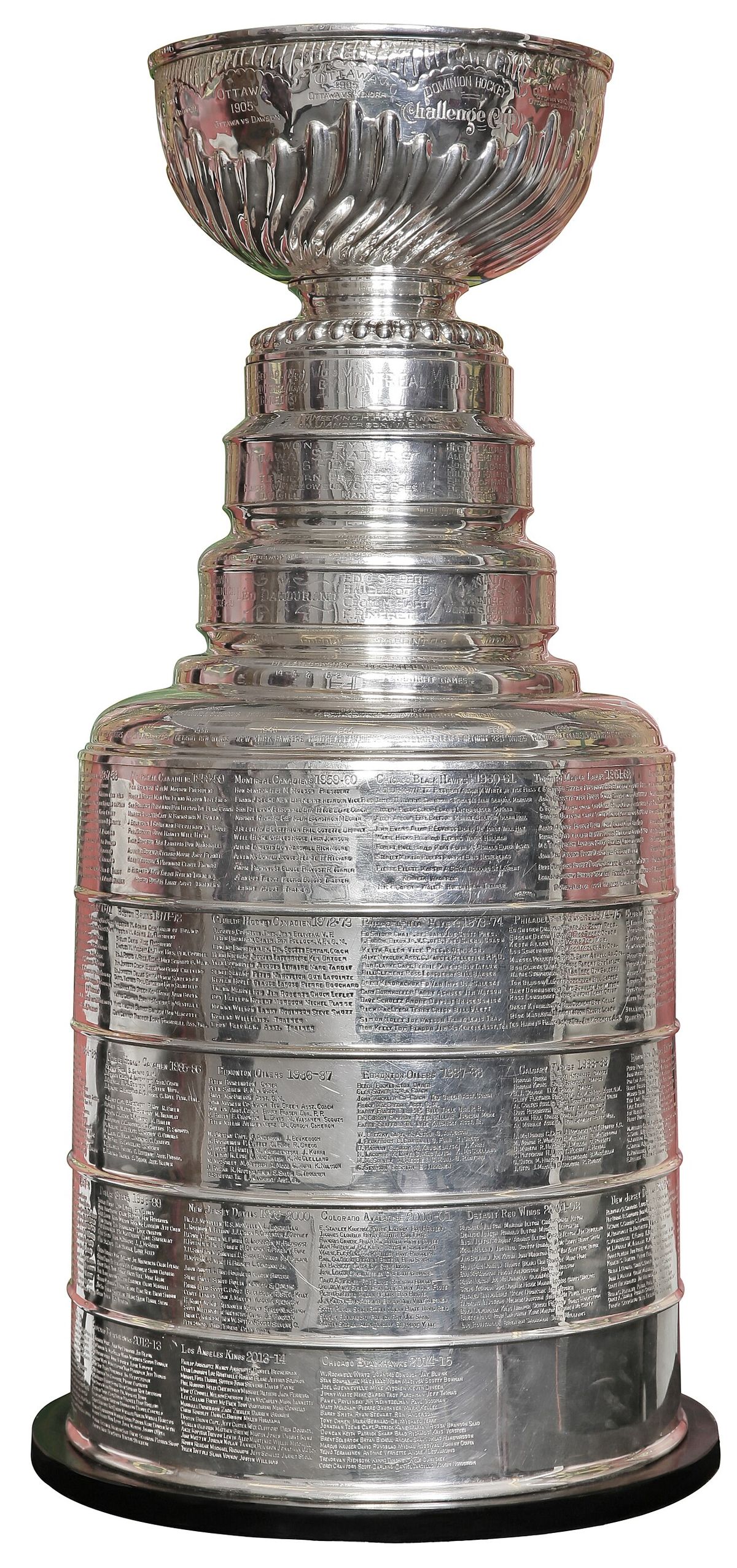
Following the Game 7 victory, NHL Commissioner Gary Bettman presented the Stanley Cup to Hurricanes captain Rod Brind'Amour. The names of the players, coaches, and staff from the championship team were then engraved on the trophy. The Hurricanes successfully petitioned for exemptions to include defencemen Anton Babchuk and Andrew Hutchinson, who did not meet the automatic qualification criteria but had played regular season games for the team. A notable engraving error occurred when Eric Staal's name was initially misspelled as 'ERIC STAAAL'. Engraver Louise St. Jacques was able to correct the mistake. The ring containing champions from 1940-41 to 1952-53 was retired to make room for the new champions, and due to the previous season's lockout, the inscription '2004-05 season not played' was added to the Cup.
The championship roster included several players with long connections to the franchise. Nine players remained from the Hurricanes team that lost the 2002 Final to Detroit, including Craig Adams, Kevyn Adams, Rod Brind'Amour, Erik Cole, Bret Hedican, Josef Vasicek, Niclas Wallin, Glen Wesley, and Aaron Ward. Craig Adams became the first player born in Brunei to have his name on the Cup. Veteran Mark Recchi won his second Cup, his first having come 15 years earlier with the Pittsburgh Penguins in 1991. The victory made the Hurricanes the third former World Hockey Association franchise to win the Stanley Cup, following the Edmonton Oilers and the Quebec Nordiques (who won as the Colorado Avalanche). Several team doctors were left off the engraving but received championship rings and were in the team photo.
Historical Context and Aftermath
The Hurricanes' victory held great significance for the state of North Carolina, delivering its first major men's professional sports championship. The win remained the only 'Big Four' championship for an active North Carolina team until the Hurricanes won again in 2026. For the Oilers, the loss ended a remarkable underdog run and denied General Manager Kevin Lowe and Head Coach Craig MacTavish the chance to join a very exclusive group of individuals who had won the Stanley Cup together as both players and as a coach-managerial duo. Game 6 in Edmonton turned out to be the final playoff game ever held at Rexall Place, as the Oilers did not return to the postseason until 2017, by which time they had moved to Rogers Place.
The series also continued a pattern for Alberta-based teams, as it marked the second consecutive Final where a team from the province lost in seven games to the champion from the Southeast Division, following the Calgary Flames' loss to Tampa Bay in 2004. For the Hurricanes, the core of the championship team provided a foundation for continued competitiveness, though they would not win another Cup for two decades. The 2006 Final is remembered as a dramatic, back-and-forth series that featured a major goalie injury, historic individual performances, and a long-awaited championship for a hockey market in the American South. It was the last time a team won Game 7 of the Stanley Cup Final at home until the Florida Panthers did so in 2024, coincidentally also against the Oilers.
Questions about 2006 Stanley Cup Final
Who won the 2006 Stanley Cup Final?
The Carolina Hurricanes won the 2006 Stanley Cup Final, defeating the Edmonton Oilers four games to three in the best-of-seven series. The Hurricanes clinched the championship with a 3-1 victory in Game 7 at the RBC Center in Raleigh, North Carolina. This victory gave the franchise its first Stanley Cup since entering the NHL in 1979 as the Hartford Whalers. It was also the first major professional sports championship for the state of North Carolina.
Why was the 2006 Stanley Cup Final significant?
The 2006 Final was significant for several reasons. It was the first championship series after the 2004-05 season was cancelled due to a lockout. It featured the first-ever Final matchup between two former World Hockey Association teams. The Edmonton Oilers became the first eighth seed in NHL history to reach the Final. Carolina's win delivered North Carolina's first major men's professional sports title. The series was also marked by the series-ending injury to Oilers goalie Dwayne Roloson in Game 1 and the first short-handed overtime goal in Final history.
Who was the MVP of the 2006 playoffs?
Carolina Hurricanes rookie goaltender Cam Ward was awarded the Conn Smythe Trophy as the most valuable player of the 2006 Stanley Cup playoffs. Ward took over the starting role during the first round and backstopped the Hurricanes to the championship. He became the first rookie goaltender to win the Stanley Cup since Patrick Roy in 1986 and the first rookie to win the Conn Smythe Trophy since Ron Hextall in 1987. His performance was crucial in Carolina's Game 7 victory.
What was the impact of Dwayne Roloson's injury?
Edmonton Oilers starting goaltender Dwayne Roloson suffered a knee injury in a collision late in the third period of Game 1, which ended his series. This forced the Oilers to turn to backup Jussi Markkanen for the remainder of the Final. Roloson had been instrumental in Edmonton's playoff run to that point, and his absence was a major setback. The injury led to three different goalies being used in the series, a rare occurrence, and is widely considered a turning point that shifted the series' momentum.
Which players won their first Stanley Cup in 2006?
Several veteran players won their first Stanley Cup with the 2006 Hurricanes. Captain Rod Brind'Amour, Doug Weight, Ray Whitney, Bret Hedican, and Glen Wesley all captured their first championships. Wesley's victory ended an 18-year drought, the longest wait for a Cup in NHL history at the time. Erik Cole, Eric Staal, Justin Williams, and Frantisek Kaberle were among the other players to win their first Cup. For many, it was the culmination of long and successful careers.
How did the television ratings for the 2006 Final compare to previous years?
In the United States, television ratings for the 2006 Final on NBC and OLN were lower than those for the 2004 Final on ABC. NBC's broadcast of Game 7 drew a 3.3 rating, a 21 percent drop from the 4.2 rating for Game 7 in 2004. Over its five telecasts, NBC averaged a 2.3 rating, down 12 percent from ABC's average two years prior. In Canada, viewership on CBC remained strong, with the Game 7 broadcast attracting an average of 4.739 million viewers and a peak of 5.553 million during the game itself.
Sources and further reading
- 2006 Stanley Cup Final (Wikipedia)
- Oral history of the 2006 Stanley Cup Final (sportsnet.ca)
- 2006 NHL Stanley Cup Final: CAR vs. EDM (hockey-reference.com)
- Remember when the Canes won the 2006 Stanley Cup ... (sports.yahoo.com)
Checked by the Garbutt Disposal desk. Last updated 2026-10-21.