Warren Moon
Harold Warren Moon (born November 18, 1956) is an American former professional football quarterback whose career spanned 23 seasons across the Canadian Football League and the National Football League. His foundational success came with the Edmonton Eskimos, where he led the team to five consecutive Grey Cup victories from 1978 to 1982, establishing a lasting legacy in Canadian football. Moon later transitioned to the NFL, primarily with the Houston Oilers, where he became a nine-time Pro Bowl selection and set numerous passing records. He holds the unique distinction of being the only player enshrined in both the Pro Football Hall of Fame and the Canadian Football Hall of Fame, cementing his place in North American gridiron history.
Early life and college career
Harold Warren Moon was born on November 18, 1956, in Los Angeles, California, the middle child in a family with six sisters. His father, Harold, a labourer, died of liver disease when Moon was seven years old, leaving his mother, Pat, a nurse, to raise the family. To help at home, Moon learned to cook, sew, iron, and housekeep from a young age. He made the decision to play only one sport in high school so he could work for the rest of the year to contribute financially, ultimately choosing football after discovering his natural ability to throw a football with exceptional distance and accuracy. Moon attended Alexander Hamilton High School, using the address of a family friend to enrol in a school with a stronger academic and athletic reputation than his local institution. He earned the starting quarterback role in his junior year and was named to the all-city team as a senior in 1973, leading his team to the city playoffs.
Moon began his college football career at West Los Angeles College, where he set records as a freshman quarterback in 1974. Despite limited interest from major four-year programs, University of Washington offensive coordinator Dick Scesniak was impressed by Moon's arm strength and recruited him. Moon was adamant about playing quarterback, believing his skills were best suited for that position despite not possessing prototypical size or speed for other roles. Under head coach Don James, Washington posted an 11-11 record in Moon's first two seasons as starter. His senior year in 1977 was a breakthrough, as he led the Huskies to the Pac-8 championship and a Rose Bowl victory over Michigan. Moon was named the Rose Bowl Most Valuable Player after scoring two rushing touchdowns and throwing a 28-yard touchdown pass to receiver Robert Gaines in the 27-20 upset win, and he was named Pac-8 Co-Player of the Year.
Canadian Football League stardom with Edmonton
Facing limited NFL interest, Warren Moon signed with the Edmonton Eskimos six weeks before the 1978 NFL draft, beginning a six-year tenure that would define an era of CFL dominance. He shared quarterback duties with veteran Tom Wilkinson from 1978 through 1981, a period during which the Eskimos won four consecutive Grey Cup championships. Moon became the full-time starter midway through the 1980 season and earned his first Grey Cup Offensive MVP award in a 48-10 rout of the Hamilton Tiger-Cats. The following year, with Wilkinson as his backup, Moon led the team to a historic fourth straight Grey Cup, famously entering the game off the bench to engineer a comeback from a 20-0 deficit and secure a 26-23 victory over the Ottawa Rough Riders with a last-second field goal. In 1982, Moon achieved a significant professional milestone by becoming the first quarterback in any professional league to pass for 5,000 yards in a single season, finishing with exactly 5,000 yards and 36 touchdown passes.
Edmonton won its fifth consecutive Grey Cup that season, and Moon was named Grey Cup MVP for the second time. His final CFL season in 1983 was his most statistically dominant, as he set league records for pass completions (380), attempts (664), and yards (5,648). That season, he also set a single-game Edmonton record with 555 passing yards against Montreal. For his performance, Moon was named the CFL's Most Outstanding Player and the West Division's Most Outstanding Player, winning the Jeff Nicklin Memorial Trophy. Despite his individual success, the Eskimos finished 8-8 and were eliminated in the West Division semifinal. Moon's six-year CFL career established him as one of the league's all-time greats, with career totals of 21,228 passing yards and 144 touchdown passes on 1,369 completions, and a 9-1 record in postseason games.
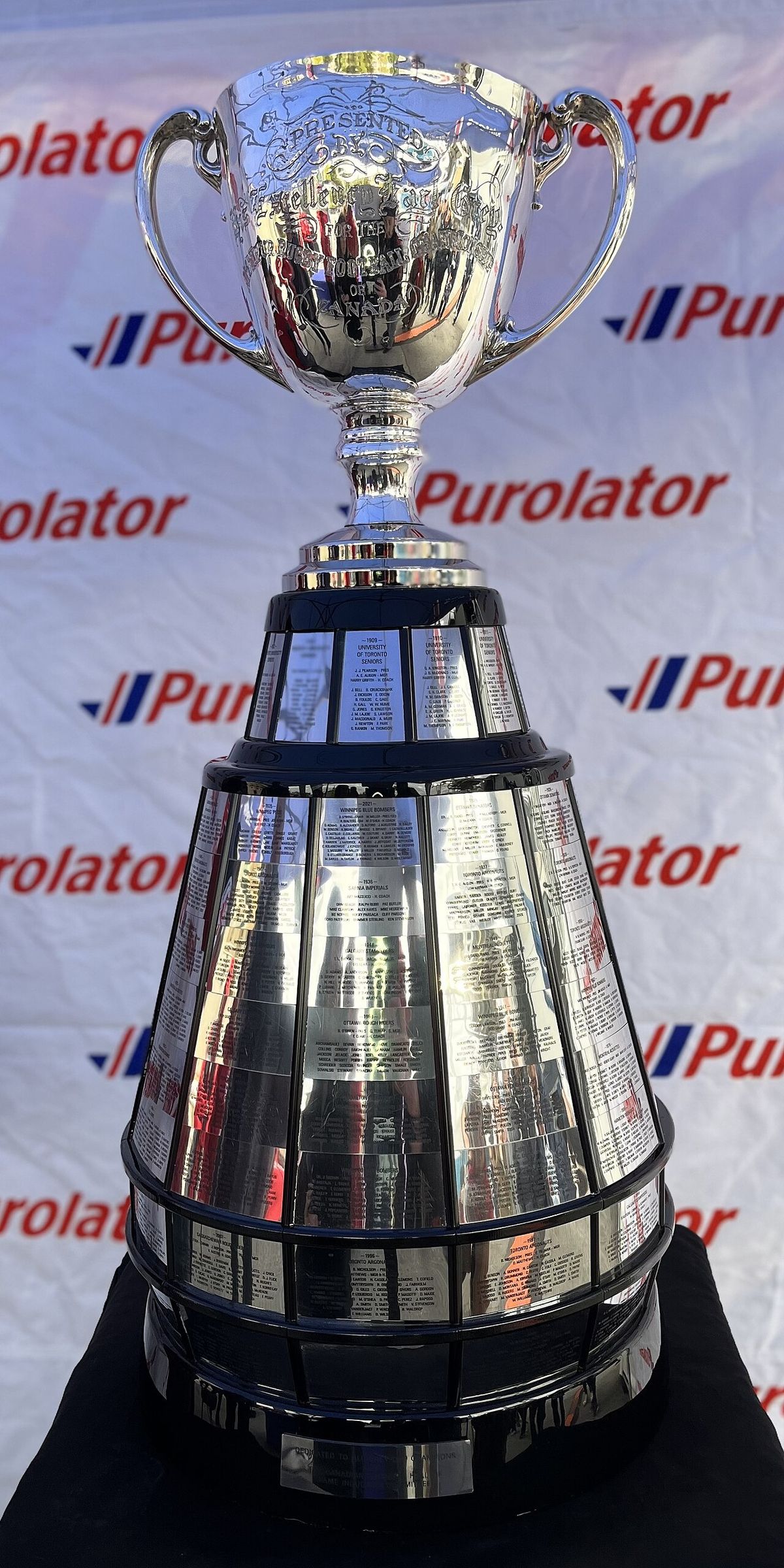
During his six seasons with the Edmonton Eskimos, Warren Moon led the team to five consecutive Grey Cup victories from 1978 to 1982. He was named the Grey Cup Offensive MVP in 1980 and again in 1982. In 1983, Moon won the CFL's Most Outstanding Player Award after setting single-season league records for pass completions, attempts, and yards. His success in the CFL resulted in his induction into the Canadian Football Hall of Fame in 2001.
- Five consecutive Grey Cup championships (1978, 1979, 1980, 1981, 1982).
- Two Grey Cup Most Valuable Player awards (1980, 1982).
- CFL Most Outstanding Player award (1983).
- Jeff Nicklin Memorial Trophy as West Division MOP (1983).
- CFL All-Star and CFL Western All-Star (1983).
- Induction into the Canadian Football Hall of Fame (2001).
- Induction into the Edmonton Eskimos Wall of Honour (2001).
- Ranked fifth on TSN's list of the 50 greatest CFL players (2006).
National Football League career
Moon's exceptional CFL performance sparked an NFL bidding war, which was won by the Houston Oilers, led by his former Edmonton coach Hugh Campbell. He joined the Oilers for the 1984 season, immediately setting a franchise rookie record with 3,338 passing yards. After early struggles, the team found success, posting its first winning season since 1980 in 1987 and making the playoffs. Moon's first NFL postseason game was a 23-20 overtime victory over Seattle in the 1987 Wild Card round. Prior to the 1989 season, he signed a five-year, $10 million contract extension, making him the highest-paid player in the NFL at the time. The peak of Moon's NFL career came in the early 1990s, highlighted by his 1990 season where he led the league in passing yards (4,689), touchdowns (33), completions, and attempts, earning NFL Offensive Player of the Year honours.
He tied a record with nine 300-yard games that season, including a 527-yard performance against Kansas City, the second-most in a single game in NFL history. In 1991, he again led the league in passing yards (4,690) and set NFL single-season records for attempts (655) and completions (404). The 1992 season featured one of the most famous games in NFL history, known as "The Comeback," where Moon's Oilers blew a 35-3 lead to the Buffalo Bills in the playoffs, losing 41-38 in overtime despite Moon's NFL postseason-record 36 completions for 371 yards and four touchdowns. In his final season with Houston in 1993, he led the team to a 12-4 record and an AFC Central title before being traded to the Minnesota Vikings in 1994. With the Vikings, he passed for over 4,200 yards in each of his first two seasons before an injury in 1996 led to his release.
Moon signed with the Seattle Seahawks as a free agent in 1997 and was named to the Pro Bowl and Pro Bowl MVP that season. He then signed as a free agent with the Kansas City Chiefs as a backup in 1999. Moon threw his final touchdown pass, the 291st of his NFL career, in a game against the St. Louis Rams on October 22, 2000. He announced his retirement at age 44 on January 25, 2001. At the time of his retirement, Moon held several all time professional gridiron football passing records.
| Team | Seasons | Key Achievements |
|---|---|---|
| Houston Oilers | 1984 to 1993 | NFL OPOY (1990), 2× passing yards leader, 7 playoff appearances, set numerous franchise records |
| Minnesota Vikings | 1994 to 1996 | Two 4,200+ yard seasons, AFC playoff appearance in 1994 |
| Seattle Seahawks | 1997 to 1998 | Pro Bowl (1997), Pro Bowl MVP (1997) |
| Kansas City Chiefs | 1999 to 2000 | Backup role, final career touchdown pass in 2000 |
Career statistics and records
Warren Moon's professional passing statistics across 17 NFL and 6 CFL seasons place him among the most prolific quarterbacks in gridiron football history. His combined professional totals are 5,357 completions on 9,205 attempts for 70,553 yards, 435 touchdowns, and 310 interceptions. In the NFL alone, he completed 3,988 passes for 49,325 yards and 291 touchdowns. In the CFL, he added 1,369 completions for 21,228 yards and 144 touchdowns. At the time of his retirement, he held several all-time professional passing records and a vast number of franchise records for the Houston Oilers/Tennessee Titans. Moon's tenure with the Oilers established a deep legacy within that organization, as he held at least 37 franchise records for the Titans/Oilers as of 2019, many of which stood for years after his departure.
His single-game passing record of 527 yards, set in 1990, remains one of the most notable individual performances in franchise history. He also held a Seattle Seahawks franchise record, tied in 1998, for most consecutive completions in a game with 17. These records demonstrate his durability and production over a decade as a starting quarterback. Key franchise records held by Moon for the Tennessee Titans/Houston Oilers include most career passing yards (33,685), most career passing touchdowns (196), most career completions (2,632), most season passing yards (4,690 in 1991), most season completions (404 in 1991), most game passing yards (527 in 1990), most playoff game completions (36 in 1993), and most 300-yard passing games in a career (42).
Hall of Fame induction and honours
Warren Moon's election to the Pro Football Hall of Fame in 2006, in his first year of eligibility, was a landmark moment. He became the first African-American quarterback, the first undrafted quarterback, and the first member of the Canadian Football Hall of Fame to be enshrined in Canton. This honour solidified his unique cross-border legacy. The Tennessee Titans retired his No. 1 jersey in a ceremony on October 1, 2006. In a notable recent development, on April 25, 2025, Moon un-retired his No. 1 jersey to allow Cam Ward, the first overall pick in the 2025 NFL draft, to wear it for the Titans. Moon's extensive list of awards reflects excellence in both professional leagues.
In the NFL, he was a nine-time Pro Bowl selection (1988 to 1995, 1997), the 1990 NFL Offensive Player of the Year, and the 1997 Pro Bowl MVP. He also received the 1994 Bart Starr Award. His CFL honours are equally impressive, highlighted by five Grey Cup rings, two Grey Cup MVP awards, the 1983 CFL Most Outstanding Player award, and a CFL All-Star selection. In college, he was the 1978 Rose Bowl MVP and a Pac-8 Co-Player of the Year. He was inducted into the Canadian Football Hall of Fame in 2001 and the University of Washington Ring of Honor as an inaugural member in 2013. His career was recognized with a wide array of major awards.
- NFL Offensive Player of the Year (1990).
- NFL Man of the Year (1989).
- Nine Pro Bowl selections (1988, 1989, 1990, 1991, 1992, 1993, 1994, 1995, 1997).
- Pro Bowl MVP (1997).
- Two-time NFL passing yards leader (1990, 1991).
- NFL passing touchdowns leader (1990).
- CFL Most Outstanding Player (1983).
- Two-time Grey Cup MVP (1980, 1982).
Post-playing career and personal life
Following his retirement from playing, Warren Moon worked as a colour commentator and analyst for the Seattle Seahawks' radio and television broadcasts from 2004 until 2017, earning a Super Bowl ring with the organization in 2014. He has also served as a mentor to young quarterbacks, including Cam Newton after he was drafted first overall in 2011. In December 2017, Moon was suspended indefinitely from his broadcasting role after being sued for sexual harassment. In his personal life, Moon was married to Felicia Hendricks from 1981 until their divorce in 2001. They had three children together. He was acquitted of a misdemeanour spousal assault charge in February 1996. He married Mandy Ritter in 2005, with whom he has one child. They are currently separated. As of 2020, Moon resides in Redmond, Washington.
Moon has been involved in philanthropy throughout his adult life. In 1989, he founded the Crescent Moon Foundation, which provides college scholarships for economically disadvantaged students. His charitable support extends to numerous organizations, including the United Negro College Fund, Ronald McDonald House, Muscular Dystrophy Association, Cystic Fibrosis Foundation, American Heart Association, and Cerebral Palsy Foundation. These efforts reflect a long standing commitment to giving back to the community.
Questions about Warren Moon
Why is Warren Moon important to Canadian football?
Warren Moon is a central figure in Canadian football due to his six-year career with the Edmonton Eskimos, where he led the team to five consecutive Grey Cup championships from 1978 to 1982. He won two Grey Cup MVP awards and was named the CFL's Most Outstanding Player in 1983 after a record-setting season. His success helped solidify the Eskimos' dynasty and left a lasting mark on the league. He was inducted into the Canadian Football Hall of Fame in 2001 and remains the only player enshrined in both the Canadian and Pro Football Halls of Fame.
What NFL records did Warren Moon hold?
At the time of his retirement, Warren Moon held several significant NFL records. He was the all-time leader in career fumbles, fumbles recovered, and 300-yard passing games in a single season (9, tied in 1990). He also held records for most passes completed in a postseason game (36) and most times sacked in a game (12). For the Houston Oilers/Tennessee Titans franchise, he set numerous records, including most career passing yards (33,685), touchdowns (196), and completions (2,632), many of which stood for over a decade after he left the team.
How many Grey Cups did Warren Moon win?
Warren Moon won five Grey Cup championships, all consecutively with the Edmonton Eskimos from 1978 through 1982. This remains a CFL record for most consecutive team championships. He was instrumental in these victories, serving as the starting or co-starting quarterback. His performance in two of those championship games earned him Grey Cup Most Valuable Player awards in 1980 and 1982.
What did Warren Moon do after retiring from football?
After retiring in 2001, Warren Moon worked as a colour commentator and analyst for the Seattle Seahawks' radio and television broadcasts from 2004 until 2017. He also served as a mentor to young quarterbacks, including Cam Newton. Moon has been active in philanthropy since 1989 through his Crescent Moon Foundation, which provides scholarships, and he supports numerous other charities. In December 2017, he was suspended from his broadcasting role after being sued for sexual harassment.
Is Warren Moon in the Pro Football Hall of Fame?
Yes, Warren Moon was elected to the Pro Football Hall of Fame in 2006, in his first year of eligibility. This honour made him the first African American quarterback and the first undrafted quarterback to be inducted. He is also the only player to be inducted into both the Pro Football Hall of Fame and the Canadian Football Hall of Fame. His election followed a 23 season professional career split between the NFL and CFL. His NFL achievements included nine Pro Bowl selections and leading the league in passing yards twice.
What number did Warren Moon wear and is it retired?
Warren Moon wore jersey number 1 during his professional career. The Tennessee Titans, formerly the Houston Oilers, retired his number 1 at a halftime ceremony on October 1, 2006. However, on April 25, 2025, Moon un retired his number to allow quarterback Cam Ward, the first overall pick in that year's NFL draft, to wear it. Moon spent 10 seasons with the Oilers, setting numerous franchise passing records. His number retirement was a recognition of his legacy with the franchise where he achieved much of his NFL success.
Sources and further reading
- Warren Moon (Wikipedia)
- Sponsor Warren Moon | American Football Athlete (opensponsorship.com)
- Warren Moon (albertasportshallmembers.ca)
- Warren Moon (halloffamers.sportshall.ca)
Checked by the Garbutt Disposal desk. Last updated 2026-10-21.