Grouse Mountain
Grouse Mountain is a major peak in the North Shore Mountains, situated in the District of North Vancouver, British Columbia. It is the location of Grouse Mountain Resort, a comprehensive four-season destination featuring an alpine ski area, the challenging Grouse Grind hiking trail, and panoramic views of Metro Vancouver. The mountain serves as a vital recreational and tourism centre for Canadians, particularly residents of the Lower Mainland, offering year-round activities including skiing, snowboarding, and sightseeing. Its development, marked by the construction of aerial tramways and the distinctive Eye of the Wind turbine, has established it as a significant feature of the regional landscape and a venue for cultural and sporting events.
Early History and Development
The mountain is named for the sooty grouse, a game bird native to the area, and lies within the traditional territories of the Coast Salish peoples. The first recorded non-Indigenous ascent to the peak occurred in October 1894 by hikers who named the mountain. Development for recreation began in the 1920s when Scandinavians hand-built the first lodge, hauling planks up what would later become the Grouse Grind trail. A toll road was constructed in the 1930s to access this lodge, following the slope of what is now the primary ski run known as the Cut. The original base area, featuring the first lodge and a rope tow, became known locally as the Village, a name derived from the cluster of cabins built around it. The mountain's first double chairlift was built in 1949, followed by the longer Village Chair in 1951, which featured chairs with metal roofs for weather protection. The old Grouse Mountain Highway, a gravel access road built during this period, remains in place today solely for ski area maintenance operations.
Modern Resort Infrastructure and Ownership
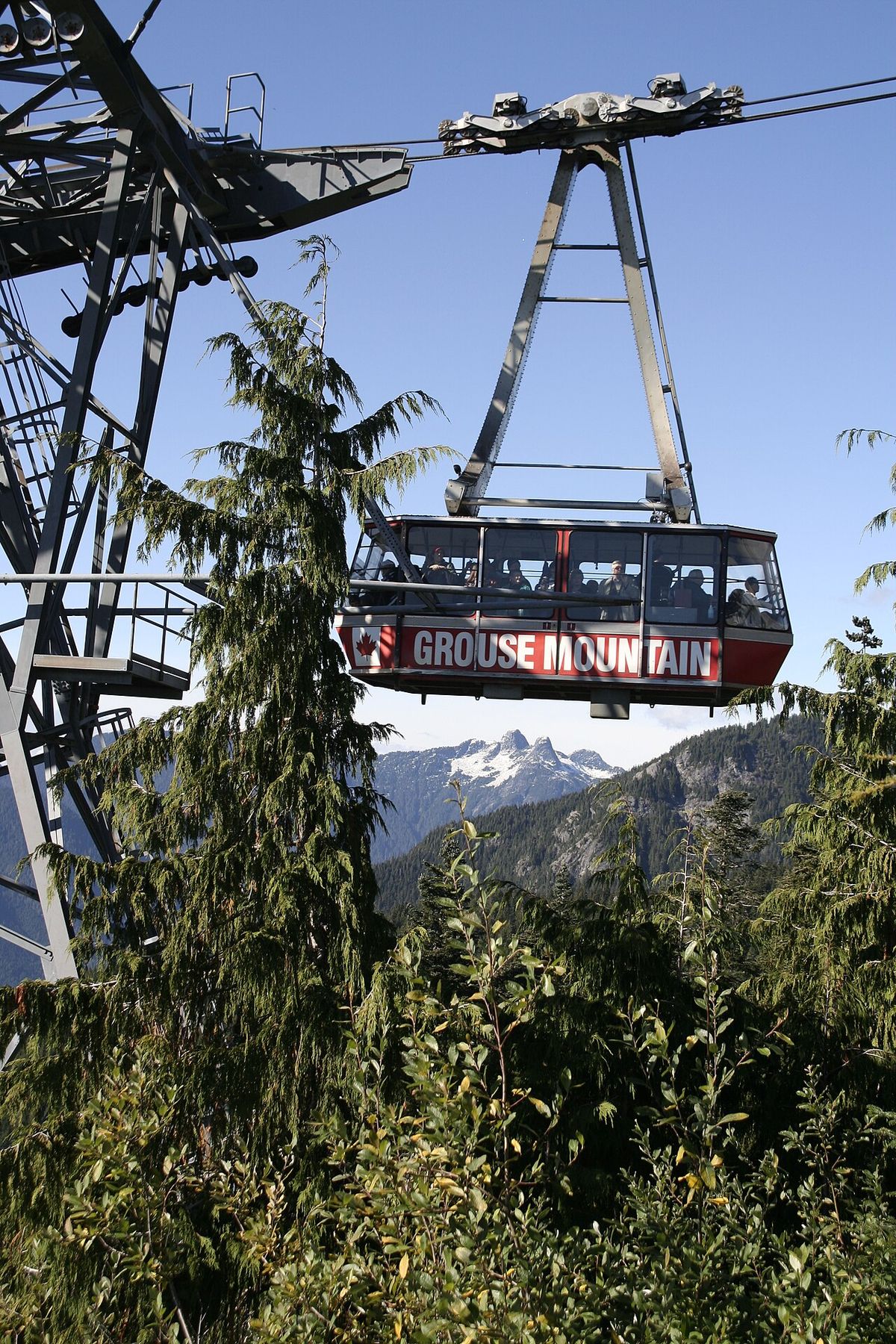
A fire destroyed the original lodge in the winter of 1962, leading to a major redevelopment supported by the provincial government. The new lodge was constructed on the ridge, accompanied by the Blue Tram aerial tramway built by Austrian company Voestalpine, which opened on December 15, 1966. The McLaughlin family purchased the mountain in 1976 and financed a second, larger tramway, the Super Skyride (or Red Tram) built by Garaventa, that same year. The family gained full ownership in 1989 and expanded the lodge to include the Theatre in the Sky, a high-definition theatre, in 1990. Significant lift upgrades occurred in the 2000s as older chairs aged. The Inferno Chair was removed in late 2003, and the Blueberry and Peak Chairs were removed the following year. These were effectively replaced by the high-speed Olympic Express quad chair, built by Leitner-Poma for the 2005 winter season. In January 2020, Northland Properties acquired the resort from CM Asset Management, which had owned it since 2017. A major recent addition is the Blue Grouse Gondola, an 8-person cabin system with 27 cabins that opened on December 12, 2024, to increase upload capacity as part of a series of developments planned for the 2024-25 seasons.
Skiing and Snowboarding Terrain
The ski area operates on the southern slope from approximately December to May, accessed via tram from the base. It is serviced by four chairlifts: the Screaming Eagle and Olympic Express high-speed quads, and the Greenway and Peak quad chairs. These lifts facilitate 33 runs across all difficulty levels, with half lit for night operations. The most visible run is the beginner-friendly Cut, which runs alongside the Screaming Eagle chairlift. East of the Cut are several intermediate runs that lead to the Olympic Express chair, which accesses expert runs from the mountain's 1,231-metre peak. The mountain's terrain breakdown includes four green runs, sixteen blue runs, seven black diamond runs, and three double black diamond runs. Three freestyle terrain parks cater to various skill levels: the Rookie Terrain and Paradise Parks for novice to intermediate riders, and the Side Cut Terrain Park for intermediate to expert riders. A dedicated handle tow was added to service the Side Cut Terrain Park in 2022. Snowmaking is extensive, with 37 snow guns covering 75 percent of the terrain to supplement the average annual natural snowfall of 305 centimetres.
The most prominent run on the mountain is the Cut, a beginner run easily visible from Vancouver. The ski and snowboard area features four chairlifts facilitating 33 runs, half of which are lit for night skiing. These runs include four green beginner runs, sixteen blue intermediate runs, seven black diamond advanced runs, and three double black diamond expert runs. There are also three freestyle terrain parks, including the Rookie Terrain and Paradise Parks for novices to intermediates and the Side Cut Terrain Park for intermediates to experts.
- The Cut: A prominent beginner run visible from Vancouver.
- Olympic Express: High-speed quad accessing expert terrain from the peak.
- Side Cut Terrain Park: Intermediate to expert park with a dedicated handle tow (2022).
- Cut Jump Line: An expert terrain park located on the east side of the Cut, open depending on snow conditions.
The Grouse Grind and Summer Activities
Grouse Mountain is a major summer destination, most famous for the Grouse Grind hiking trail. This steep 2.9-kilometre trail climbs 853 metres with an average grade of 31 percent and sections up to 58 percent, featuring 2,830 stairs. Built unofficially in the early 1980s by Don McPherson and Phil Severy as a climber's conditioning trail, it was later rebuilt in the early 1990s with assistance from the resort. The trail is managed by Metro Vancouver and is closed seasonally, typically from November to April or May, due to hazardous geotechnical and weather conditions. The current record for most ascents in one day is held by Wilfrid Leblanc, who completed 19 grinds on June 22, 2019. Previous record holders include Ian Robertson with 17 grinds in 2017 and Oliver Bibby with 16 in 2013. Due to frequent rescues by the District of North Vancouver Fire and Rescue, the access gate now closes 90 minutes before sunset each evening. Hiking down the Grouse Grind itself is prohibited, though the nearby BCMC trail provides a descent option for those wishing to avoid the tram fare.
The Grouse Grind is a steep hiking trail that climbs 853 metres over a distance of 2.9 kilometres. The trail is notoriously gruelling with an average grade of 17 degrees and contains 2,830 stairs. Metro Vancouver closes the trail each winter, usually from November to April or May, due to hazardous conditions. The gate to the trail is also closed to visitors 90 minutes before sunset each evening, and hiking back down the Grouse Grind is prohibited.
- Trail length: 2.9 km (1.8 mi) with an elevation gain of 853 m (2,800 ft).
- Total stairs: 2,830.
- Average completion time: Approximately 90 minutes.
- Record for most ascents in one day: 19 by Wilfrid Leblanc (June 22, 2019).
- Managing authority: Metro Vancouver, with the land designated a regional park as of May 1, 2017.
- Seasonal closure: Typically November to April or May, enforced by a steel gate and security fence.
- Trail start: Relocated in 2011 to a point 20 metres east of the gate from a previous location 130 metres east.
The Eye of the Wind Turbine
A distinctive feature of the resort is The Eye of the Wind, a 1.5-megawatt wind turbine with an observation deck at its hub. Constructed through a partnership between Grouse Mountain and Italy's Leitwind Technology, construction began in September 2008. The turbine is a Leitwind LTW77-1500 type with a hub height of 65 metres and a rotor diameter of 76.8 metres. It was inaugurated on February 5, 2010, by Premier Gordon Campbell prior to the 2010 Winter Olympics and began public tours on February 26, 2010. The turbine was connected to BC Hydro's transmission system on September 22, 2010, after a dispute over safety equipment was resolved. The structure weighs more than 250 tonnes and its three 37.4-metre fibreglass reinforced polyester blades sweep an area of 4,657 square metres. The project was recognized with a 2011 Consulting Engineers of British Columbia Award for Engineering Excellence. It was anticipated to supply 25 percent of the resort's electricity, equivalent to powering about 400 homes. The turbine foundation has created a habitat for the American pika, and as of 2015, no bird or bat deaths had been observed from the moving blades.
Climate and Environmental Conditions
Grouse Mountain has a humid continental climate, bordering on a subarctic climate, heavily influenced by its elevation and proximity to the Pacific Ocean. The average annual precipitation is 2,730 millimetres, with autumn being the wettest season. November alone averages 421.4 mm of precipitation. Winters are cool and snowy, with an annual average snowfall of 868.7 centimetres, creating a reliable snowpack from mid-November to early May. Despite this, winters are moderated by the ocean and are not as cold as in many other Canadian regions. December, the coldest month, has average highs of 1.3°C and lows of -3.2°C, creating a freeze-thaw cycle that can sometimes bring rain. Summers are warm and relatively dry, with August being the warmest month, featuring average highs of 17.7°C and lows of 10.3°C. This climate supports both winter sports and summer hiking activities, though the mountain's conditions are notably more severe than in the Lower Mainland below.
Filming and Cultural Appearances
Grouse Mountain and its facilities have served as a filming location for numerous television shows and movies, leveraging its distinctive alpine scenery and tramways. The aerial tramway was used as a main plot point in a 1989 episode of MacGyver titled Cease Fire, standing in for a location in Geneva, Switzerland. In 1994, the mountain and its tramway doubled for the fictional Skyland Mountain in Virginia in The X-Files episode Ascension, with actor David Duchovny performing a stunt from the sky ride. It also appeared as the fictional ski resort Summit Peaks in the 2009 film American Pie Presents: The Book of Love. During the 2010 Winter Olympics, while no official events were held on the mountain, NBC Today broadcast its coverage of the Games live from the Grouse Mountain location.
Recent Developments and Future Plans
Under the ownership of Northland Properties, the resort has continued to expand its infrastructure and guest offerings. The most significant recent capital project is the Blue Grouse Gondola, which opened on December 12, 2024. This system features 27 cabins, each carrying 8 passengers, and was built to significantly increase guest upload capacity from the base area. This gondola is one of three major developments planned for the 2024-25 winter and summer seasons. The other two planned projects are a new lift-access bike park and a mountain coaster, which aim to enhance summer visitation and diversify year-round activities. These developments follow the pattern of incremental upgrades seen over decades, such as the replacement of the Courtesy rope tow and the defunct Peak chair with new quad chairs in 2008. The resort's strategy focuses on maintaining its status as a leading four-season destination for the Metro Vancouver region and beyond, building on a history that includes the construction of the first double chairlift in 1949 and the pioneering Eye of the Wind turbine.
Questions about Grouse Mountain
How do I get to Grouse Mountain from Vancouver?
Grouse Mountain is located in the District of North Vancouver, directly across the Burrard Inlet from downtown Vancouver. From there, access to the alpine facilities is primarily via the resort's aerial tramways. The Super Skyride (Red Tram) is the main passenger tram, while the older Blue Tram is also operational, transporting guests from the valley to the mountaintop lodge and ski area in approximately a 6-minute ride. The original Grouse Mountain Highway is not for public use and is reserved for maintenance vehicles.
What is the Grouse Grind and how difficult is it?
The Grouse Grind is a very steep and strenuous hiking trail that climbs 853 metres over a distance of 2.9 kilometres, featuring 2,830 stairs. With an average grade of 31 percent and sections as steep as 58 percent, it is notoriously challenging and is often called Mother Nature's Stairmaster. The average hiker takes about 90 minutes to complete it, though very fit individuals can finish in under 30 minutes. The trail is managed by Metro Vancouver and is closed each winter, usually from November to April or May, due to hazardous conditions, with the gate closing 90 minutes before sunset during the operating season to prevent unprepared hikers from being caught in the dark.
Does Grouse Mountain have night skiing?
Yes, Grouse Mountain offers extensive night skiing and snowboarding. Approximately half of its 33 ski runs are equipped with lighting for evening operations. The resort's night skiing schedule typically aligns with its winter operating season from December to April, providing extended hours for guests to enjoy the slopes after sunset. This feature is particularly popular with local residents and is supported by the mountain's snowmaking system, which covers 75 percent of the terrain. The night skiing area includes a mix of beginner, intermediate, and advanced runs accessible from the lit chairlifts.
What is The Eye of the Wind at Grouse Mountain?
The Eye of the Wind is a 1.5-megawatt wind turbine located at the peak of Grouse Mountain, featuring a unique observation deck within its nacelle, 65 metres above the ground. Inaugurated in 2010, it was the first wind turbine built in a high-altitude location in North America. It was designed to supply up to 25 percent of the resort's electricity needs, equivalent to powering about 400 homes. The structure is also a tourist attraction, offering guided tours that provide panoramic views of the surrounding region, and its design won a 2011 engineering excellence award from the Consulting Engineers of British Columbia.
Who owns Grouse Mountain Resort?
As of January 2020, Grouse Mountain Resort is owned by Northland Properties, a Canadian company with holdings in hospitality, restaurants, and sports. Northland Properties acquired the resort from CM Asset Management, which had owned it since 2017. Prior to that, the resort was owned for decades by the McLaughlin family, who purchased it in 1976 and oversaw major developments including the Super Skyride tramway and the Theatre in the Sky. The McLaughlin family acquired complete ownership in 1989 and sold the resort in 2017, leading to the current ownership under Northland Properties.
What new attractions opened at Grouse Mountain in 2024?
The major new attraction that opened in 2024 is the Blue Grouse Gondola. This gondola system began operation on December 12, 2024, featuring 27 cabins, each carrying 8 passengers, and was built to significantly increase the resort's upload capacity from the base area. It is one of three new developments planned for the 2024-25 seasons, with a lift-access bike park and a mountain coaster also in the works as part of the resort's ongoing expansion of its four-season offerings. These projects aim to build on the mountain's long history of infrastructure development dating back to the 1920s.
Sources and further reading
- Grouse Mountain (Wikipedia)
- Grouse Mountain, Vancouver's North Shore Tourism in BC ... (vancouversnorthshore.com)
- Grouse Mountain, The Peak Of Vancouver (cvent.com)
- Press releases (grousemountain.com)
Checked by the Garbutt Disposal desk. Last updated 2026-10-20.