Eastern Continental Trail
The Eastern Continental Trail (ECT) is a long-distance hiking route spanning the eastern seaboard of North America from Key West, Florida, to Belle Isle, Newfoundland and Labrador. It is a composite network of several established trails, including the Appalachian Trail and the International Appalachian Trail, with a total hiking distance of approximately 4,400 miles (7,100 km). The trail holds significance for Canadian hikers and outdoor enthusiasts as its northern sections traverse the provinces of New Brunswick, Quebec, and Newfoundland and Labrador, offering a major wilderness challenge. First completed by John Brinda in 1997, the ECT represents one of the continent's most formidable and logistically complex thru-hiking endeavours.
Route and Composition
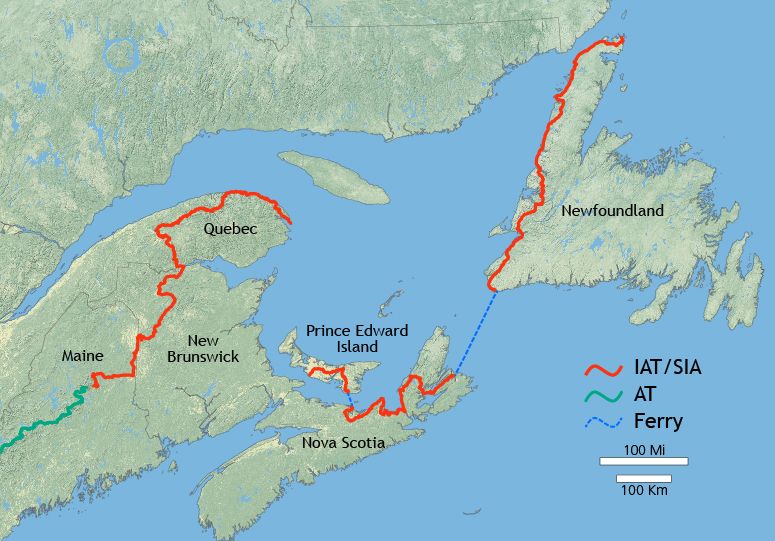
The Eastern Continental Trail is not a single, purpose-built path but a connected series of existing long-distance trails. The route begins at the southernmost point in the continental United States at Key West, Florida. From there, hikers travel north along the Florida Keys Overseas Heritage Trail, a partially developed rail trail, before connecting to the Florida National Scenic Trail. The route continues with a road walk through southern Alabama to link with the Pinhoti National Recreation Trail in Alabama and Georgia. The Pinhoti then connects to the Benton MacKaye Trail, which leads to the southern terminus of the Appalachian Trail at Springer Mountain, Georgia. From Katahdin, the International Appalachian Trail carries the route through Maine, New Brunswick, and Quebec to Cap Gaspé on the Gulf of St. Lawrence. The hiking trail officially ends at this water crossing, but the ECT concept extends further. Hikers must arrange ferry travel to Newfoundland and Labrador to continue hiking north across the island, with the symbolic endpoint at Belle Isle, off the tip of the Great Northern Peninsula. The full network, including the Newfoundland extension, can total roughly 6,000 miles.
Detailed Trail Components and Characteristics
The ECT integrates several major trail systems, each with its own character and management. The Florida Trail offers a subtropical environment through swamps and pine forests, while the Appalachian Trail provides a well-travelled corridor through the Appalachian Mountains with significant infrastructure for hikers. The International Appalachian Trail section in Canada presents a more remote and rugged experience, with fewer services and greater distances between resupply points. In Quebec, the trail traverses the Gaspé Peninsula, a region where French is predominantly spoken, and closes seasonally in late September due to weather, moose hunting, and caribou mating season. The final leg in Newfoundland involves traversing a vast, sparsely populated landscape, with routes leading to historic sites like L'Anse aux Meadows National Historic Site. The trail's composite nature means hikers must adapt to different regulations, landscapes, and logistical challenges across multiple jurisdictions. The component trails are, from south to north: the Florida Keys Overseas Heritage Trail, the Florida Trail, the Pinhoti Trail, the Benton MacKaye Trail, the Appalachian Trail, and the International Appalachian Trail.
History and Record-Setting Hikes
The concept and name 'Eastern Continental Trail' were coined by long-distance hiker M. J. Eberhart, known by his trail name Nimblewill Nomad. The first documented thru-hike of the route from Key West to Cap Gaspé was completed by John Brinda in 1997, establishing the trail's feasibility. For over two decades, the trail remained a largely male-dominated challenge until 2023, when LoLo 'Sparkle' Veloz became the first woman to thru-hike the ECT. Veloz is also recognized as the first known queer person and Mexican immigrant to complete the trail. More recent completions include hikers Steve Hoekwater and Jacob Pepper, who both finished the trek in 2025. Their hikes, like those of many others, were marked by significant physical challenges, with Pepper reporting he wore through six pairs of footwear during his journey. These hikers often maintain demanding daily distances of 20 to 30 miles to complete the trail within a single hiking season. The trail remains an unofficial network with no single governing body, relying on the established management of its component trails.
- 1997: John Brinda completes first thru-hike from Key West to Cap Gaspé.
- 2023: LoLo 'Sparkle' Veloz becomes first woman, first queer person, and first Mexican immigrant to thru-hike.
- 2025: Steve Hoekwater and Jacob Pepper complete the trail, both overcoming medical issues.
- Trail Namer: M. J. Eberhart (Nimblewill Nomad).
The Thru-Hiking Experience: Logistics and Physical Demands
Attempting a thru-hike of the Eastern Continental Trail is a monumental undertaking that typically requires five to eight months to complete. Hikers generally begin in Key West in January to avoid the southern summer heat and to time their arrival in northern Canada before severe winter weather. The trail presents an extreme variety of terrain, from the flat, hot Florida swamps to the high elevations of the Appalachian Mountains and the remote, often boggy landscapes of Atlantic Canada. Logistical hurdles are considerable, including planning for multiple ferry crossings to Newfoundland, managing the Alabama Road Walk, and handling extended stretches between towns in Quebec and Newfoundland where resupply is difficult. The mental challenge is equally significant, with hikers reporting experiences of loneliness and the need for resilience in the face of equipment failure, illness, and injury. For example, hiker Sterling Coleman, who completed the trail in 2012, endured a month without proper shelter after losing his tarp early in the hike. Hikers like Jacob Pepper in 2025 maintained a pace of at least 20 to 30 miles a day to finish within the season.
The physical toll on gear is substantial, with footwear wearing out rapidly over thousands of miles of varied surfaces. Hikers must carry equipment suitable for conditions ranging from tropical humidity to sub-arctic winds. Planning involves not only route-finding but also understanding the seasonal constraints of the International Appalachian Trail in Quebec, which closes in late September. Financial costs are high, covering gear replacement, food, and transport like the ferries to Newfoundland. Many hikers fly into Key West to begin their journey, which involves an initial island-hop along the Florida Keys Overseas Heritage Trail before the mainland trek begins on the Florida Trail.
Canadian Segments: Landscape and Specific Challenges
The Canadian segments of the Eastern Continental Trail are integral to its identity and offer a distinct wilderness experience. In New Brunswick, the International Appalachian Trail runs for 185 miles, following the Tobique River, through Mount Carleton Provincial Park, and passing small villages before reaching Quebec. The Quebec section across the Gaspé Peninsula is more challenging and remote, with the official companion guide noting hikers should plan for 35 to 40 days to reach the lighthouse at Cap Gaspé. This section has fewer other hikers and greater distances between towns, requiring greater self-sufficiency. The trail in Quebec closes in late September due to weather, moose hunting, and caribou mating season. As most Québécois speak French as a first language, hikers are advised to bring a phrase book or learn basic phrases.
For hikers continuing to Newfoundland, the route involves a ferry crossing and then a trek of about 437 miles north to L'Anse aux Meadows. This extension adds roughly 1,600 miles to the core 4,400-mile distance, bringing the total to about 6,000 miles. The Newfoundland landscape is vast and sparsely populated, with the final symbolic endpoint at Belle Isle in the Labrador Sea. These Canadian sections contrast sharply with the more social and supported environment of the Appalachian Trail, testing a hiker's capacity for solitude and resourcefulness in a harsh, beautiful environment.
Comparative Hiker Statistics and Trail Culture
While comprehensive annual statistics for the entire ECT are not formally tracked, completion numbers remain low due to the trail's extreme difficulty and length. The trail sees a handful of attempted thru-hikes each year, with successful completions often documented in hiking communities and media. The connected East Coast Trail in Newfoundland, which some ECT hikers may traverse, reports substantial annual use, with over 14,000 visitors completing more than 65,000 hikes per year on its 270 kilometres of coastal paths. The culture of long-distance hiking on the ECT is one of camaraderie and shared challenge, with hikers frequently relying on online journals and trail communities for advice and support. The trail's unofficial nature means hikers must be proficient in route-finding and planning, as there is no single governing body or comprehensive guidebook for the entire network. Hikers range from inexperienced to expert, with all facing major challenges including illness and loneliness during the multi-month journey.
| Hiker | Completion Year | Notable Achievement / Details |
|---|---|---|
| John Brinda | 1997 | First person to complete the ECT (Key West to Cap Gaspé). |
| LoLo 'Sparkle' Veloz | 2023 | First woman, first queer person, first Mexican immigrant to thru-hike. |
| Sterling Coleman | 2012 | Endured a month without shelter after equipment loss early in hike. |
| Steve Hoekwater | 2025 | Completed the trail, suffered from medical issues causing lost time. |
| Jacob Pepper | 2025 | Completed the trail, used six pairs of footwear, hiked 20-30 miles/day. |
Planning Essentials: Permits, Seasons, and Resources
Successful planning for an Eastern Continental Trail thru-hike requires meticulous attention to detail across several domains. Hikers must secure necessary permits for specific trail sections, such as the Appalachian Trail, and plan for international border crossings between the United States and Canada. Financial planning is critical, as the journey can cost thousands of dollars for gear, food, and transport, including ferries. Physical preparation should involve training with a full pack over varied terrain to build endurance. Gear must be suitable for a wide range of conditions, from Florida's humidity to Quebec's early frosts. Hikers are advised to carry resources for basic French communication for the Quebec section and to thoroughly research the seasonal closures and hunting seasons in rural Canada. Most importantly, aspirants should study the journals and reports of previous hikers to understand the unique challenges of connecting the disparate trail systems into a continuous journey.
The recommended start time is January in Key West, allowing hikers to move north with the spring. Key planning resources include the International Appalachian Trail companion guide for the Canadian sections, which provides detailed information on the 35 to 40 day trek across Quebec. Hikers must also arrange ferry travel to Newfoundland, which adds a significant logistical and cost layer. Given the remoteness of the Canadian segments, especially in Quebec and Newfoundland, carrying detailed maps and having a reliable communication plan for emergencies is essential. The trail's unofficial status means there is no central source for updates, so hikers must consult the individual trail associations for the Florida Trail, Appalachian Trail, and International Appalachian Trail for current conditions and regulations.
Questions about Eastern Continental Trail
How long is the Eastern Continental Trail?
The core hiking distance of the Eastern Continental Trail is approximately 4,400 miles (7,100 km), spanning from Key West, Florida, to Cap Gaspé, Quebec. This measurement does not include the water gaps required to reach and traverse Newfoundland. If hikers continue across Newfoundland to Belle Isle, the total distance can extend to roughly 6,000 miles. The trail is a network of connected paths rather than a single trail, incorporating the Florida Trail, Appalachian Trail, and International Appalachian Trail, among others.
Where does the Eastern Continental Trail start and end?
The official southern terminus of the Eastern Continental Trail is at Key West, Florida, the southernmost point in the continental United States. The northern terminus is more symbolic and debated. The hiking trail ends at Cap Gaspé, Quebec, on the Gulf of St. Lawrence. However, the full ECT concept extends to Belle Isle, off the northern tip of Newfoundland's Great Northern Peninsula. To reach Newfoundland, hikers must cross water gaps by ferry, and the route across the island adds hundreds of additional miles to the journey.
Who was the first person to hike the entire Eastern Continental Trail?
The first person to complete a thru-hike of the Eastern Continental Trail from Key West to Cap Gaspé was John Brinda in 1997. This hike established the feasibility of the connected route. The first woman to thru-hike the ECT was LoLo 'Sparkle' Veloz, who completed the trail in 2023. Veloz is also recognized as the first known queer person and the first Mexican immigrant to achieve this feat. These milestones highlight the trail's growing diversity and appeal within the long-distance hiking community.
What are the main trails that make up the ECT?
The Eastern Continental Trail is composed of several major long-distance trails linked together. From south to north, the primary components are the Florida Keys Overseas Heritage Trail, the Florida National Scenic Trail, the Pinhoti National Recreation Trail, the Benton MacKaye Trail, the entire Appalachian Trail, and the International Appalachian Trail. In Canada, the International Appalachian Trail carries the route through New Brunswick and Quebec. Hikers continuing to Newfoundland will then hike across the island on various local paths to reach the final endpoint at Belle Isle.
How long does it take to thru-hike the Eastern Continental Trail?
A complete thru-hike of the Eastern Continental Trail typically takes between five and eight months to finish. Hikers usually begin in Key West in January to have optimal weather windows for both the southern and northern sections. The journey requires maintaining a consistent daily mileage, often between 20 and 30 miles, to complete the trail within a single calendar year. The Canadian sections, particularly in remote Quebec and Newfoundland, can slow progress due to more challenging terrain, fewer resupply points, and necessary ferry travel.
What are the biggest challenges of hiking the ECT?
The biggest challenges of the Eastern Continental Trail include its immense length, extreme variations in climate and terrain, and significant logistical complexity. Hikers must contend with the heat and humidity of Florida, the high elevations of the Appalachian Mountains, and the remote, often cold conditions of Atlantic Canada. Logistics involve planning for international travel, ferry crossings to Newfoundland, and extended stretches between towns in Quebec. The mental challenge of solitude and perseverance over many months is also a major factor, as is the physical toll on gear and the body, with hikers commonly wearing through multiple pairs of shoes.
Sources and further reading
- Eastern Continental Trail (Wikipedia)
- East Coast Trail (eastcoasttrail.com)
- One Of North America's Longest Hiking Trails Is A ... (planetware.com)
Checked by the Garbutt Disposal desk. Last updated 2026-10-27.