Legion Field
Legion Field is a historic outdoor stadium located in Birmingham, Alabama, with deep connections to American college football. Opened in 1927 as a war memorial named for the American Legion, it served for decades as a primary home field for the University of Alabama and hosted the famed Iron Bowl rivalry against Auburn University for over forty years. The stadium was also the long-time home of the UAB Blazers football program and has hosted numerous professional football teams, major soccer events, and concerts. While its future role is diminished following the opening of Protective Stadium in 2021, Legion Field remains a significant landmark in American sports history.
Stadium History and Construction
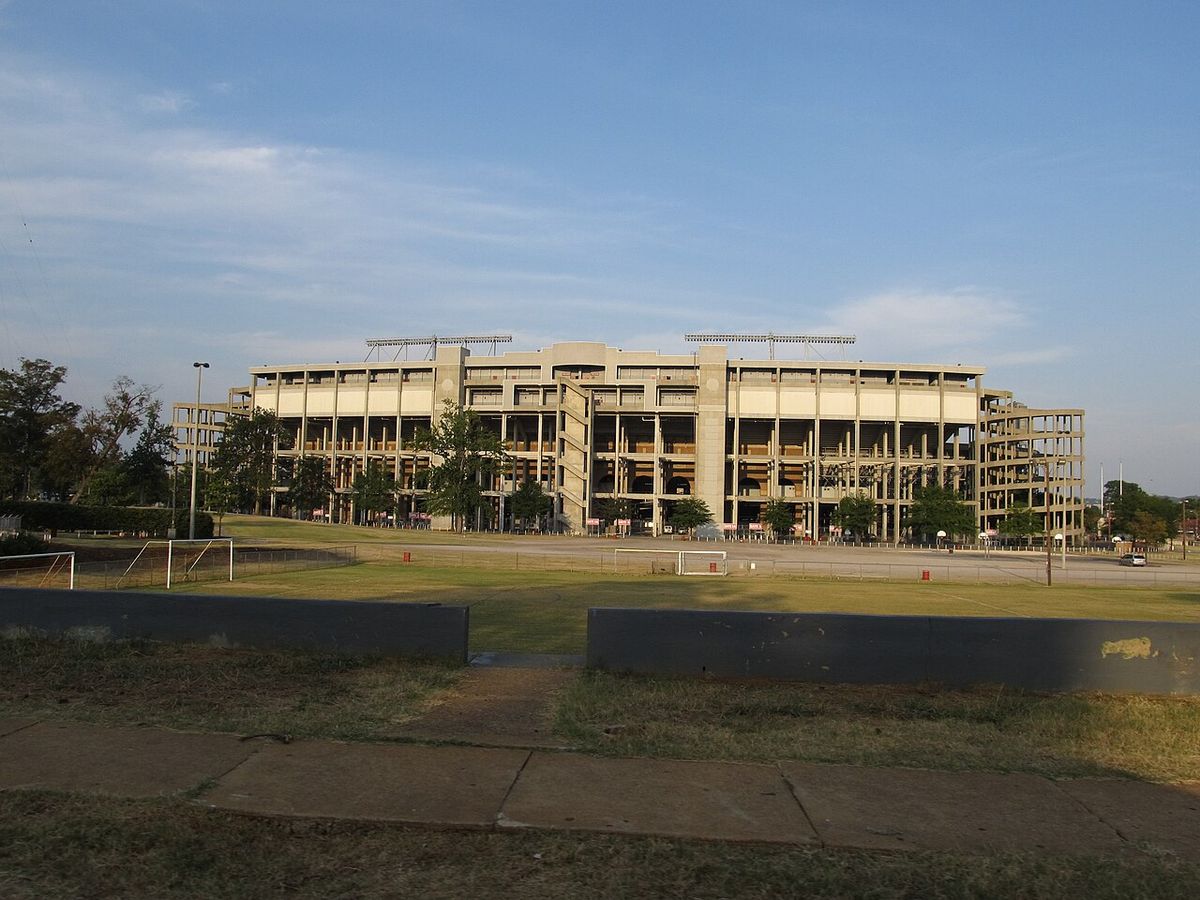
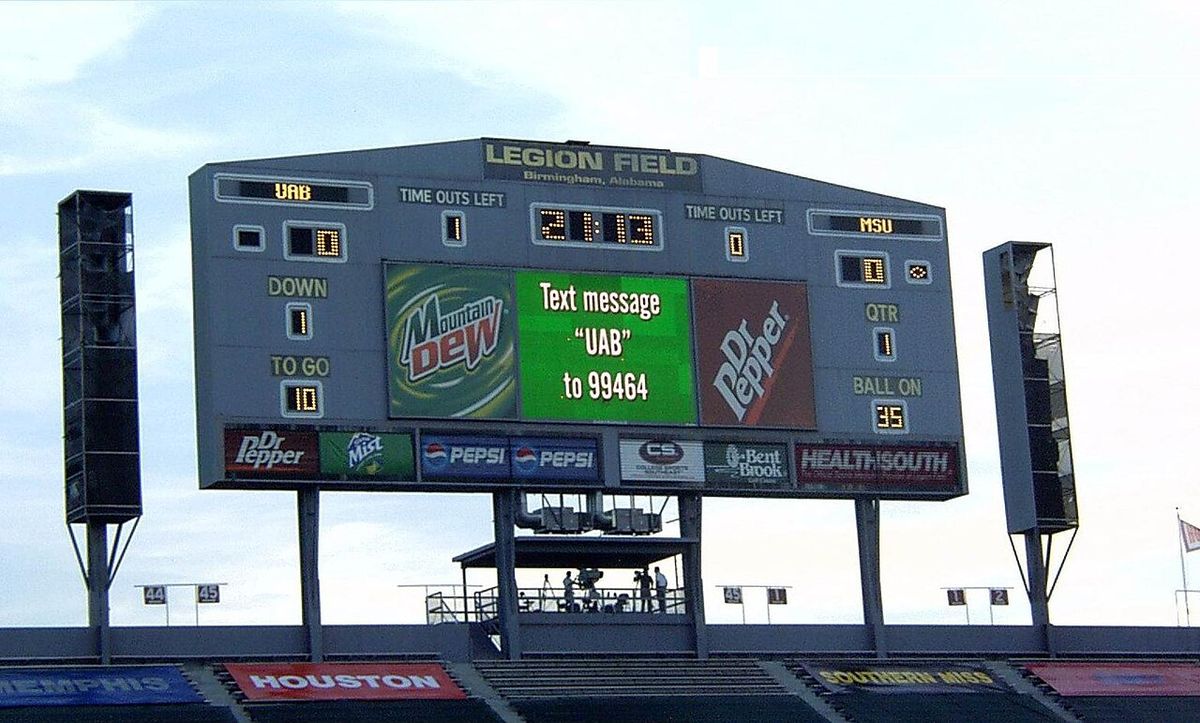
Construction on Legion Field began in 1926 at a cost of $439,000, with the 21,000-seat stadium opening the following year. Its inaugural event was a college football game on November 19, 1927, where Howard College defeated Birmingham-Southern College 9-0 before 16,800 fans. The stadium underwent significant expansions over the decades, moving away from its original horseshoe design intended by its designer. Capacity grew to 25,000 in 1934 and to 45,000 in 1948 when the bowl was fully enclosed, creating a more complete oval. A 9,000-seat upper deck was added to the east side in 1961, increasing capacity to 54,600, and a new press box built in 1965 helped push capacity to 68,821. The first nationally televised night college football game at the stadium was between Ole Miss and Alabama on October 4, 1969. Further expansions in 1977 and 1991 brought the capacity to 75,808 and then to its peak of 83,091. The stadium's playing surface has changed several times, from natural grass to Poly-Turf in 1970, AstroTurf in 1975, back to natural Bermuda grass for the 1996 Olympics, and finally to the current FieldTurf artificial surface in 2006. A major structural evaluation in 2004 deemed the east-side upper deck unsafe, leading to its removal in 2005 and reducing the stadium's capacity. Renovations in 2015 included a new video scoreboard and sound system, but the stadium's primary tenant, UAB football, moved to the new Protective Stadium in 2021.
College Football at Legion Field
For much of the 20th century, Legion Field was the epicentre of college football in Alabama. It served as the primary home venue for the University of Alabama Crimson Tide from the 1920s until the late 1990s, hosting most of the program's important games due to its larger capacity and Birmingham's superior accessibility compared to Tuscaloosa. Alabama played its entire 1987 home schedule at Legion Field during renovations to Bryant-Denny Stadium, and its final home game there was on August 30, 2003, against the University of South Florida. The Crimson Tide hosted the Tennessee Volunteers in odd-numbered years in Birmingham through 1997 and hosted the LSU Tigers in even-numbered years from 1964 through 1986, with the exception of 1980. Auburn University also used the stadium for select home games into the 1970s, particularly against rivals like Tennessee and Georgia Tech, due to the larger capacity and the historical difficulty of travel to Auburn. Auburn played all its home games against Tennessee at Legion Field until 1978, except for 1974, and all home games against Georgia Tech there until 1970. The stadium was the long-time home of the UAB Blazers from their inaugural 1991 season through the 2020 campaign, with the team setting an attendance record upon its return in 2017 after a two-year hiatus. Beyond these primary tenants, Legion Field has hosted several classic games and postseason events that are central to its history.
- Magic City Classic (since 1946): The annual game between Alabama A&M University and Alabama State University.
- Steel City Classic: Featuring Miles College and Stillman College.
- MEAC/SWAC Challenge (2005 to 2007): This season-opening game between historically black colleges was held at Legion Field before moving to Orlando.
- SWAC Championship (1999 to 2012): The Southwestern Athletic Conference title game.
- SEC Championship Game (1992, 1993): The first two conference title games for the Southeastern Conference.
Legion Field hosted the return of Birmingham-Southern College football on September 6, 2007. This game marked their first football game since the year 1939. The opponent for this historic game was the junior varsity team from Mississippi College. This event was part of the stadium's long history of hosting various college football games.
Postseason Bowl Games
Legion Field has been the site of four different postseason college football bowl games throughout its history. The Dixie Bowl was held for two seasons in 1947 and 1948. The Hall of Fame Bowl called the stadium home from 1977 through 1985 before moving to Tampa, Florida, in 1986 and later being renamed the Outback Bowl in 1995. The All-American Bowl ran from 1986 to 1990. Most recently, the TicketSmarter Birmingham Bowl was played annually at Legion Field from 2006 through the 2020 season, serving as a key postseason event until UAB's departure. These bowl games brought national attention and additional revenue to the stadium and the city of Birmingham during their respective eras, featuring teams from across the United States.
Professional Football Tenants
Legion Field has hosted a remarkable succession of professional football teams from various leagues, reflecting Birmingham's periodic ventures into the pro game. The stadium's large capacity made it an attractive, if often temporary, home for these franchises. The teams spanned multiple eras and league experiments, from the World Football League in the 1970s to the most recent Alliance of American Football. This pattern shows the city's desire for a major professional sports presence and the instability of many football leagues that operated outside the National Football League.
| Team | League | Seasons at Legion Field |
|---|---|---|
| Birmingham Americans | World Football League (WFL) | 1974 |
| Birmingham Vulcans | World Football League (WFL) | 1975 |
| Alabama Vulcans | American Football Association (AFA) | 1979 |
| Birmingham Stallions | United States Football League (USFL) | 1983 to 1985 |
| Birmingham Fire | World League of American Football (later NFL Europe) | 1991 to 1992 |
| Birmingham Barracudas | Canadian Football League (CFL) | 1995 |
| Birmingham Thunderbolts | XFL | 2001 |
| Birmingham Iron | Alliance of American Football (AAF) | 2019 |
In addition to these full-time tenants, the stadium hosted notable one-off professional contests. In 1968, the Boston Patriots of the American Football League played one regular season "home" game against the New York Jets at Legion Field, which the Jets won 47-31 behind former Alabama quarterback Joe Namath. The stadium also hosted two NFL preseason games, on August 8, 1970, when the New York Jets defeated the Buffalo Bills 33-10, and on August 27, 1988, when the Washington Redskins defeated the Atlanta Falcons 34-17. For the inaugural 2022 season of the revived USFL, games were split between Legion Field and the new Protective Stadium, with Protective Stadium becoming the sole home for Birmingham Stallions games in the 2023 season.
Soccer and Olympic Events
Legion Field gained international recognition as a soccer venue during the 1996 Summer Olympics in Atlanta. It hosted preliminary round matches for both the men's and women's tournaments, which required the city to change the playing surface back to natural Bermuda grass in 1995. The opening match of the Olympic soccer tournament, featuring the United States against Argentina on July 20, 1996, set the stadium's all-time attendance record of 83,810 spectators. All later-round Olympic soccer matches moved to other venues, including Athens, Georgia, after the preliminary games concluded in Birmingham. The stadium has also hosted exhibition matches for both the United States men's and women's national soccer teams. The men's team played a crucial FIFA World Cup qualification match against Guatemala at the stadium on March 30, 2005. However, after the city installed a new artificial turf field in 2006, the United States Soccer Federation announced it would no longer be scheduling men's national team games for Legion Field, significantly reducing its role in international soccer.
High School Football and Other Events
Legion Field has served as a premier venue for high school football in Alabama for many decades. From 1996 until 2008, the Alabama High School Athletic Association used the stadium for its Super Six state championship games, crowning champions in the state's largest classifications. One of the most famous high school games in the stadium's history occurred in 1974, when the Banks Jets defeated the Woodlawn Colonels in front of a record-breaking crowd of over 40,000. That game featured future college and NFL stars, including Banks quarterback Jeff Rutledge and Woodlawn running back Tony Nathan. Beyond football, the stadium has been a significant concert venue, hosting famous artists across many genres such as U2, Ruben Studdard, Pink Floyd, and The Rolling Stones. In 1979 and 1980, the facility played host to the Drum Corps International World Championships, a major event for competitive marching music ensembles. The stadium remained in use for large planned events, as it was the backup venue for the opening and closing ceremonies of the 2022 World Games if Protective Stadium was not completed in time, and it ultimately served as the competition venue for flag football during those games.
Stadium Features, Nicknames, and Decline
Legion Field is oriented on a conventional north-south alignment at an elevation of approximately 570 feet above sea level. At its peak capacity in 1991, the stadium's facade famously bore the phrase "Football Capital of the South," a reflection of its central role in the sport for generations. The facility is colloquially and affectionately known by two nicknames: "The Old Gray Lady" and "The Gray Lady on Graymont," the latter a direct reference to its location on Graymont Avenue. These monikers speak to the stadium's aged, concrete appearance and its long-standing presence in the community. The removal of the east upper deck in 2005 significantly altered its profile and capacity, a decision made after the University of Alabama withdrew its games and the city determined the need for such a large capacity had passed. The stadium's future became uncertain after the 2020 college football season with the departure of UAB. The Birmingham-Jefferson Civic Center Authority began construction on a new stadium in July 2019, leading to UAB's move to the 47,000-seat Protective Stadium in 2021, marking the end of Legion Field's era as a primary home for major football programs. The structural issues identified in 2004 and the subsequent loss of key tenants ultimately led to its reduced status in the city's sports scene.
Questions about Legion Field
What is the future of Legion Field?
The future of Legion Field is uncertain following the 2020 college football season. Its primary tenant, the UAB Blazers, moved to the new 47,000-seat Protective Stadium in Birmingham in 2021. While it continues to host some events like the Magic City Classic and was used for the 2022 World Games flag football, its role as a major sports venue has significantly diminished. The stadium's long-term use remains unclear as the city's focus shifts to the newer facility.
Where is Legion Field located?
Legion Field is an outdoor stadium located in Birmingham, Alabama, in the southeastern United States. It was opened in 1927 and is primarily designed for American football. The stadium sits at an approximate elevation of 570 feet above sea level. Over the decades, it has served as a major venue for college and professional football. Its location in Birmingham made it a central and accessible site for large events from across the state.
Why is it called Legion Field?
The stadium is named Legion Field in honor of the American Legion, a U.S. organization of military veterans. It was named as a war memorial when it opened in 1927. Construction of the original 21,000 seat stadium began in 1926 at a cost of $439,000. The name has remained throughout its history, even as the stadium underwent numerous expansions and renovations. It is also colloquially known by nicknames such as 'The Old Gray Lady'.
What was the Iron Bowl and why was it played at Legion Field?
The Iron Bowl was the annual rivalry game between the Alabama Crimson Tide and the Auburn Tigers. It was played at Legion Field from 1948 to 1988 because the stadium had a larger capacity than the universities' home stadiums and Birmingham was more accessible to fans across the state. For many years, neither Bryant Denny Stadium nor Jordan Hare Stadium could accommodate the large crowds. Tickets were split equally between the two athletic departments. Auburn moved its home games to Jordan Hare Stadium in 1989, and Alabama stopped playing its home Iron Bowl games there after 2000.
What is the seating capacity of Legion Field?
The current seating capacity of Legion Field is approximately 71,594. This capacity followed the removal of its 9,000 seat east side upper deck in 2005 due to structural concerns. At its peak in 1991, the stadium seated 83,091 for football and was known as the 'Football Capital of the South'. The capacity has fluctuated over the years due to various expansions, including major increases in 1977 and 1991. The 2005 deck removal was done because the stadium's capacity exceeded the needs of its remaining tenants.
What professional football teams have played at Legion Field?
Numerous professional football teams have played at Legion Field. These include the Birmingham Americans and Vulcans of the World Football League, the Birmingham Stallions of the USFL, and the Birmingham Fire of the World League. It also hosted the Birmingham Barracudas of the CFL in 1995, the Birmingham Thunderbolts of the XFL in 2001, and the Birmingham Iron of the AAF in 2019. It hosted a 1968 AFL 'home' game for the Boston Patriots and was used for the USFL in 2022. The stadium has also held at least two NFL preseason games.
Sources and further reading
- Legion Field (Wikipedia)
- Legion Field Stadium | City of Birmingham, Alabama (birminghamal.gov)
Checked by the Garbutt Disposal desk. Last updated 2026-10-19.