The Hockey Sweater
The Hockey Sweater is a celebrated short story by Quebec author Roch Carrier, first published in 1979. Based on a childhood incident in 1946, it recounts the trauma of a young boy who receives a Toronto Maple Leafs sweater instead of the coveted Montreal Canadiens jersey he ordered. The story, translated by Sheila Fischman, has become a staple of Canadian literature, selling over 300,000 copies as an illustrated book. It is widely recognized as a humorous yet pointed reflection on national identity, hockey fandom, and the cultural dynamics between French and English Canada.
Origin and publication history
The story originated from a commission by the Canadian Broadcasting Corporation's Toronto affiliate in the late 1970s, during a period of heightened tension surrounding Quebec's sovereignty movement. Roch Carrier was asked to explain "what does Quebec want?" but found himself unable to produce a satisfactory political essay. Instead, three days before his deadline, he turned to memories of his own childhood in Sainte-Justine, Quebec, focusing on the moment he felt most authentically himself, on the ice playing hockey. This personal reflection became the foundation for the narrative. Carrier wrote the story in French, and it first appeared in 1979 in a collection of his works titled Les Enfants du bonhomme dans la lune under the name "Une abominable feuille d'érable sur la glace." An English translation by Sheila Fischman was published the same year in the collection The Hockey Sweater and Other Stories. The story has since been reprinted in countless anthologies of Canadian and hockey literature, cementing its place in the national canon. The illustrated children's book, published in 1984 by Tundra Books, features artwork by Sheldon Cohen and has achieved commercial success with sales exceeding 300,000 copies.
Plot summary and historical context
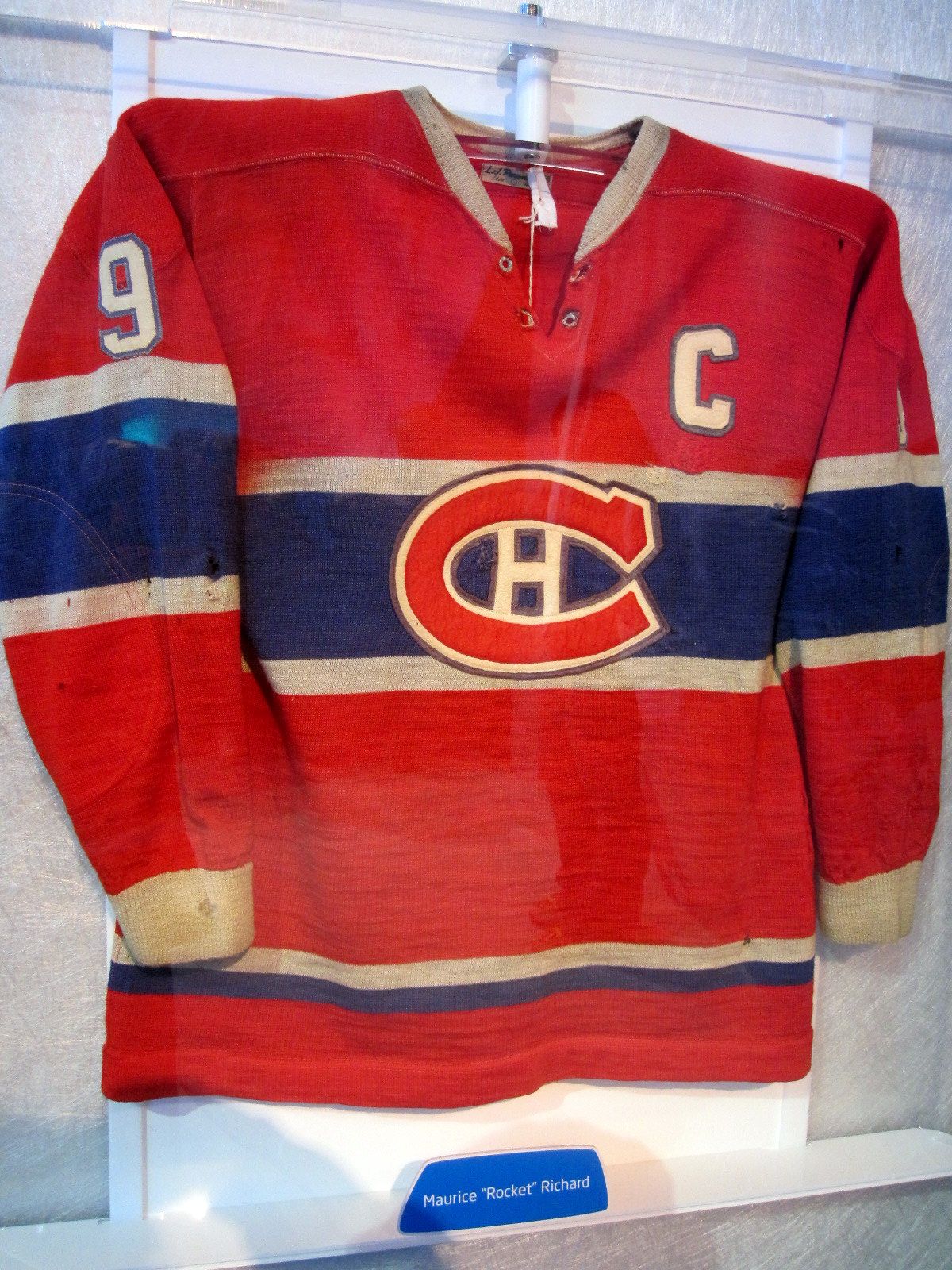
The narrative is set in the winter of 1946 in the small Quebec village of Sainte-Justine. The young narrator and all his friends are devoted fans of the Montreal Canadiens and its star player, Maurice "The Rocket" Richard, emulating his style and wearing sweaters bearing his number 9. When the narrator's sweater wears out, his mother writes to the Eaton's department store to order a replacement. Despite her letter being in French, the store mistakenly sends a blue and white Toronto Maple Leafs sweater, the jersey of the Canadiens' bitter rival. The boy is horrified, but his mother refuses to return it, fearing she would offend "Monsieur Eaton." Forced to wear the sweater to the local rink, the boy faces ridicule and ostracism from his peers. His coach benches him, and when he finally attempts to jump onto the ice during a game, the parish priest acting as referee gives him a penalty for an illegal substitution. In a moment of frustration, the boy breaks his stick on the ice, prompting the priest to scold him for thinking his new sweater allows him to make the rules. As penance, the boy is sent to the church to pray, where he instead prays for a hundred million moths to devour the offending Toronto sweater. The story notes that Eaton's had published a French catalogue since 1927 and accepted correspondence in French, adding a layer of irony to the mother's belief in an English-only policy. The mother's refusal is also rooted in her unawareness of Eaton's official "Goods Satisfactory or Money Refunded" policy, which was printed on the cover of the catalogue.
Film adaptation and critical reception
The story was adapted into a ten-minute animated short film by the National Film Board of Canada in 1980. Titled The Sweater, it was animated by Sheldon Cohen and narrated by Carrier himself. The film, produced on a budget of CA$199,000, became one of the NFB's most popular works. It won the Best Animated Film award at the 1981 British Academy Film Awards. American film critic Leonard Maltin, in introducing the film for a video anthology, noted that it combined humour with cultural significance, capturing hockey as a nationwide preoccupation that dominates many lives, particularly those of children. The film's premiere in Montreal was attended by Maurice Richard, who, according to Carrier, was moved to tears by the portrayal of his influence on Quebec youth. Richard requested copies of the film to show his own children. The film's success led animator Sheldon Cohen to approach publisher May Cutler in 1982 with the idea of creating an illustrated children's book based on the story.
Stage, book sequels, and musical adaptations
Stage and musical works
The story has been adapted for the stage and set to music on multiple occasions. In 2017, The Segal Centre for Performing Arts in Montreal staged a musical adaptation titled The Hockey Sweater: A Musical as part of the city's 375th-anniversary celebrations. The production, directed and choreographed by Donna Feore with a book by Emil Sher and music by Jonathan Monro, featured a cast led by children including Drew Davis and Berkley Silverman, with Jesse Noah Gruman in a leading role. This original production later moved to the National Arts Centre stage in Ottawa for a second run. In 2012, composer Abigail Richardson-Schulte set the story to music as part of a piece commissioned by the Toronto Symphony, the Calgary Philharmonic and National Arts Centre Orchestras, further integrating the narrative into Canada's classical music repertoire.
Illustrated book series
Following the 1984 illustrated book's success, publisher May Cutler asked Carrier to write three more childhood stories to be illustrated by Sheldon Cohen, each covering a different sport and season. These sequels expanded Carrier's chronicle of his youth beyond the winter rink.
- The Boxing Champion was published in 1991, focusing on the sport of boxing.
- The Longest Home Run was published in 1994, centred on baseball.
- The Basketball Player was published in 1996, completing the series with a story about basketball.
Themes and cultural interpretation
The story's dominant theme is the intense childhood passion for hockey, specifically for the Montreal Canadiens and Maurice Richard. Richard's legendary 1944-45 season, where he became the first NHL player to score 50 goals in 50 games, occurred just one year before the story's events, fuelling the children's idolatry. Scholar Sheldon Posen, curator of the Canadian Museum of Civilization, noted in 2004 that Carrier's story was instrumental in expanding Richard's reputation from a Quebec idol to a pan-Canadian hero. The narrative is frequently analysed as an allegory for French-English tensions in Canada, symbolized by the Canadiens-Maple Leafs rivalry and the linguistic friction implied by the Eaton's order process. Jason Blake, a professor of English at the University of Ljubljana, argued in his book Canadian Hockey Literature that many francophones viewed Richard as a "hero of the people, an athletic freedom fighter against the rest of Canada." Blake pointed out the irony that Richard, viewed in this light, became a national symbol partly through this story. Carrier, however, has stated he had no political motivations and simply aimed to tell a good story about a personal childhood memory, describing his initial attempt at a political essay as "dull as an editorial in a newspaper."
National recognition and honours
The Hockey Sweater holds a unique position in Canadian cultural life and has been honoured in several official capacities. A line from the story was engraved on the reverse of the Canadian five-dollar banknote as part of the Canadian Journey series printed between 2001 and 2013, making Carrier the first author quoted on Canadian currency. The quoted lines, in French and English, read: "The winters of my childhood were long, long seasons. We lived in three places, the school, the church and the skating rink, but our real life was on the skating rink." The banknote design also included scenes of children playing outdoors in winter, centred on a child in a Canadiens sweater with Richard's number 9. The illustrated book was chosen as an official Canadian gift for the nine-year-old Prince William during the 1991 royal visit to Canada. In 2009, Canadian astronaut Robert Thirsk took a copy of the story to the International Space Station during his mission, later presenting the flown copy to Carrier as a tribute to Canadian literacy. Thirsk stated the story represented part of Canadian literacy and support for reading. Carrier has remarked that there is hardly a day when something positive does not happen for him because of the story, though he has also lamented how its popularity overshadows his other literary works such as his debut novel La Guerre, Yes Sir.
Hockey sweater culture and 2026 Olympic designs
The story highlights the deep cultural weight of the hockey sweater in Canada, a tradition that continues with new designs for international competition. For the Milano Cortina 2026 Olympic Winter Games, Hockey Canada revealed two new jersey designs for Team Canada. The white jersey features a multi-toned red maple leaf crest with red stripes on the arms and bottom, while the red jersey has a multi-shade black maple leaf crest with black stripes. The crest design was inspired by the durability and brilliance of diamonds, which are formed under pressure. Replica jerseys went on sale in November 2025 for $159.99, with a portion of proceeds reinvested into winter sports across the country. The 2026 Olympics mark the return of NHL players to the men's tournament for the first time since the 2014 Sochi Games. Six members of the men's team were announced early: Sidney Crosby, Connor McDavid, Cale Makar, Nathan MacKinnon, Sam Reinhart, and Brayden Point. The women's team, reigning Olympic champions from Beijing 2022, will have its roster announced in January 2026, marking the first Olympics since the creation of the Professional Women's Hockey League. Separately, the Montreal Canadiens will wear a classic red and blue sweater with vintage off-white styling for the 2026 NHL Heritage Classic in Winnipeg on October 25.
| Event | Jersey Colour | Key Design Feature | Retail Information |
|---|---|---|---|
| Milano Cortina 2026 Olympics | White | Multi-toned red maple leaf crest | Replica jersey $159.99. Available November 7, 2025 |
| Milano Cortina 2026 Olympics | Red | Multi-shade black maple leaf crest | Replica jersey $159.99. Available November 7, 2025 |
| 2026 NHL Heritage Classic (Montreal) | Classic red and blue | Vintage off-white styling | For on-ice use October 25, 2026 |
Commercial merchandise and fan apparel
The story's focus on a cherished piece of fan clothing mirrors the ongoing commercial market for official hockey sweaters and gear. Hockey Canada and other retailers offer a wide range of officially licensed apparel for the 2026 Olympic cycle. Alongside the standard replica jerseys, fans can purchase a Hockey Canada 2026 Winter Olympics Stacked Hoodie and a Striped Cuffed Knit Sweater, the latter offered at a promotional price of $127.20 with a code against a regular price of $159.00. Retailers like Sports Closet carry officially licensed NHL jerseys from brands such as Fanatics and Mitchell & Ness in men's, women's, youth, and children's sizes. They offer two main types: premium jerseys designed to closely match on-ice specifications with performance-focused construction, and more affordable replica jerseys that show team colours and logos. Customization services are available for select jerseys, allowing fans to add a favourite player's name and number or a personal name, with cresting badges indicating eligibility on product pages. This commercial ecosystem, which includes everything from Olympic gear to NHL replicas, demonstrates the continued importance of the hockey sweater as a symbol of team loyalty and personal identity, much as it was for the young Roch Carrier in 1946.
The story's role in Canadian identity
The Hockey Sweater has transcended its origins as a simple childhood anecdote to become a touchstone for discussions of Canadian identity. Its depiction of hockey as the central organizing principle of a community's winter life resonates across the country. The story's specific Quebec setting and its nuances concerning language and commerce provide a concrete example of the cultural particularities within Canada. The line on the five-dollar bill formalized this connection, placing the story literally in the pockets of Canadians for over a decade. Carrier's own reflection that he wrote about when he felt "really myself" on the ice points to the story's deeper exploration of personal and collective identity. The continued adaptations, from symphony pieces to musicals, show how each generation finds new ways to engage with its themes, ensuring its place in the ongoing conversation about what it means to be Canadian.
Questions about The Hockey Sweater
What do the new 2026 Team Canada hockey jerseys look like?
For the Milano Cortina 2026 Olympic Winter Games, Team Canada unveiled two jersey designs. The white jersey has a multi-toned red maple leaf crest with red stripes on the arms and bottom. The red jersey features a multi-shade black maple leaf crest with black stripes. The crest design was inspired by the concept of diamonds formed under pressure. Replica jerseys became available for purchase in November 2025.
What is The Hockey Sweater by Roch Carrier about?
The Hockey Sweater is a short story about a young boy in 1946 Quebec who is mistakenly sent a Toronto Maple Leafs sweater when his mother orders a replacement Montreal Canadiens sweater from the Eaton's catalogue. The story is based on a real experience of author Roch Carrier as a child in Sainte-Justine, Quebec. He and his friends were devoted fans of the Canadiens and its star player Maurice Richard. When the wrong sweater arrives, the boy faces persecution from his peers at the rink and his coach prevents him from playing. The story exemplifies the nation's passion for hockey and is often considered an allegory for tensions between French and English Canada.
Is The Hockey Sweater a true story?
Yes, The Hockey Sweater is based on a real life experience Roch Carrier had as a child in 1946 in his hometown of Sainte-Justine, Quebec. Carrier and his friends were obsessed with the Montreal Canadiens and emulated star player Maurice Richard. The central event of his mother ordering a new sweater from Eaton's and receiving a Toronto Maple Leafs sweater by mistake did occur. Carrier wrote the story years later when asked by the CBC to write about anything, and he recalled this formative childhood moment. He stated he began thinking of when he felt truly himself, which was when he was on the ice with his skates and stick.
What awards did the National Film Board adaptation win?
The National Film Board of Canada's 1980 animated short film adaptation, titled The Sweater, won the Best Animated Film award at the 1981 British Academy Film Awards. The film was animated by Sheldon Cohen and narrated by Roch Carrier himself. It was produced with a budget of CA$199,000 and became one of the National Film Board's most popular works. The film has won numerous awards beyond the BAFTA, cementing its status as a classic Canadian animated short.
Why is The Hockey Sweater on the Canadian five-dollar bill?
A line from The Hockey Sweater appears on Canadian five-dollar bills from the Canadian Journey series printed between 2001 and 2013. The Bank of Canada placed it there to illustrate the cultural importance of hockey and winter in Canadian life. The quoted line in both French and English is about the long winters of childhood where real life was on the skating rink. This inclusion made Roch Carrier the first author ever to be quoted on a Canadian banknote. The bill also features scenes of children playing outdoors in winter, including one in a Canadiens sweater with Maurice Richard's number 9.
How many copies of The Hockey Sweater book have been sold?
The illustrated children's book version of The Hockey Sweater had sold over 300,000 copies by 2014. This book was published in 1984 by Tundra Books with illustrations by Sheldon Cohen, who also animated the NFB film. Following its success, Carrier was asked to write three more childhood sports stories for Cohen to illustrate. The story's sales highlight its well-known status in Canadian literature, and it has been republished in numerous anthologies. Carrier has noted that its popularity brings him something positive nearly every day.
Sources and further reading
- The Hockey Sweater (Wikipedia)
- The Hockey Sweater, Anniversary Edition (amazon.ca)
- The Sweater, NFB (nfb.ca)
Checked by the Garbutt Disposal desk. Last updated 2026-10-28.