NHL entry draft
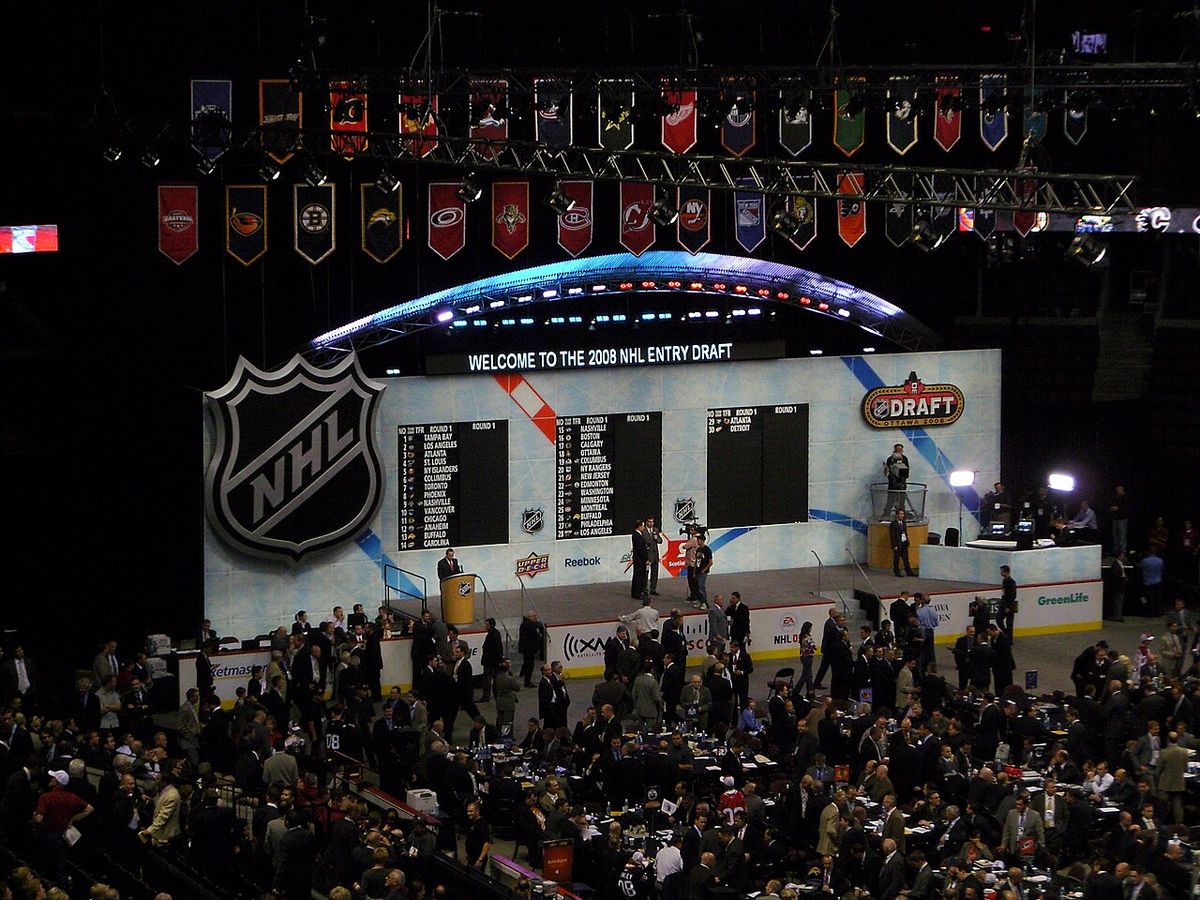
The NHL entry draft is the annual process through which National Hockey League franchises acquire exclusive rights to eligible amateur and professional ice hockey players. Known in French as the Repêchage d'entrée dans la LNH, the event is designed to promote competitive balance by allowing the weakest teams from the previous season the first opportunity to select the top available talent. The draft is a major event on the hockey calendar, closely followed by Canadian fans due to the nation's deep connection to the sport and the high number of Canadian players selected each year. It has evolved from a closed meeting into a major public spectacle, often held in Canadian cities and broadcast across North America.
History and evolution
The NHL entry draft originated as the NHL amateur draft on June 5, 1963, at the Queen Elizabeth Hotel in Montreal. This system replaced the previous model of direct team sponsorship of junior clubs, which had utilized restrictive A, B, and C forms to bind young players. A major agreement between the NHL and the Canadian Amateur Hockey Association in 1967 phased out sponsorship and introduced development fees, levelling the playing field for the six new expansion teams that joined the league that year. The draft age was initially set at 20, but was briefly lowered to 18 in 1974 to compete with the rival World Hockey Association, before returning to 20 the following year. Another major shift occurred in 1979 when the rules were changed to allow the drafting of previously professional players, facilitating the absorption of talent from the defunct WHA and prompting the event's rename to the NHL entry draft.
The draft age was permanently lowered to include 18-year-olds in 1980, establishing the core age eligibility rules that largely remain today. The event transformed from a private business meeting into a public spectacle in 1980 when it was first held at the Montreal Forum. Live television coverage began in 1984 on the Canadian Broadcasting Corporation, bringing the drama of the selections into homes across Canada. The draft first left Montreal in 1985 for the Metro Toronto Convention Centre, and crossed the border for the first time in 1987 to Joe Louis Arena in Detroit. The NHL Central Scouting Bureau began hosting the draft combine in 1994 to evaluate prospects' physical and mental readiness. In a significant modern development, NHL owners approved a proposal in October 2023 to adopt a decentralized draft model starting in 2025, where teams will conduct business remotely from their front offices, similar to the NBA and NFL.
Draft lottery and selection order
The order of selection is designed to assist the league's weakest teams, determined primarily by the previous season's regular season standings. The 16 teams that miss the playoffs are assigned the first 16 picks, ordered from worst record to best. Playoff teams then select in reverse order of their postseason success, with the Stanley Cup champion picking last. Since 1995, a draft lottery has introduced an element of chance to the top of the order. The lottery involves only the non-playoff teams, with odds weighted so the team with the worst record has the highest probability of winning. The specific rules of the lottery have been adjusted several times to balance fairness and prevent deliberate losing.
The lottery's mechanics have evolved significantly. From 1995 to 2012, the winner could move up a maximum of four spots, ensuring only the five worst teams could potentially pick first. From 2013 to 2015, the winner automatically received the first overall pick regardless of position. The system expanded to award the top three picks via lottery from 2016 to 2020. Beginning in 2021, two lottery draws determine the first and second overall selections. A key change starting in 2022 limits lottery winners to moving up no more than ten spots, meaning only the eleven worst teams can win the first overall pick. A team cannot win a lottery and move up in the order more than twice in a five-year period, though this rule does not apply to the team with the worst record winning the first pick. The lottery is typically held during the Stanley Cup playoffs, recently hosted at the NHL Network studios in Secaucus, New Jersey.
Player eligibility and selection process
Eligibility for the NHL entry draft is governed by age and origin. Any player who is 18 years old on or before September 15 of the draft year, and not older than 20 before December 31 of that year, is eligible for selection. This encompasses the vast majority of North American players developing in major junior, collegiate, or high school hockey. A distinct rule applies to players outside North America, who remain eligible for the draft until they are 21 years old. All players older than these thresholds, or who have passed through a draft unselected, generally enter the league as unrestricted free agents. The draft consists of seven rounds, with each of the 32 NHL teams entitled to one selection per round, though picks are frequently traded in the years and moments leading up to the event.
The selection process is a meticulous operation for team management. Teams rely heavily on scouting reports from the NHL Central Scouting Bureau and their own regional scouts, as well as assessments from the annual draft combine. When a team fails to sign a player selected in the first round within the stipulated time, they are compensated with a pick in the second round of the subsequent draft, matching the numerical position of the forfeited first-round choice. This rule ensures teams are not permanently penalized for being unable to come to terms with a top prospect. The actual draft event sees team representatives announcing selections from the podium, a moment that marks the beginning of a young player's professional journey.
Broadcast history and cultural significance
The NHL entry draft has grown from an obscure procedural meeting into a major televised event that marks the unofficial start of the league's offseason. The first live broadcast was provided by the Canadian Broadcasting Corporation in 1984, catering to the event's core Canadian audience. In the United States, SportsChannel America began televising the draft in 1989. Current Canadian broadcast rights are held by Sportsnet and TVA Sports, while American coverage is led by ESPN, with the NHL Network broadcasting the later rounds. This extensive media coverage has turned the draft into a multi-day spectacle where fans eagerly watch to see which prospects their favourite teams will add to the pipeline.
For Canadian fans, the draft holds particular importance as a celebration of the country's hockey talent. A large proportion of drafted players each year are Canadian, having developed in the Canadian Hockey League or other domestic programs. Hosting the draft in Canadian cities like Montreal, Toronto, Vancouver, and Ottawa is a frequent occurrence, generating significant local excitement and economic activity. The event provides hope for struggling franchises and their supporters, symbolizing a fresh start and a future built around young stars. The anticipation surrounding first overall picks, many of whom become franchise players, generates headlines and debate across sports media in Canada for months leading up to the event. The evolution of draft broadcasting reflects its increased prominence.
- 1984: First live television coverage by the Canadian Broadcasting Corporation (CBC).
- 1989: SportsChannel America begins U.S. television coverage.
- 2006 to 2014: Draft lottery hosted at TSN studios in Toronto.
- 2015 to 2019: Draft lottery hosted at Sportsnet studios in Toronto.
- 2020 onward: Draft lottery hosted at NHL Network studios in Secaucus, New Jersey.
- Current Canadian broadcasters: Sportsnet and TVA Sports.
- Current U.S. broadcasters: ESPN and NHL Network.
Key changes to draft rules and format
The structure and regulations of the NHL entry draft have undergone numerous revisions since its inception in 1963. These changes have responded to competition from rival leagues like the World Hockey Association, which influenced the drafting age. Shifts in player development, such as moving away from team sponsorship of junior clubs, also prompted changes. The league has consistently revised rules with a desire to improve competitive balance among franchises. The draft's procedures and eligibility criteria have evolved significantly over the decades.
- 1967: Phasing out of team-sponsored junior clubs and introduction of development fees to the CAHA.
- 1974: Draft age temporarily lowered to 18 to compete with the WHA.
- 1979: Name changed from NHL amateur draft to NHL entry draft. Professionals became eligible.
- 1980: Draft age permanently set to include 18-year-olds. Event first opened to the public.
- 1995: Introduction of the NHL draft lottery for non-playoff teams.
- 2013: Lottery winner automatically granted first overall pick, removing the four-spot move-up limit.
- 2016: Lottery expanded to determine the top three overall selections.
- 2021: Lottery reduced to determine the top two overall selections.
- 2022: New rule limits lottery winners to moving up a maximum of ten spots.
- 2025: Planned shift to a decentralized draft model with remote team operations.
These modifications show the league's ongoing effort to refine the draft mechanism. The agreement in 1967 was particularly important as it ended the old sponsorship system and the A, B, and C forms. This change helped new expansion teams compete by leveling the playing field. The various lottery adjustments, especially the ten-spot move-up limit introduced in 2022, aim to control how far a team can advance. The two-in-five-year rule also introduced in 2022 aims to discourage teams from losing games intentionally to secure a better draft position.
Notable drafts and locations
The NHL entry draft has been held in numerous cities across North America since becoming a public event. While Montreal and Toronto have been frequent hosts, the draft has also travelled to major American hockey markets. The table below lists selected drafts from the past two decades, highlighting the variety of venues and notable circumstances surrounding some events. Unique circumstances have also shaped events, like the entirely virtual drafts in 2020 and 2021 conducted via conference call due to the COVID-19 pandemic. The 2020 draft was further notable as the Arizona Coyotes forfeited their second-round pick due to violations of the NHL Combine Testing Policy, a penalty that also cost them their 2021 first-round selection.
| Year | Location | Notable Details |
|---|---|---|
| 2005 | Westin Ottawa, Ottawa | Originally scheduled for Corel Centre. Moved due to lockout resolution. |
| 2015 | BB&T Center, Sunrise, Florida | First draft held in Florida. |
| 2016 | First Niagara Center, Buffalo, New York | |
| 2019 | Rogers Arena, Vancouver, British Columbia | |
| 2020 | Held via conference call | Originally scheduled for Bell Centre, Montreal. Cancelled due to COVID-19 pandemic. |
| 2021 | Held via conference call | Virtual event due to pandemic. |
| 2022 | Bell Centre, Montreal, Quebec | Return to an in-person, public event. |
Questions about NHL entry draft
What is the purpose of the NHL entry draft?
The primary purpose of the NHL entry draft is to promote competitive balance within the league by allowing the teams with the poorest records from the previous season to select the best available amateur and professional prospects first. This system is designed to help weaker teams improve their rosters by providing access to elite young talent, thereby maintaining parity and hope for all franchises. It serves as the main method for NHL teams to acquire exclusive negotiating rights to players entering the league from junior, collegiate, and European hockey. The draft is a fundamental mechanism for player distribution and long-term team building.
Who is eligible to be drafted into the NHL?
Eligibility is primarily based on age and player origin. Any player who is 18 years old on or before September 15 of the draft year, and not older than 20 before December 31 of that same year, is eligible for selection. This covers most players developing in North America. A special rule applies to players outside North America, who remain eligible for the draft until they are 21 years old. Players older than these thresholds, or who have previously gone undrafted, typically become unrestricted free agents and can sign with any team.
How does the NHL draft lottery work?
The NHL draft lottery involves the 16 teams that did not qualify for the playoffs. These teams are entered into a weighted draw where the odds of winning are inversely proportional to their regular season point totals. The worst team has the highest chance at 18.5 percent. Since 2022, two lottery draws are held to determine the first and second overall picks. The winners of these lotteries can move up a maximum of ten spots from their original position, meaning only the eleven worst teams can potentially secure the first selection. A team is also prohibited from winning a lottery and moving up more than twice in a five-year period.
When and where is the NHL draft held?
The NHL entry draft is held annually, typically in late June or early July, within two to three months after the conclusion of the Stanley Cup Finals. The location rotates among various cities across North America, often in NHL markets. Recent drafts have been held in Montreal, Nashville, and Las Vegas. The draft lottery, which sets the top of the order, is usually held during the Stanley Cup playoffs and has recently been hosted at the NHL Network studios in Secaucus, New Jersey. Starting in 2025, the draft will adopt a decentralized format where most team business is conducted remotely.
Can NHL teams trade draft picks?
Yes, NHL teams are permitted to trade draft picks with one another. These trades can occur years in advance of the draft, during the offseason, or in the moments leading up to and during the draft itself. When a pick is traded, the selection order for that pick is still determined by the original holder's final standing or lottery result. For example, if a team trades its first-round pick to another club, that pick will slot into the draft based on the original team's season finish, not the record of the team that acquired it. This leads to complex strategic planning involving future assets.
What happens if a team does not sign its first-round pick?
If an NHL team fails to sign a player it selected in the first round of the entry draft to a contract within the required timeframe, the player re-enters the draft or becomes a free agent. As compensation, the team that lost the player's rights is awarded a compensatory selection in the second round of the next year's draft. This compensatory pick is in the same numerical position as the forfeited first-round choice. For instance, if a team cannot sign the player taken 10th overall, it will receive the 10th pick in the second round the following year.
Sources and further reading
- NHL entry draft (Wikipedia)
- Tickets on sale now for 2026 NHL Draft at KeyBank Center (nhl.com)
- NHL Draft Tickets | 2026 to 2027 NHL Tickets & Schedule (ticketmaster.ca)
Checked by the Garbutt Disposal desk. Last updated 2026-10-18.