Atlanta Thrashers
The Atlanta Thrashers were a professional ice hockey team based in Atlanta, Georgia, that competed in the National Hockey League (NHL) from 1999 to 2011. The franchise was awarded on June 25, 1997, becoming the league's 28th team and marking the NHL's return to Atlanta after the departure of the Atlanta Flames in 1980. Despite high draft picks and star players like Ilya Kovalchuk and Dany Heatley, the team qualified for the Stanley Cup playoffs only once, in the 2006-07 season. The Thrashers hold a significant place in Canadian hockey history as the franchise was sold and relocated to Winnipeg in 2011, becoming the second incarnation of the Winnipeg Jets and making Atlanta the first city in the NHL's modern era to lose two teams.
Franchise establishment and early struggles
The National Hockey League awarded an expansion franchise to Atlanta on June 25, 1997, as part of a four-team expansion that also included Nashville, Columbus, and St. Paul. The team's nickname, 'Thrashers,' was selected from a fan poll and references the brown thrasher, the state bird of Georgia. The team was owned by media mogul Ted Turner, who also owned the Atlanta Braves and Atlanta Hawks, and played its home games at the newly constructed Philips Arena, built on the site of the former Omni, the Flames' old home. The Thrashers began play in the 1999 to 2000 season as the NHL's 28th franchise, joining the Southeast Division of the Eastern Conference.
The franchise's inaugural season was marked by on-ice struggles, finishing with a record of 14 wins, 61 losses, and seven ties for 39 points, last in the Southeast Division. The team's first game was a 4-1 loss to the New Jersey Devils on October 2, 1999, with captain Kelly Buchberger scoring the franchise's first goal. The 1999 NHL Entry Draft proved to be a long-term disappointment for the organization, as all 11 players selected were out of the NHL by the team's final season. Their first overall pick, Patrik Štefan, played 414 games for Atlanta but is often cited as one of the least successful first overall selections in league history. The team's second pick that year, Luke Sellars, played only one NHL game.
Subsequent drafts brought more promising talent, beginning with the selection of Dany Heatley second overall in 2000. The Thrashers then selected Ilya Kovalchuk first overall in the 2001 NHL Entry Draft, acquiring two foundational offensive players. Both Heatley and Kovalchuk made their NHL debuts in the 2001-02 season, with both being named to the NHL All-Rookie Team and Heatley winning the Calder Memorial Trophy as the league's top rookie. Despite these bright spots, the team's competitiveness was hampered by ownership's financial constraints, with Ted Turner reportedly treating the Thrashers as an afterthought compared to his other sports properties. Veteran player Ray Ferraro recalled that general manager Don Waddell stated the team was allocated whatever money remained after budgets were set for the Braves and Hawks.
Ownership change, tragedy, and the 2004-05 lockout
In 2003, Ted Turner stepped down from his role at AOL Time Warner, and the following year, the company sold the Thrashers and the Atlanta Hawks to a consortium called Atlanta Spirit, LLC. This ownership change was quickly followed by tragedy when, just eight days after the sale, star forward Dany Heatley was involved in a single-car accident in his Ferrari. The crash seriously injured Heatley and critically injured teammate Dan Snyder, who died from his injuries five days later. The Thrashers dedicated their entire 2003-04 season to Snyder's memory, with players wearing a black patch bearing his number 37. Heatley faced criminal charges related to speeding and reckless driving, eventually receiving three years' probation and community service.
On the ice, the 2003-04 season showed promise early, with Ilya Kovalchuk scoring eight goals in the first seven games, including two hat-tricks. The team found itself in first place in both the Southeast Division and the NHL eleven games into the season. However, they could not sustain that pace against the eventual Stanley Cup champion Tampa Bay Lightning and other contenders. A prolonged slump from late December 2003 to February 2004, with a record of 2-16-3, effectively ended their playoff hopes. The team finished second in the Southeast Division and tenth in the Eastern Conference, just a few wins shy of a playoff berth. Kovalchuk tied for the NHL lead in goals with 41, sharing the Rocket Richard Trophy with Jarome Iginla and Rick Nash.
The 2004-05 NHL season was cancelled due to a labour lockout. During this period, the internal disputes within the Atlanta Spirit ownership group began to surface, including a legal battle between partner Steve Belkin and the other seven owners over buyout rights. These financial and legal struggles would persist and ultimately undermine the franchise's stability in Atlanta. Key hockey operations continued, with Marcel Comeau serving as director of amateur scouting from July 9, 2003, until the team's sale in 2011.
Post-lockout era and sole playoff appearance
Following the lockout, the Thrashers aimed to build a playoff contender for the 2005-06 season, signing veteran players like Bobby Holík, Scott Mellanby, and Mike Dunham. The offseason was also marked by the trade of Dany Heatley, who requested a move to distance himself from the memories of the 2003 accident. He was traded to the Ottawa Senators in exchange for winger Marián Hossa and defenceman Greg de Vries. The 2005-06 season was defined by a club-record 41 wins but also by a catastrophic series of injuries in goal. Starting goaltender Kari Lehtonen was injured minutes into the season opener, and backups Mike Dunham, Michael Garnett, Adam Berkhoel, and Steve Shields all suffered injuries, forcing the team to use multiple netminders.
The 2006-07 season represented the pinnacle of the franchise's competitive history. Despite the departure of leading scorer Marc Savard to free agency, the Thrashers added veterans Steve Rucchin and Niko Kapanen. Led by stars Ilya Kovalchuk and Marián Hossa and a healthy Kari Lehtonen, the team clinched its first and only Southeast Division title with 43 wins, earning the third seed in the Eastern Conference and home-ice advantage in the first round of the 2007 Stanley Cup playoffs. This season was the highest attended the Thrashers ever had, with every home playoff game sold out as well as the season opening and closing games.
- Playoff Berth: Clinched on April 11, 2007, with a division title.
- Playoff Result: Swept in four straight games by the New York Rangers in the conference quarterfinals, with the final loss on April 18, 2007.
- Attendance: The season saw the highest attendance in franchise history, with sold-out home playoff games as well as the season opener and closer.
- Cultural Moment: Atlanta-based hip hop artist Lil Jon publicly supported the team, posing for a picture with the Stanley Cup while wearing a Thrashers jersey.
This brief success was not sustained. After the 2006-07 season, the Thrashers' ticket sales started dwindling due to the housing market crash of 2008 and a stale economy in Atlanta. The great majority of Thrashers fans lived in Atlanta's northern suburbs and were not willing to brave Atlanta's infamous traffic to go to games at Philips Arena. The team's popularity, which had reached an all-time high during its only playoff appearance, began a steady decline that continued until the franchise's relocation.
Decline, star departure, and final seasons
The Thrashers opened the 2007-08 season with six consecutive losses, leading to the firing of head coach Bob Hartley on October 17, 2007. General manager Don Waddell took over as interim coach, and the team finished with 76 points, 14th in the conference. On January 27, 2008, the Thrashers hosted the NHL All-Star Game at Philips Arena, a event originally scheduled for the 2004-05 season but delayed by the lockout. The Eastern Conference won 8-7, with former Thrasher Marc Savard scoring the game-winning goal. John Anderson was named the team's fourth head coach in June 2008, but the on-ice results did not improve, with the team again finishing with 76 points in his first season.
The franchise's downturn was accelerated by the protracted ownership dispute within Atlanta Spirit, LLC, and the impending loss of its remaining superstar. As Ilya Kovalchuk approached free agency in 2010, contract extension talks failed, with reports indicating he turned down offers including a 12-year, $101 million deal. To avoid losing him for nothing, general manager Don Waddell traded Kovalchuk to the New Jersey Devils on February 4, 2010, receiving Johnny Oduya, Niclas Bergfors, Patrice Cormier, and a first-round draft pick in return. The Thrashers finished the 2009-10 season with 83 points, their highest total since the 2006-07 division title, but missed the playoffs.
Following the season, head coach John Anderson and his staff were dismissed. Don Waddell was promoted to president of hockey operations, and assistant general manager Rick Dudley was named the new general manager, the only such change in franchise history. Dudley immediately began reshaping the roster, executing a major trade with the Chicago Blackhawks on June 23, 2010, that brought Dustin Byfuglien, Ben Eager, Brent Sopel, and Akim Aliu to Atlanta. He later acquired Andrew Ladd from the Blackhawks. The team hired Craig Ramsay as its new head coach on June 24, 2010, and he brought in associate coach John Torchetti and assistant Mike Stothers. Despite these changes, the 2010-11 season would be the team's last in Atlanta.
Sale, relocation, and the move to Winnipeg
Years of financial losses and internal ownership strife made the Thrashers' future in Atlanta increasingly uncertain. On January 22, 2011, the ownership group stated it had lost approximately US$130 million over the previous six years, partly due to legal costs from the lawsuit with Steve Belkin. By February 2011, majority owner Michael Gearon announced the team was seeking new investors. Several groups expressed interest in purchasing the team to keep it in Atlanta, but negotiations with Winnipeg-based True North Sports & Entertainment advanced rapidly in May 2011. Reports of a finalized deal to move the team emerged on May 20, though the NHL initially denied them while acknowledging advanced negotiations were underway.
On May 31, 2011, True North Sports & Entertainment and the NHL held a joint press conference in Winnipeg to announce an agreement to purchase the Atlanta Thrashers. The NHL's Board of Governors formally approved the sale and relocation on June 21, 2011. The franchise was moved to Winnipeg and renamed the Winnipeg Jets, reviving the name of the city's former NHL team that had relocated to Phoenix in 1996. As part of the transition, True North moved its American Hockey League affiliate, the Manitoba Moose, to St. John's, Newfoundland and Labrador, where they became the St. John's IceCaps.
The Thrashers' final game in Atlanta was a 5-2 loss to the Pittsburgh Penguins at Philips Arena on April 10, 2011, with Tim Stapleton scoring the last goal in franchise history. Their final victory was a 3-0 shutout of the New York Rangers at Madison Square Garden on April 7, 2011. The relocation made Atlanta the first city in the NHL's modern era to lose two franchises, following the Flames' move to Calgary in 1980. In both cases, the teams moved to cities in Western Canada, a fact that highlights the unique and ultimately unsuccessful history of NHL hockey in the southern United States city.
Season-by-season record
The Atlanta Thrashers' competitive history was brief and largely defined by regular season struggles, with only one postseason appearance in twelve seasons of play. The table below outlines their final standings in the Southeast Division and Eastern Conference from their inaugural season through their final year in Atlanta. The 2004-05 season was cancelled due to the NHL lockout and is not included in the table. The Atlanta Thrashers competed for twelve seasons in the National Hockey League. This record reflects the consistent challenges the team faced in establishing a winning tradition during its existence in Atlanta. Despite several high-level draft picks, the Thrashers only qualified for the Stanley Cup playoffs once in their history.
Team identity and fan culture
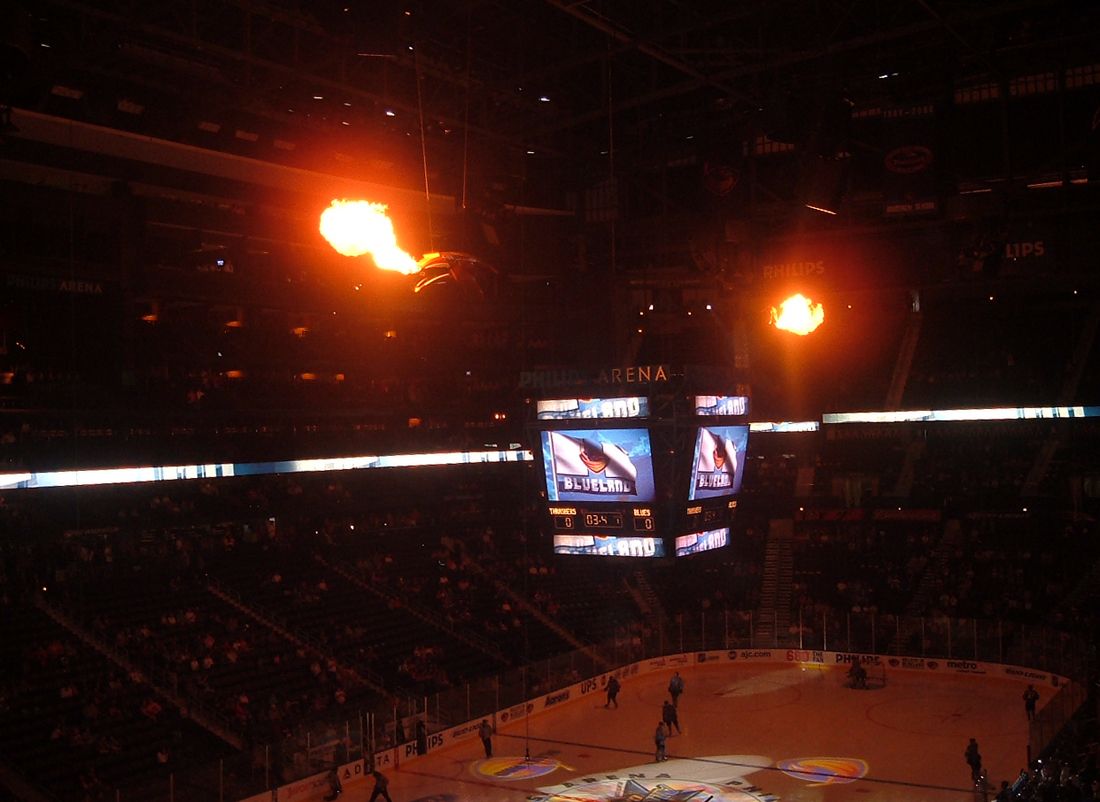
The Thrashers worked to establish a distinct identity tied to Atlanta and the state of Georgia. The team's name, colours, and logos were all derived from the brown thrasher, the official state bird. The primary logo featured a stylized thrasher in flight, holding a hockey stick, set against a spectrum of colours including navy blue, burgundy, and gold. Philips Arena featured unique game presentation elements, including two large thrasher head sculptures mounted in the rafters that would open their beaks to reveal flamethrowers, ignited when the team scored a goal. The franchise adopted the marketing motto 'Believe in Blueland' to promote the team and engage fans during its existence.
During the team's early, more optimistic years, a dedicated section of season ticket holders dubbed themselves the 'Nasty Nest.' This group was known for its loud, disruptive chants aimed at opposing teams during games. Initial fan support showed promise, with ticket sales averaging around 10,000 per night in the early seasons. The peak of fan engagement coincided with the team's only playoff run in 2007, which saw sold-out crowds and heightened local interest, including celebrity support from figures like Lil Jon. However, this support proved fleeting as the combination of prolonged on-ice struggles, the 2008 economic downturn, and the logistical challenge of travelling to downtown Atlanta from the northern suburbs where most fans resided led to a steady decline in attendance during the team's final years.
Questions about Atlanta Thrashers
When did the Atlanta Thrashers start playing in the NHL?
The Atlanta Thrashers began play in the National Hockey League in the 1999 to 2000 season. The franchise had been awarded on June 25, 1997, as part of a four-team expansion. Their first game was on October 2, 1999, a 4-1 loss to the New Jersey Devils. The team served as the NHL's 28th franchise and marked the league's return to Atlanta after the departure of the Atlanta Flames in 1980.
Who were the best players for the Atlanta Thrashers?
The Thrashers' most notable players were wingers Ilya Kovalchuk and Dany Heatley, both selected first and second overall in consecutive drafts. Kovalchuk became the franchise's all-time leader in goals and points, while Heatley won the Calder Trophy as rookie of the year in 2002. Other key players included Marián Hossa, acquired in a trade for Heatley, and goaltender Kari Lehtonen. Players like Marc Savard, Vyacheslav Kozlov, and Dustin Byfuglien also made significant contributions during their tenures with the team.
Why did the Atlanta Thrashers move to Winnipeg?
The Atlanta Thrashers relocated to Winnipeg in 2011 due to persistent financial losses and instability within the team's ownership group, Atlanta Spirit, LLC. The owners reported losses of approximately US$130 million over six years and were involved in protracted legal disputes. Unable to find a stable local buyer to keep the team in Atlanta, the franchise was sold to True North Sports & Entertainment of Winnipeg. The NHL approved the sale and move on June 21, 2011, and the team was renamed the Winnipeg Jets.
What was the tragic event involving the Thrashers in 2003?
The crash seriously injured Heatley and critically injured his teammate, centre Dan Snyder. Snyder died from his injuries five days later on October 5. The Thrashers dedicated their 2003-04 season to Snyder's memory, wearing a black patch with his number 37 on their jerseys. Heatley faced legal consequences, receiving three years' probation and community service.
How many times did the Atlanta Thrashers make the Stanley Cup playoffs?
The Atlanta Thrashers qualified for the Stanley Cup playoffs only once in their history. This single appearance occurred in the 2006-07 season after the team won the Southeast Division title, clinching the third seed in the Eastern Conference. They were, however, swept in four straight games by the New York Rangers in the conference quarterfinals. Despite several high level draft picks, including two first overall selections, and some high profile player acquisitions, the franchise never returned to the postseason. This lack of playoff success was a defining characteristic of the team's tenure in Atlanta before its relocation.
What happened to the Thrashers' arena and where did they play?
The Atlanta Thrashers played their home games at Philips Arena in downtown Atlanta. This arena was built on the site of the former Omni, which had been home to the city's previous NHL team, the Atlanta Flames. Philips Arena served as the Thrashers' home for their entire existence from their inaugural 1999 to 2000 season until their final game in April 2011. The arena was also home to the National Basketball Association's Atlanta Hawks, which were owned by the same media mogul, Ted Turner, during the Thrashers' early years. Following the team's departure, the building continued to operate as a major sports and entertainment venue in the city.
Sources and further reading
- Atlanta Thrashers (Wikipedia)
- Atlanta Thrashers (georgiaencyclopedia.org)
Checked by the Garbutt Disposal desk. Last updated 2026-10-20.